Two Tools for Mastering Stakeholder Management Through Trust, Loyalty, and Advocacy
This article, co-authored by Bruce McCarthy and Sean Flaherty, was inspired during a recent podcast episode from Product Momentum featuring Bruce as guest and Sean as co-host.
By Bruce McCarthy and Sean Flaherty
In a recent episode of Product Momentum, Bruce McCarthy explained that the hardest part about being a product manager is wrangling the needs of multiple stakeholders and saying ‘no’ to some things so that you can say ‘yes’ to others. But those are precisely the decisions that lie at the crux of the product manager’s job. And they’re fraught with risk – inadvertently suggesting a preference for one key stakeholder while alienating others.
As we recorded the episode, we quickly discovered the parallels between Bruce’s Stakeholder Canvas model and Sean’s Relationship Ladder framework – and how these tools can work in concert to help product managers navigate thorny decisions to arrive at workable solutions and preserve stakeholder relationships.
It’s not enough to have product-market fit to be successful; we also need product-organization fit. And that’s where the Stakeholder Canvas and Relationship Ladder render the greatest value.
The Stakeholder Canvas and The Relationship Ladder: A Primer
Bruce introduced us to his Stakeholder Canvas in Aligned: Stakeholder Management for Product Leaders (2024). The Canvas is used to identify and categorize stakeholders, their roles, and their influence on projects or initiatives. By helping product managers understand who needs to be involved and how their input and influence might impact the project, we can create a more solid basis for decisions around prioritization.
And by mapping out stakeholders and their roles, the Canvas helps product teams ensure stakeholder engagement. The key to stakeholder management lies in understanding the dynamics between a product leader and their various stakeholders.
Central to the discussion is the concept of the Relationship Ladder, a framework that explores the significance of behaviors and micro-experiences – particularly those that foster trust, loyalty, and advocacy along a ladder-like continuum.
Interplay of The Stakeholder Canvas + The Relationship Ladder
As product leaders, we need to identify both the explicit and hidden stakeholders within our organizations – and to understand their needs and motivations. The company org chart might reveal its structural organization, but tells only part of the story. Stopping our inquiry there belies the importance of alignment and influence and collaboration across different departments. Often lost amid the maze of boxes and lines is the fact that every functional group brings its own unique incentives and goals that must be identified, acknowledged, and managed.
The official org chart isn’t very helpful when you’re figuring out who you need on an extended virtual team. In fact, it can be misleading. As product leader, you need to find out who has the CEO’s ear – who, if they were to whisper something to the CEO, would make or break the alignment you need from the rest of the organization to support your project.
Learning who the critical stakeholders are and fostering relationships with them can lead to better alignment on initiatives, smoother collaboration, and ultimately a more successful product. This relationship building aligns well with the goals of Sean’s Relationship Ladder, where transparent communication inspires a series of positive micro-experiences and collaborative efforts that can build Trust, Loyalty, and Advocacy over time.
How Product Leaders Can Apply These Tools
Know the Players
Bruce’s Stakeholder Canvas helps to illustrate the entire ecosystem. Be patient as you study the playing field and identify who your product’s stakeholders are – especially the hidden ones. Use the Canvas to uncover real needs, map influencers and their motivations, and to make smart, strategic decisions around prioritization.
My favorite ‘hidden stakeholder’ is the one who may not even appear on the org chart. They have some vague title, like ‘Partnerships’ or ‘Strategy’ or something like that. You don't really know what they do. And that's deliberate, because they’re advisor to the CEO – the ‘CEO whisperer.’
The more shared knowledge we can create about all our stakeholders and their concerns, the more creative potential we will unleash from our teams.
Establish Goals Using the Relationship Ladder
Goals matter. And product managers who use the Stakeholder Canvas to clearly define stakeholder concerns, objectives, and behaviors will be well positioned to deploy the Relationship Ladder to establish goals around building stakeholder trust, earning their loyalty, and inspiring behaviors that reflect their support – even advocacy – of our objectives.
The Relationship Ladder Framework
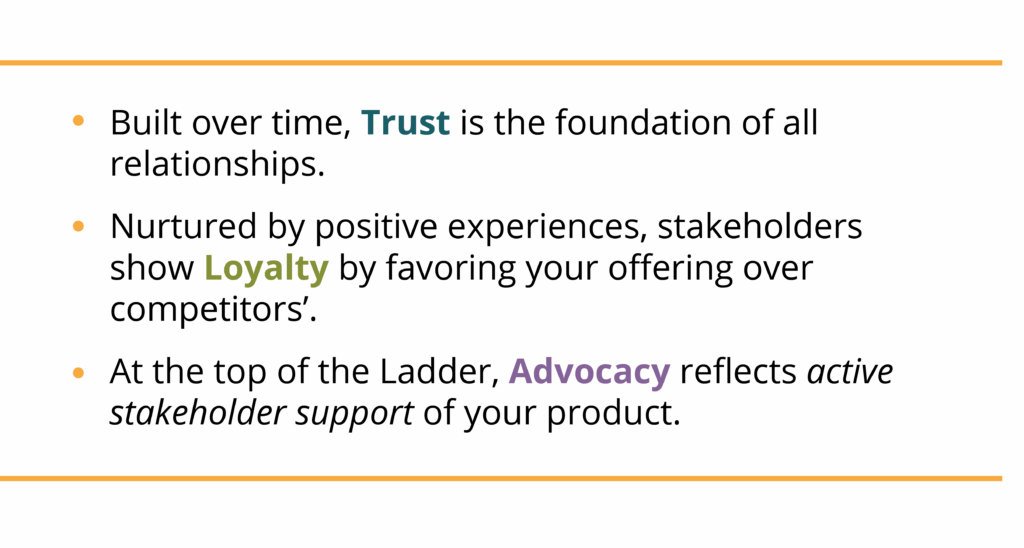
When we think of stakeholders not as obstacles to be managed but as customers to serve, we naturally begin to create value propositions that emphasize the product’s helpfulness in fulfilling the stakeholders’ needs. This approach also ensures that they feel connected and valued – both of which are vital to long-lasting relationships. Just as you do with customers, center your communication around these goals to effectively climb the Relationship Ladder, nurturing deeper relationships with your internal stakeholders.
Measure Stakeholder-Customer Behaviors
Product leaders can prioritize stakeholder behaviors systematically. This not only allows them to measure trust and loyalty effectively but also helps them identify how their offerings can adapt to better meet customer needs.
Creating and tracking metrics associated with expected customer behaviors allows product teams to lean into their own creativity to adapt approaches and produce innovations that lead to more powerful outcomes for all.
When we think of stakeholders not as obstacles to be managed, but as customers to serve, we naturally begin to create value propositions that emphasize the product’s helpfulness in fulfilling our stakeholders' needs.
Each rung of this ladder corresponds to specific behaviors and measurable outcomes, meaning that the more effectively a product leader facilitates positive interactions, the higher it can ascend this ladder and the better it competes in its market.
Positive Psychology and Self-Determination Theory (SDT)
The Relationship Ladder is rooted in the principles of Self-Determination Theory (SDT), which highlights three core psychological needs: autonomy, competence, and relatedness. Relatedness – feeling connected and valued – is crucial for building trust, loyalty, and advocacy.
When we product leaders understand stakeholder motivations and foster an empathetic, inclusive environment, we can use these principles to climb the relationship ladder, creating stronger bonds and driving sustainable collaboration.
Recognizing and understanding hidden stakeholders and their needs is an essential tool for product leaders aiming to build meaningful relationships founded on trust, loyalty, and advocacy. Bruce’s insights into stakeholder management highlight the importance of identifying those less visible yet influential members within an organization.
Using these tools, product leaders can better navigate complex relationships and drive positive product outcomes. By observing behaviors and gaining a deeper understanding of both their own and their stakeholders’ emotions, leaders can cultivate an environment that fosters collaboration and creativity. This approach enables them to climb the Relationship Ladder, ultimately leading to inspired innovation and long-term, sustainable business success.
Additional Resources
- Aligned: Stakeholder Management for Product Leaders, by Bruce McCarthy and Melissa Appel.
- Product Roadmaps Relaunched: How to Set Direction while Embracing Uncertainty, by C. Todd Lombardo, Bruce McCarthy, Evan Ryan, and Michael Connors.
- The Relationship Ladder, by Sean Flaherty.

Bruce McCarthy is the co-founder of Product Culture and author of Aligned: Stakeholder Management for Product Leaders. A prolific writer and sought-after speaker, Bruce also runs an invitation-only Forum for Chief Product Officers.

Sean Flaherty is EVP and Board Member at ITX. A prolific writer and award-winning speaker, Sean helps organizations scale their leadership, sharing lessons from the trenches about maximizing clarity and optimizing for innovation.


