Listen
Podcast: Play in new window | Download
About


Bob Moesta is an influential entrepreneur and innovator known for his groundbreaking work in the field of Jobs-To-Be-Done (JTBD) theory. He has dedicated his career to understanding and solving customer struggles. Bob has started 8 companies and is currently the President and co-founder of the Re-Wired Group, which helps companies of all sizes unlock hidden insights and create successful products and services. Among the principal architects of the Jobs to be Done theory in the mid-90s along with Harvard Business School Professor Clayton Christensen, Bob has continued to develop, advance, and apply the innovation framework to everyday business challenges. Bob is also a fellow at the Christensen Institute.
Recommended Reading
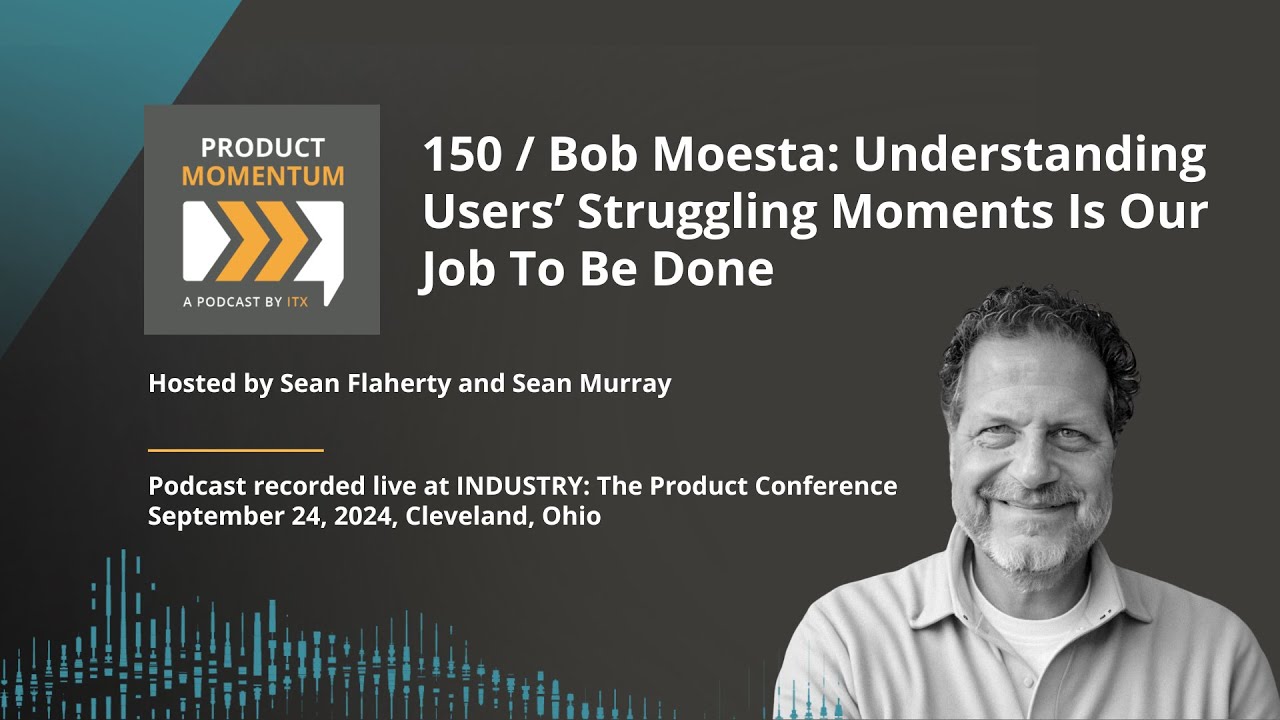
We didn’t realize it when we started recording this episode with Bob Moesta. But the moment our conversation ended, we knew his would serve as Product Momentum’s milestone 150th podcast! And what better topic to explore – and who better to explore it with – than a product manager’s job to be done with the champion of JTBD theory. As Bob explains, people don’t buy products at random; we hire them to solve specific problems or fulfill specific needs. Understanding the user’s struggling moments is our primary job to be done.
Product Momentum co-hosts Sean Flaherty and Sean Murray caught up with Bob live and in person at INDUSTRY: The Product Conference. In their lively conversation, Bob touched on three main themes, each embracing our users’ struggling moments as the key to a product manager’s success.
Understanding User Context – The Path to Better Products
As product managers, we have to grow to appreciate the context surrounding our end users’ struggling moments. When users realize “the anxieties or habits that prevent them from making changes easily,” product managers are enabled to actually see better ways to develop the products that fulfill users’ needs.”
Focus on Cause, Not Probability
Sales and Marketing often rely on probability-based approaches, Bob adds, “because they don’t fully understand customer behavior.” As product managers, though, we are better positioned to identify the causes behind a customer’s need for a product; when we do that, our teams can focus on helping them make real progress, rather than just pushing unnecessary features that fail to address their specific challenges.
Customer Choice Is Based on Elimination, Not Selection
Customers won’t even notice a product unless they are already frustrated, Bob explains. So we should be targeting these precise moments of frustration to effectively capture their attention. Then, as they evaluate the range of possible product solutions, customers eliminate the ones they know won’t meet their needs. The process is reminiscent of the standardized tests of our school-age years; oftentimes, we didn’t choose the best answer as much as we eliminated the ones we knew to be wrong.
Be sure to catch the entire episode with Bob Moesta; as you do, be on the lookout for his list of 5 skills that every successful product team should possess.
Podcast: Play in new window | Download
Paul Gebel [00:00:19] And welcome back to Product Momentum, a community of product people and a marketplace of ideas where leaders and learners come together to shape our way ahead. My name is Paul Gebel, and together with my co-host Sean Flaherty and the rest of our amazing team, we record conversations with thought leaders in product, UX, security and beyond. That will help you shape the lives of your users through software. Check us out on all your favorite listening platforms, but for those who prefer the video experience, you can find all our latest episodes on the Product Momentum YouTube channel.
Sean Flaherty [00:00:50] Awesome interview with Bob Moesta. I’ve been trying to get him on the podcast for a while. He’s the guy that invented that little arrow that’s on your fuel tank gauge in all cars. But he’s been an innovator for a very long time. He is close to Clayton Christensen, another one of my academic heroes, Harvard professor and author and inventor of the Jobs to Be Done framework. Bob has just got a lot of a lot of knowledge and a lot of information to bring to our industry.
Sean Murray [00:01:14] He’s Robert Redford. He’s The Natural, right? I mean, that was amazing. He could go forever on any topic that that he’s that he’s that he’s touched. He’s going from choosing college to helping you out in your career to…now look the next thing he’s on is helping out with relationships. World peace is in his future.
Sean Flaherty [00:01:34] But he definitely has a lot of great insights for product leaders. So we talk about a lot of them. I can’t wait to get after it with you. Let’s do it.
Sean Murray [00:01:41] Let’s do it.
Sean Murray [00:01:44] We are here today with a champion of the Jobs to be Done framework, an author, a speaker. He got one of the books right here signed. That’s mine. No one can have that. But also founder of the Rewired Group in Detroit, Michigan. Bob Moesta. Bob, thank you so much for being here.
Bob Moesta [00:02:00] Thanks for having me. I’m excited to share whatever questions you’ve given me. I love the fact that I have no idea what we’re going to talk about.
Sean Murray [00:02:06] That’s great. So, I was actually doing some research before. Episode 12 of this podcast. We’re doing some throwbacks to episode 12 of this podcast. Mike Belsito was on, talking about the Jobs to Be Done framework.
Bob Moesta [00:02:19] Yes, I do remember that.
Sean Murray [00:02:21] Referencing you over and over again. So, we’re happy to have you back.
Bob Moesta [00:02:24] Somebody had articulated it. It’s like the Bill Walsh line of coaches, like I taught him and now he’s teaching everybody.
Sean Murray [00:02:34] Tree, the coaching tree…
Sean Flaherty [00:02:35] Children, grandchildren.
Bob Moesta [00:02:36] Children, grandchildren all people out there kind of I’ve been doing this for 40 years. So yeah, I’ve been building product for forty years. I have fun.
Sean Murray [00:02:43] So you led off today by saying something like, people don’t buy products, they hire them to do a job in their life. And make progress. Tell us about that. Why is that so important?
Bob Moesta [00:02:54] So the interesting part is that that. The way that we were taught as engineers about product is build it and they will come. And somehow that got translated into probability that like, what’s the probability somebody will buy my product? But the reality is, is people buying your product is cause –– it’s not random. And ultimately, we need to understand those causes. And they’re doing it because there’s a problem in their life or there’s an outcome that they need. And to be honest, you need to actually understand they have to make a change, which usually means they have to give something up in order to get something. And so it’s studying that. That then enables me to actually see better ways to develop the products. And so it’s starting from the demand side going over to the supply side. But it’s understanding their struggling moments, their context, the outcomes they want and then the anxieties they have about it and the habits that they have to overcome.
Sean Flaherty [00:03:44] I loved your quote in the talk. You said “Everything’s caused…
Bob Moesta [00:03:47] Everything.
Sean Flaherty [00:03:48] …we’re just not smart enough yet to know all the causes.” This makes perfect sense.
Bob Moesta [00:03:52] It’s one of those things where probability theory has been useful when we when we don’t have the knowledge. But the fact is, the reason why I hate it is because if we just accept it and we don’t go deeper to find the knowledge. And so, I really pride myself on being very causally oriented and trying to basically understand that causation.
Sean Murray [00:04:11] My friends at home that are listening to this will will be remiss if I don’t say that it does hurt me personally to hear that you don’t like if you build it, they will come because that’s how I get our poker game set up. If we if we get the table set up, they will they will come…
Bob Moesta [00:04:24] Tell you what. What I’ll tell you is it works in some situations, but it’s not. This is a good strategy for product.
Sean Murray [00:04:31] Yeah. And you said you said.
Sean Flaherty [00:04:33] The context was baseball, too. It’s games. Yeah.
Bob Moesta [00:04:36] Exactly.
Sean Murray [00:04:38] You said nobody randomly buys your product.
Bob Moesta [00:04:40] Nope. And again, this is one of those things where it’s an obvious statement, but the reality is when you talk to sales and their sales funnel, they have all probabilities, right? Like, well, the probability because it’s because they don’t know. And so, what we’ve done is we’ve actually taken teams where we actually replace the sales funnel with the timeline and just say, where are they on the timeline and what are the forces that are pushing them and pulling them to basically say today, they gotta change. And so, you rechange the sales from pushing the product to helping them make progress. It’s a really different perspective because nine times out of ten, you only need to talk about 3 or 4 features because their problem and their outcome only relate to those 3 or 4 features as opposed to the 20 features. When you add these other features that go like, I don’t think we need that. And then now they’re…
Sean Flaherty [00:05:27] Actually now it’s confusing
Bob Moesta [00:05:29] Now they’re confused!
Sean Flaherty [00:05:30] Yeah. So, another thing you said in your talk about this was that your customers can’t even see you unless they have a frustration, unless they’re already frustrated.
Bob Moesta [00:05:38] This is this is the thing that’s kind of amazing to me is that like when you really think about is like, I want to get people’s attention and they’re like, we’ll make something funny. The reality is, is funny, they might be able to remember it, but can they remember it when they’re struggling?
Sean Flaherty [00:05:51] That’s right. Right. When it matters.
Bob Moesta [00:05:52] And that’s when it matters. And this is the hard part is marketing is trying to do the almost like the blanket. You know, let’s just make everybody we’re going to say statements that make people stop and look at us. But the reality is, is the moment you understand the struggling moment and where they have it, you can pinpoint what you need to do because it’s amazing.
Sean Murray [00:06:12] You said people don’t pick, they eliminate choices. Tell us a little bit about that.
Bob Moesta [00:06:16] Picking and choosing. I did something with Todd Rose who is the author of End of Average. And we went through this thing and it’s kind of like you pick your health insurance but you choose your auto insurance and the difference is usually your employer gives you health insurance. Right? And so with that, you actually then choose, you know, good, better, best one of the three. But because it’s part of the package you actually have, you’re not actually buying it. You’re just getting it. And so you know nothing about your health insurance.
You know more about your car insurance than your health insurance because you pick it. And so the whole aspect is people pick things. And what happens is…jobs to be done….just like when you if you really think about it, there’s no choice in health insurance like you’re getting it or you’re not getting it and you can say good, better, best, but that depends on health and a whole bunch of things. But ultimately, your car insurance is like, you know where you’re at. You have to you can switch between things. It’s kind of amazing.
Sean Flaherty [00:07:14] Now that’s interesting. I’d like to throw back and go and talk about your book because I read it years ago….Learning to Build.
Bob Moesta [00:07:22] Learning to Build. Yeah, yeah, yeah.
Sean Flaherty [00:07:23] My favorite book.
Bob Moesta [00:07:24] Why? What do you like about it?
Sean Flaherty [00:07:27] The thing I like most about it is that you’re very much like me in that you’re a visual thinker. Because you lay out all those visuals in the book. There’s like a diagram, a contextual model.
Bob Moesta [00:07:35] I wrote all the graphics first. Yeah. And then I talked about the graphics and then they took my talking about the graphics and they put in the book. That’s how. That’s how I made the book.
Sean Flaherty [00:07:45] Yeah, I get it. Because you explain that you don’t read and write.
Bob Moesta [00:07:48] I’m dyslexic, I can’t read and write. So, I have a company who I have so I have a writer-editor. Yeah. And at the same time, they did ten two-hour sessions and they wrote the book for me. But if you pick up the book, it’s like I’m speaking to you, right? Because that’s how I wrote it.
Sean Flaherty [00:08:02] Yeah. It resonated around, it resonated with me and I’ve, I’ve reference back there, referred back to it many, many times.
Bob Moesta [00:08:08] What part did you like the most?
Sean Flaherty [00:08:09] The five rules. These are the five things, the skills and innovators need to have.
Bob Moesta [00:08:18] I’ve worked with thousands of people over the years and what I did is I took, I did a ranking of the top ten innovators that truly like were just amazing innovators. And I put them in a corner and I said, like, what makes them so different from the rest of these? Because I’m not trying to compare like, these are better or different, but more like these people seem to have these people have some skills that these people don’t and I can’t figure it out. And I started with seven and then I got it down to three. And but ultimately I came back to like in the way that I tied it together is like me as an innovator. I literally, at 18 years old, was told to be a baggage handler or a carpenter. And the reality is, is like my mom said, that was not going to happen. And so I had to actually kind of figure that out. So, I look at it and say I was I was as stupid as I was going to get at 18 years old. We probably all are at 18.
But the reality is that the fact is, is like I had four people pour all this knowledge into me. And so I wanted to take those five skills and say, how did one how did it help me become an innovator? But also, then how do I tell stories of other people being innovators? And so that’s really and it’s the interesting part is I don’t think you have to have all five skills. I think the team has to have all five skills.
Sean Flaherty [00:09:33] I would agree that. Well, let’s go through the skill set. yeah. Empathic perspective.
Bob Moesta [00:09:37] Yeah, yeah. Empathetic perspective. So this is one where it’s about…really good innovators and entrepreneurs can see things from other people’s perspective. And it’s not just it’s not just like the customer perspective. They can literally sit in the in the role of the investor. They can actually think about the co-founder and how they’re going to actually negotiate with them. And they can think about what it’s like to be an engineer. And so, though they might not be an engineer, they have this ability to play these roles. So, they can almost in their head see the world from a very, very from a 360-degree perspective.
The other thing is, is you start to realize that that there are people’s perspective and then there’s things perspective. So, I think about like the flow of money. I think about kind of the different performance criteria of how do we look at this system, right? But ultimately, we want to have empathy so we can actually surround whatever we’re talking about from all these different perspectives so we can see. And that’s you find really good entrepreneurs. They do this so intuitively, like they’ve honed and refined the skill that they can literally they almost feel like they’re in your head. That’s empathetic perspective.
Sean Flaherty [00:10:44] Now they can reconstruct that.
Bob Moesta [00:10:46] The second one is really uncovering demands. Uncovering demand is I call I call it bread and butter. But it’s the fact this is like most people believe that the product creates the demand. But when you dive down the rabbit hole and you realize where demand come from, it comes from the void inside the customer. So, products don’t create anything. Struggling moments, they fill the hole.
Sean Flaherty [00:11:10] I think you said disruptive moments was the was the distinction I captured.
Bob Moesta [00:11:13] Disruptive innovation is where you have actually underserved people to do that. But but uncovering demand is about basically finding struggling moments. Where do they happen? When do they happen? Who do they happen to? And who wants to take the responsibility to do something about it? And so, this is where studying and understanding where demand lies and where it comes from and how to access demand. Because again, through time and space, we always end up having new context that causes a struggling moment. The third one is causal structures. I love this one. This one is so hard to come to…
Sean Flaherty [00:11:45] Systems thinking.
Bob Moesta [00:11:46] Yeah, but see, this is the problem. Everybody thinks they know systems thinking and they don’t know the way that I think about system, the way I was taught systems, which is completely different than what they were doing. But ultimately causal structures is about how do things work. This is the curiosity of it’s a little bit of the engineering curiosity. But it’s that notion of like, I like to know how things work and what we can do with it. And, and so it’s this deep dive down the rabbit hole of these are the inputs, these are the outputs. This is the system that I have to have. Here’s the subsystems, here’s the super system. But it’s understanding how they all work together.
Sean Flaherty [00:12:30] Together, how they nest.
Bob Moesta [00:12:31] And how they nest. That’s the fun. That’s the fun part. And so, like, this is one of those things where if I have empathetic perspective and I can see the causal structures and now I understand demand like I am set up to like, okay, I can see where the holes are, I can see what I don’t know. And I fundamentally believe that most innovation is about the unknowns as opposed to the knowns. Right, and most people build a plan on what they know. And the reality is the plan should be about finding the unknowns and solving the unknown.
Sean Flaherty [00:13:02] Filling the gap, fill in the gaps.
Bob Moesta [00:13:04] And so that.
Sean Flaherty [00:13:05] Frustration.
Bob Moesta [00:13:05] Points. So that gets us to the to the fourth skill, which is prototyping to learn, right? Iteration, iteration and basically small increments and being able to do it fast. And what you start to realize is that most of the testing that I was taught as an engineer is verification testing, not discovery testing. And so I was taught at 18, 19 years old how to do this discovery testing where I can walk into a problem. The funniest part is everybody who sees the problem, they all have an opinion and nobody has the facts. And so what happens is I was taught a method called design of experiments through Kenichi Taguchi, where I’d go in and say, I have no idea about this thing. I want to run these ten experiments and just and then we’ll see how it goes. So, it’s totally empirical. It’s all observational and it’s literally like, I don’t know what’s going to happen. And when you do that, you learn way more than everybody else. And so, because everybody else is building one, maybe they have an old one and then they compare it.
They do A/B Testing. I was taught at 18 years old A/B Testing is the most inefficient and ineffective way to test anything, and that is the predominant way in which we test software. It drives me out of my mind.
Sean Flaherty [00:14:11] Like there’s only two possible solutions.
Bob Moesta [00:14:13] Well, no, because they’re trying to just incrementalize it and they don’t realize they built a house of cards. So, they say A or B. Oh, B, but they don’t know why B is better. And so, what happens when you get to some you build this house out. And then somebody goes we got to do cost reduction, we got to make this thing, and they come in and they pull three things out and the whole thing topples.
Sean Flaherty [00:14:32] Interesting.
Bob Moesta [00:14:33] And so you end up having this problem that’s around that. The last one is the hardest one and you need the four to do the fifth one, which is identifying and managing tradeoffs. It’s prioritization. But it’s it’s the aspect of what am I going to give up on? It’s not about what’s important. But like this, I have to do more than that. And so this will have a bigger impact. And it’s the problem is, is that, again, we’ve been taught as engineers to optimize, which is make it all happen. And so people from product, people for markets do it all, do it all, just do a lot of things like figured out limited resources, limited knowledge, limited time. How do they make that work? And so ultimately it’s, it’s tools and methods to help you frame the tradeoffs and then ultimately be able to make the decision. But what do.
Sean Flaherty [00:15:21] It’s like a full loop back to number one which is about that’s what’s going to create the best experience for the ecosystem. That’s a keep point because of the customers, the shareholders…
Bob Moesta [00:15:31] You have to teach them almost like a separate –– I’ve got to think of the customer. Different than the consumer. Different than the investor, right. Different than the employees. Different perspective. They all have a notion of progress, right? And so we have to understand that.
Sean Murray [00:15:45] We had Janna Bastow on a couple of podcasts ago, a couple of episodes ago, and she really laid out the thinking of like now, next, later in terms of your roadmap. I think when you get into that trade-off conversation maybe some of those are like, “hey, well right now. Those can’t be the focus.” Right? And you said we’ve got to choose what we’re going to suck at. So, we have to accept some things now. But we could address them next.
Bob Moesta [00:16:07] We could put them on the roadmap for later. And so I want to talk about the road map for a minute, because I believe the road map is is fundamentally flawed and that and that we think about what we should be doing for the next 24 months. And we lay it out and we build this as a communication tool to help everybody understand where we’re going.
But the reality is, is I would say a lot of people didn’t even see AI coming. And so it was not on their roadmap. It came out they had to redo the entire roadmap. And the reality is, AI is a solution. And what they should be doing, the roadmap that you should be talking about is the roadmap for the next 90 days of what we’re doing in building, what’s on the what’s in production or in development. Right. Anything after 90 days should be the struggling moments we’re going to go solve. And when we get there, we’re going to actually do the deep dive to figure out kind of what is the feature we’re really going to build. But don’t talk about the feature because it then almost makes everybody pre-sell the feature that you don’t know.
But if you actually frame it as the is a struggling moment. So, if you look at into it, what they did is they literally just looked for where the next struggling moment was because every small business has a list. Here’s what the three things that happened. First, here’s what happens next. Here’s what. And so, it’s really just following their list of the shit that happens to them. Yeah. And so instead of trying to talk about the feature we’re going to build, it’s the struggling moment we’re going to go after because that’s constant. The feature might change five different times between the time when you learn it, when you learn, and you might not have to do it, and then you have to go change the organization’s expectation. Well, we’re not really building a search. We’re building more of an AI, and then it’s like all this bloat you have to do to fix and you just want to go build. And so to me, I advise teams to basically say 90 days, you got like 90 days I can have enough vision on. But like.
Sean Flaherty [00:17:50] Beyond that…
Bob Moesta [00:17:51] But, but next November, I have no idea what I should be doing. But I know, I know I have to be thinking about next November or so. How do I think about it right?
Sean Flaherty [00:17:58] Yeah. Depending on the situation, the infrastructure, the industry, the market. You also have to think about, if we’re you know, we are thinking years out because we have to architect it so that we can adapt.
Bob Moesta [00:18:08] That’s right. And so that’s and what I think about is that’s like a strategic exercise, which is different than the product. It’s like product exercise to me is one tier down because it’s got to be more tangible. But again, it’s got to be communicated. Roadmap should come from strategy for sure.
Sean Murray [00:18:24] I’ve been working with our clients on finding gaps in their hierarchical, you know, strategic elements that help them articulate their vision. And one of the lessons that really resonates with them is that the roadmap is a strategic document. Your roadmap should be a time-based articulation of your strategy. And it should be at the business case level or, you know, user capability level, and then your product plans and your and your specific, your 90-day plan is going to come out of that.
Bob Moesta [00:18:56] That’s awesome because I think I think the reality is, is I think one of the most fun exercises I did is like we just with an organization we just sat down and said like, what’s the job? Like who are the customers of this? And you find out there’s three different customers of the roadmap and they actually want different things, right? So you start to realize like, well, do I have three different versions? What do I do? And you start to actually have to really think through and it’s I actually need 2 or 3 different systems around the roadmap. But there’s a roadmap for the executive team to know where it’s going. But the roadmap for the for the product team is building it. And there’s a roadmap for the rest of the organization. And part of it is to realize, like, like any overstatement of anything there has to be time to fix it. And most people don’t think about this as a time-sucking document, but it is.
Sean Murray [00:19:44] What I’ve seen is, you see dishonest roadmaps. Misleading roadmaps that are linear. Yeah. Yeah, you’re right. And then we have this kind of like now, next, later roadmap where it’s like, okay, we’re looking at like essentially the cone of uncertainty. Then the third one where we’re really starting to try to push people. It’s communicating a strategic roadmap where you’re outlining here are the known decision points that we’ve got in the future and that could cause us to go in different directions.
Bob Moesta [00:20:10] The roadmap doesn’t tell us why, but the strategy tells us why.
Sean Flaherty [00:20:13] Yeah
Bob Moesta [00:20:14] Now it should tell us why. Yeah, right. The other thing and I said this in the talk shop, but I, I think that changing the language of, of this is very important because when we say plan and budget. It implies certainty, right? The reality is these are bets. We’ve never done it before. We don’t know what we’re doing. We’re the best people to solve it. But the reality is, like, somehow in our minds, we think we’ve been hired to have the answer. But we’ve been hired to find the answer.
Sean Flaherty [00:20:46] That’s right. And this is we’re all building vaporware right now. You recognize that.
Bob Moesta [00:20:49] But we have to recognize and acknowledge it. And this is where this is why I think the bigger problem is when product managers started as project managers. Right? Because project managers are all about the linear aspect of execution. Yeah. And they say, well, we’ll make we’ll take a project manager and make him a product manager. But a product manager is actually more like a marketer, right?
Sean Flaherty [00:21:11] They also, I think, don’t do ourselves any service by calling what we’re doing engineering software engineer because we think back to historical engineering, which goes back to Roman times. And we think about like you build a bridge, you know exactly what you need to build a bridge like this has been done many, many times. Or you put a car together like Deming’s in Japan. But you know how many nuts and bolts it takes. But software, it’s a completely different discipline.
Bob Moesta [00:21:34] So I think one of the problems is, is that we don’t have a measure of quality of software, right? Like a universal quality. Like, like if you look at any…
Sean Flaherty [00:21:43] It’s a kind of do in the behavior of the user, like they accept it or they don’t know.
Bob Moesta [00:21:47] But there’s no metrology. There’s no there’s no I can’t look at a….
Sean Flaherty [00:21:50] I can’t read the weather.
Bob Moesta [00:21:52] Right, but I can’t look at a database and tell you how good that code is. And the quality of that code and in a universal way. And I think it’s very similar to the food industry where people go like, let me add a little salt, let me add a little sugar. They’ll just add little pieces because…
Sean Flaherty [00:22:11] It’s my grandmother, when she cooks….
Bob Moesta [00:22:12] So guess the thing is, I believe it’s the same thing because it’s so easy to make a change that we don’t have to think about it, right?
Sean Flaherty [00:22:19] The result is so subjective because. And we don’t get to choose whether it’s successful. It’s the users, right? They get to determine whether or not it’s successful.
Bob Moesta [00:22:25] Not the users is so important because if we don’t actually understand how they’re judging it, this the other part is I have engineers who are trying to convince customers that they should be measuring performance this way because they’re really good that way. And I’m like, Yeah, that’s just ridiculous.
Sean Flaherty [00:22:41] Well, that’s a distortion of how we’re compensated and how we’re recognized as an engineering team.
Bob Moesta [00:22:46] Yeah. So, this book has been like a…
Sean Flaherty [00:22:51] Highly recommend.
Bob Moesta [00:22:52] A labor of love. And it’s one of those things where the moment that…all my mentors have passed. Clay was just a dear friend. He was just a friend. And the moment he died, I realized, like, I have to. Can you continue his like, I have to answer like, you don’t realize it, but I have that obligation as a part of this is need to pay homage to them for all the things they have given me and that my job is to pay it forward. Yeah, I love it.
Sean Flaherty [00:23:18] With each chapter, you actually profiled one of your mentors, and it’s pretty amazing.
Bob Moesta [00:23:22] It was so special. And this is where like. I’m so I have a couple of new topics I’m looking at and one of them is mentoring and it’s trying to realize that I worked for all those people that I’m not sure that I can mentor if you don’t work for me. I think I can advise you. So, there’s a difference between advisor, mentor, coach, what’s the difference between all them? So, I’m building out the spectrum of what these are because I just feel like trying to actually frame it right. I wrote a HBR blog post about getting the mentoring equation right and the mentors up here, the mentees down here. And as we get closer and closer and closer, the fact is, is that.
Sean Flaherty [00:24:01] They can overtake you at some point.
Bob Moesta [00:24:02] Well, no, here’s the thing is what we want to happen is that it goes like this. So, this happened with Clay and I. And so it was this and this. He was a teacher mentor. But when we got to a certain point, Clay looked at me and says, we’re peers now. And I said, we’ll never be peers. And he’s like, No, no, no. We need to be peers, and you need to push harder on me because I’ve been grooming you to actually be able to push me. That’s what mentors that’s what mentors want out of this is other people — it’s a two way street. And so, the job of the mentor and the job of the mentee are two different things. And most of the time they get destroyed because when the mentee feels like they’re as good as the mentor, they just disrespect them, right? And the reality is the mentor has been literally trying to groom them the entire time. To be like that, to be there, should be there to be their collaborative ally.
Sean Flaherty [00:24:48] So what do you what are you doing now to learn what are you listening to or learning from these days?
Bob Moesta [00:24:53] So I’m, I’m deep down the rabbit hole on what is a good question. And so, I have this I’m working on this aspect of the anatomy of a good question because I right now I’m deep into comedy because I feel comedy and good questions are similar in set up and there’s different types of questions and trying to categorize questions and think about ways in which to kind of help people ask better questions. Because it’s one of those things where, as a dyslexic, you learn through observation and questions. And so I don’t really know how I learned it, but like I want to be able to help other people do it because it seems to be a lot of people wanting to ask better questions and they’ll like they’ll almost start out with, okay, this is a horrible question.
Sean Flaherty [00:25:37] You put you put Clayton Christiansen’s, quote, up there: “Questions create space for problems to fall into.”
Bob Moesta [00:25:44] Yeah.
Sean Flaherty [00:25:45] Search for solutions.
Bob Moesta [00:25:47] And he would always say, like, you can talk about your product all day, but if there’s no space in the brain, it literally hits the head and goes straight to the floor. That’s so this is this is where we have to actually learn how to create the space. And the only way he he said, I know how to create the space is that ask a question and by the way, not answer it. So, you say, how did you sleep last night? Don’t say anything else. Because if they say hard not well, then they can do some say. How did you sleep last night? Need a mattress? The first answer is no. But if you actually get them to worry about why they’re not sleeping well, eventually they’ll get to, you know what? Maybe it’s the mattress and like, yeah, I can look at the mattress.
Sean Murray [00:26:23] The last thing that we ask all of our guests: How do you define innovation?
Bob Moesta [00:26:28] That’s great. So, the difference between invention, I need to contrast that with something because I always say contrast creates meaning. Okay, so there’s invention. Invention is like patents. It’s the unique way in which to do something. Innovations are about things that change society.
Sean Flaherty [00:26:47] That cause a change in the world.
Bob Moesta [00:26:48] The change in the world. The fact is, is this is where and it doesn’t have to be a big part of the world, but it’s not. Most inventions are one off and they can be used in one place, but people who are innovators are trying to figure out how to help society as a whole through markets, basically figure out how to make progress. And so, to me, as an innovator, we have to be able to say, where do people struggle? Where’s the biggest place to build the products and how do we actually help people make progress? And you can already see how like if you look at the last hundred years and how much we accelerated, that’s what we’re doing. It’s yeah, it’s way more innovation than invention. And though we have technological invention.
Sean Flaherty [00:27:24] Theoretical versus practical
Bob Moesta [00:27:26] Exactly. And we need the technology. But the reality is like nine times out of ten, a technology-led innovation doesn’t really work that well or it takes…
Sean Flaherty [00:27:35] It takes time.
Bob Moesta [00:27:36] A long time. It takes 20 years to get a fast get adoption. But think of ChatGPT: I mean, it came in quick.
Sean Flaherty [00:27:41] Yeah, it did.
Bob Moesta [00:27:42] Right.
Sean Flaherty [00:27:43] But MLMs have been around for a while. Working on them.
Bob Moesta [00:27:46] But the notion is, I was thinking about it. I’m I drove from Detroit this morning and one of the things I was thinking about was like if I just span things out and you go like, you know, I lived when Blockbuster and Netflix both were competing. And there’s certain things where you can just see like, okay, and so can I start to look and see where people like, can I see where they’re going to be disrupted? Can I see those kinds of things?
What’s another topic I’m working on? So, my books revolve around 2 basic concepts. One is methods and tools to help you innovate and be an entrepreneur.
Sean Flaherty [00:28:21] Learning to build.
Bob Moesta [00:28:23] The other one and demand side sales. And then there’s another one, which is about big decisions in your life. My first book on this was Choosing College. Like, how do you like most people are talking about where they want to go. But the first question we got to answer is, why do you want to go?
Sean Flaherty [00:28:41] What’s the job to be done here?
Bob Moesta [00:28:42] Exactly what progress are you trying to make. Who are we making the progress for, the student or the parent? And you start to realize that they’re actually really different.
Sean Flaherty [00:28:49] They’re diametrically opposed sometimes.
Bob Moesta [00:28:51] And so the first book was on the on the big decisions in your life is college. The second one is employment. So, I have one coming out called Job Moves, which is I’ve been studying for ten years. Basically, what causes people to leave one company to go to another company. And so many cool insights out of that. And then I’m working on how to find your partner, your lifelong partner, because I just feel I feel like social media has destroyed the whole notion, like the notion of like if you think about our definition of friend. And our kid’s definition of a friend. Yeah, it’s completely different. To be honest, Facebook destroyed it.
Sean Flaherty [00:29:27] Yeah.
Bob Moesta [00:29:27] And so that’s where I feel like we got to actually start to rethink about relationships and how, how, how do good relationships really come about? When I think about.
Sean Flaherty [00:29:35] Them, how we talk about them.
Bob Moesta [00:29:37] And it’s really I’m just gonna do it empirically. I mean, there’s all these books on it and there are all these theories on it. But I’m going to start with just like, Tell me how you found your partner. How did you when did you know? I’ve already started some of the research. The funniest thing is if you talk to people about, you ask them. So, when did you know you were in love with this person? It’s a very intimate question. But the craziest part is if you interview people together, they try to make it the same time. No, no, no. It was this day, like. No, I was here. They’ve never talked about it. And so, I have to interview people individually because they distort their answers for each other. And so, by the way, that’s the cloud I’m trying to actually get rid of.
Sean Murray [00:30:18] So anyway, it was when my wife bought me Chinese food in the hospital when I had a bad infection, that’s when I knew.
Bob Moesta [00:30:28] The thing. Is, she. She might have loved you before she went to love you more after. But. But the real is it’s not the same time. And we understand is like, what was it about that moment? Because you knew she cared. Well, and this is so that’s what this this this research is about is just trying to understand, like what was it what were the actions that she had to do to know that she was the one. Yeah. And what did you have to do for her to know is one which could be completely different criteria? That’s the cool part. So excited about that one.
Sean Flaherty [00:30:55] So I got to tell you, I’ve had you on my list for a while because I’ve known that you were the guy that invented that little arrow on the side of the fuel gauge in all the cars. And I thought that was, you know, why I wanted to get you on the podcast. But it’s been it’s been a real pleasure having you. Thank you. I appreciate it. Thank you so much. Thanks for making time for us. I know you’re busy today.
Bob Moesta [00:31:12] Yeah, This has been great, though. Any chance I can help? Let me know. The new book comes out in November.
Sean Flaherty [00:31:18] We’ll promote it if you can promote it.
Bob Moesta [00:31:19] That’ll be great.
Sean Flaherty [00:31:20] Thank you. Thank you, Bob.
Bob Moesta [00:31:21] Thank you.
Paul Gebel [00:31:24] Well, that’s it for today. In line with our goals of transparency and listening, we really want to hear from you. Sean and I are committed to reading every piece of feedback that we get, so please leave a comment or rating wherever you’re listening to this podcast. Not only does it help us continue to improve, but it also helps to show climb up the rankings so that we can help other listeners move, touch and inspire the world, just like you’re doing. Thanks, everyone. We’ll see you next episode.