Listen
Podcast: Play in new window | Download
About


Dan Chuparkoff is a keynote speaker on innovation & The Future of Teams. He is one of the world’s leading experts on AI & innovation. After 30 years as a technology leader at Google and McKinsey, Dan knows first-hand that the people who leverage the power of technology will outperform those who don’t. The tech-speaker for non-tech teams, Dan’s superpower is making complex things simple and useful. He shows teams how to make sense of AI and how to combine the Power of Technology with the Power of Human Expertise so that we can thrive in the exponential future ahead.
Recommended Reading
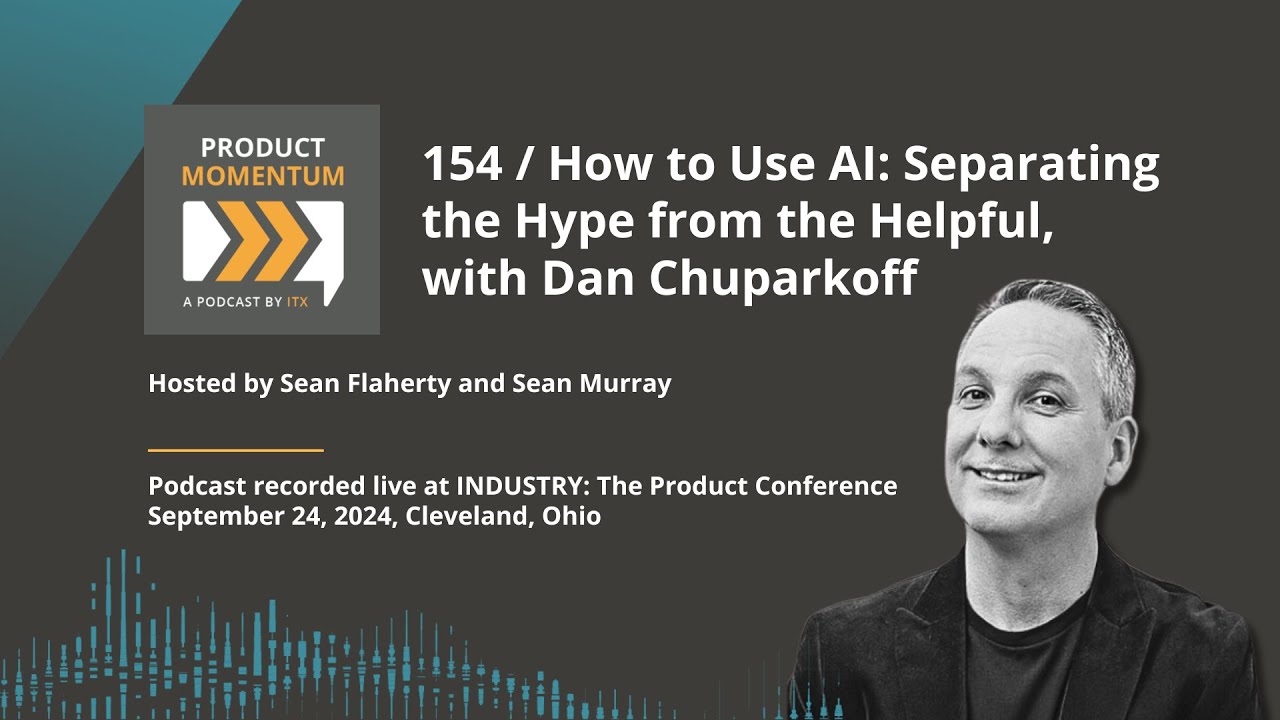
Dan Chuparkoff is a seasoned innovation leader with experience at Google, Atlassian, and McKinsey. The Product Momentum team caught up with him right after his keynote at INDUSTRY Global and talked about how product teams can get beyond the theoretical hype of AI and start zooming in on its immediate potential.
His message was clear: while AI has the capacity to deliver transformative possibilities, product teams need to balance their long-term ambition for AI with a dose of everyday practicality.
“It’s easy to think about the future-forward-looking thing when you talk about something new, like AI,” Dan says. “Maybe AGI [artificial general intelligence] works at some point in the future. Maybe it’s super helpful. But it’s not useful right now.”
Separating Hype from Practical Application
How do we separate the hype from the real-world application? Dan urges teams to embrace useful AI tools now rather than waiting for theoretical advances like artificial general intelligence (AGI).
You can’t go back to your office and use AGI to solve real problems, he adds, “but you can get hands-on now by using notetaking AI tools or translation AI tools to help overcome some everyday challenges. So here’s what I suggest: Create two buckets, one for what you can use next week and one for what might come years down the line.”
As an Umbrella Term, AI Has Leaks
One of Dan’s key points is that we should stop lumping everything under the AI umbrella. When we do that, he explains, we’re actually doing AI a disservice, obscuring its specific, actionable uses.
“Sometimes AI means machine learning from like 28 years ago, and sometimes it means a chatbot on your website. If you’re talking about machine learning a chatbot on your website, say that.” We all want to say we’re working with AI, “but that sort of hyperbole, that umbrella term, is going to confuse folks.” So, be as specific as you can as quickly as you can, he adds.
Think of AI As a Tool for ‘Accelerating Collaboration’
Dan pointed to studies showing that knowledge workers spend 68% of their time sharing information – not producing anything, but sharing it. 68%. So if we want AI tools to drive productivity, quality, and efficiency, they may be best suited (for now, at least) to reduce this resource commitment.
“If you make that even 1% better,” he said, “it’s like hiring four more people for your team.” When we automate product management-related tasks like analyzing customer feedback or summarizing meetings, our teams can focus on higher-value work. In other words, focus on the premium that your teams can offer when they’re freed from the burden of busy work that drives little value – and that AI can easily handle. “The real efficiency will come from people collaborating faster.”
If you prefer the video podcast experience, you can catch our conversation with Dan Chuparkoff on the Product Momentum YouTube channel!
Podcast: Play in new window | Download
Sean Murray [00:00:19] Hey, everyone. I’m Sean Murray.
Sean Flaherty [00:00:20] And I’m Sean Flaherty.
Sean Murray [00:00:21] Welcome back to Product Momentum, a community of product people and a marketplace of ideas where leaders and learners come together to shape our way ahead.
Sean Flaherty [00:00:28] Our production team is the best in the industry, and we are dedicated to producing high-quality content from thought leaders across the product development space.
Sean Murray [00:00:36] Check us out on your favorite listening platform; or, if you prefer the video experience, You can find all our latest episodes on the Product Momentum YouTube channel.
Sean Flaherty [00:00:44] Let’s get after it.
Sean Flaherty [00:00:47] Sean, what a great episode with Dan Chuparkoff
Sean Murray [00:00:50] That was awesome. He brings that this kind of huge topic of AI and makes it down to earth and something that we can consume and do something with.
Sean Flaherty [00:00:57] Yeah, I would say all value, all business value comes from making sense of contrasts, like making things so that you can see the differences, you know, and turning complex issues into something that we can actually work with. That’s, I think, what he did a great job of.
Sean Murray [00:01:10] Yeah, and don’t use the word AI anymore.
Sean Flaherty [00:01:13] It’s an umbrella term. It’s reached that status. Right. We got to break it down and make it useful and not throw it around as a buzzword. I really love that conversation.
Sean Murray [00:01:22] Yeah. It’s moving so fast. It’s already an umbrella term.
Sean Flaherty [00:01:25] That’s right. Right. Let’s get after it.
Sean Flaherty [00:01:27] Let’s do it.
Sean Murray [00:01:30] Dan Chuparkoff is a keynote speaker on innovation and the future of teams, formerly a technology leader at Google, McKinsey, Atlassian and more. He’s invested 60,000 hours over three decades on the ground reinventing real teams. He’s seen thousands of ideas, experiments, failures and successes on teams of every shape and size. He’s created a formula for surviving and the future of work. Dan’s here at Industry, helping product people understand how to harness the power of AI and separate the hype from the helpful. Dan, thank you so much for being here.
Dan Chuparkoff [00:02:01] Awesome. Thank you. Sean and Sean, thanks for having me. I’m excited for the conversation today. INDUSTRY is one of my favorite times of the year, and that’s it’s pretty cool to be featured here this year.
Sean Murray [00:02:10] Yeah, it’s awesome. So, can you talk us quickly through that like concept of separating the hype from the helpful? Like what are some practical strategies for product teams, the product teams doing that when it comes to AI?
Dan Chuparkoff [00:02:20] Yeah, I think especially for product teams because we’re so forward looking like we’re constantly thinking about the one year from now, two years from now roadmap. It gets easy to to keep thinking about that future forward looking thing when you talk about something new, like AI. Maybe AGI works at some point in the future. Maybe AGI is super helpful – artificial general intelligence – for any new listeners. Maybe that’s useful, but it’s not useful right now. You can’t go back to your office and use AGI to solve real problems, but you can use notetaking AI tools or translation AI tools. And so, I hope people sort of create two buckets where we know the useful stuff that you could use next week and the theoretical stuff that might come two years now, five years from now, and eight years from now.
Sean Flaherty [00:03:09] Stuff to be thinking about the future. It occurs to me that, and I say this a lot, but product leaders are inventing the future. Like we’re building tools and we’re building products that don’t exist yet. And AI is kind of one of those things. We know it’s coming. We don’t know exactly when it’s going to have a huge impact on our jobs and our work and our our the products that we build. But we know it’s coming. So how do how do we get in front of it?
Dan Chuparkoff [00:03:34] I think the first thing is just start trying, right? You start using something by starting to use something. So even, you know, even if it’s not even if you’re not completely reinventing your product from the ground up, like go into ChatGPT or Claude a little bit and ask it some questions, see what it’s good at, what it’s not good at, and, and play around with it, explore what its boundaries are.
Sean Flaherty [00:03:58] All right. So, and I agree with this, by the way. So, one of my academic heroes is a guy named Robert Sapolsky, Stanford University professor. He says he says evolution isn’t exactly what we think it is, right? The zebra that survives is the one that runs fastest when the environment changes. Right. And, you know, this is something that’s happening in all of our environments and the environment is changing at a rapid rate. And the only way to your point to be ready for it is to experiment, to try it. Right. Stay with it. Don’t let it pass you by, you know?
Dan Chuparkoff [00:04:30] Yeah, exactly. I talked to a lot of teams that aren’t comfortable with the privacy policy of something like ChatGPT yet, so they’re not using it. Sometimes it’s even blocked. For those teams, I encourage them to just use the free version or the $20 version at your house and ask it what to make for dinner tonight. Right. Start using the tool a little bit. Before it matters. Before it’s critical. Before It’s like a life-or-death situation for your organization and your customers.
Sean Flaherty [00:04:59] Absolutely. So, the simple example, I just took a trip to Greece and planning the trip to Greece, like not knowing anything about the islands. Like it was incredible, like timesaver to help find those pointers and just save me ten hours of trip planning, Right?
Sean Murray [00:05:14] Sean’s kids are out of the. So, I used it for creating tee-ball practice plans. So, just a different, different application.
Dan Chuparkoff [00:05:21] Right, Right.
Sean Murray [00:05:24] I know that we can experiment to understand what happens now. Yeah. How do we handle that kind of, like, rapidly changing capability. It seems like every three months there’s a there’s a new version of an LLM out that can do the next great thing. So how do we stay on top of, how do we stay on top of that growth?
Dan Chuparkoff [00:05:38] I think the first thing is as product managers, we’re doing that to our users all the time, right? Every month there’s a new blog post about your new feature and you expect them to read every single post and catch up every quarter and download the new release as soon as it’s there. And so first, take a little bit of your own medicine. Right. And you’ve got to it’s keeping up with new technology is a is a full-time job. Right. You’ve got to you’ve got to pay attention. You’ve got to keep looking every two weeks, every four weeks, whatever the right cadence is for you. You’ve got to deliberately prioritize that learning. One of the things that Google when we were there, we had 20% time at Google. Right. And one of the things about 20% time is not that you should get to spend every Friday working on whatever you want. It’s that you need 20% of your time to play around with new technologies so that you’re ready for them in the future when they’re critical. And that’s, I think, the most important thing I took from Google.
Sean Murray [00:06:38] For those organizations that don’t have that playtime built-in playtime, probably the wrong word. Yeah, I’ll think of a better one…
Dan Chuparkoff [00:06:43] I like that word, actually.
Sean Murray [00:06:45] Okay. Well, how do we convince, you know, whoever is above us, this is the right thing. This is the right way for us to spending for us to be spending our time and how we’re going to get value out of it. Yeah. Do we have that hard conversation of like that?
Dan Chuparkoff [00:06:59] That is a hard question. One of the things I’ll tell you, an experiment that I tried because I know that if I just had a little bit of time, I could learn some things that would change our business, right? And so instead of asking for permission because I tried that a bunch of times and it’s hard, right? I told my boss I was going on vacation. I told my boss, Hey, I’m going to Florida for a week. I’ll be back in ten days.
And then I didn’t go.
I spent the whole week watching YouTube videos. I like rewrote our strategy for next year. I spent five days with no meetings. I didn’t look at chat. My out-of-office assistant was on and I came back the following Monday and I said, Hey boss, I didn’t go to Florida. And she’s like, What? And I said, Yeah, can I have the vacation days back? And she’s like, No. And I said But look at what I did. I learned about this new tool that we’ve been wanting to learn forever. I rewrote our strategy and our deck for how we’re going to pitch it to our customers. And it was it was amazing. She’s like, wow, that’s really great. And when she saw the results, then prioritizing that again in the future was easy. So do small experiments and make those experiments a little bit bigger and a little bit bigger. And don’t try to don’t try to convince people that your theory is right. Convince them that the results that you just got are worth amplifying.
Sean Murray [00:08:24] Okay. Right. So, I’m going to go to Florida for ten days. By the way, just let you know right after.
Sean Flaherty [00:08:29] We’re going to change the subject. So, the most the most rewarding work is the work that you do when it feels like you’re playing, intrinsic motivation is defined by that. Like, that’s yeah, all the social science has shown that when you have some autonomous control over your day-to-day activities, you are more creative. And I fundamentally believe that this environment, like this product management environment, requires a tremendous amount of autonomy. Which means we have to set good goals and know where we’re going to be working towards those goals. But we’ve got to give people the space to grow and learn. That’s where creativity comes from. Right. So, they’re tightly intertwined.
Dan Chuparkoff [00:09:06] Yeah, Yeah, I completely agree. I think even outside of product management, a lot of teams probably don’t have enough autonomy, right, to get their own work done. That’s why remote work is so hard because everybody has to tell everybody else what they’re doing all the all the time.
Sean Flaherty [00:09:23] And it’s like you spend a lot more – it feels like you’re spending more time tracking and proving that you’re adding value than you are, actually.
Dan Chuparkoff [00:09:30] And I used to work on Jira, so I know the value of tracking and that’s important now. Well, also when you’re spending more time sharing the information than you’re actually spending doing the actual work, maybe you should take a look at that.
Sean Flaherty [00:09:42] The work around the work.
Dan Chuparkoff [00:09:44] Yeah.
Sean Flaherty [00:09:44] Right now, I know a lot of teams want to adopt AI. What are teams doing today to kind of mitigate the costs of, either mitigates the costs of starting up in AI, either some of that training time or like the risks that come with it? What are, what are strategies that teams are using today?
Dan Chuparkoff [00:10:00] I think the first thing is trying small experiments like we’re in the learning phase with AI right now. I would strongly recommend against people just ripping the covers out of everything they built in and building again with an AI foundation. Because it’s changing so fast. We don’t even know what six months from now will look like. And so starting slow. Starting smaller. Trying with some of the information that’s less critical like not your employee PII or your customer, PII or your health data or – try it just with your basic status report sharing. Like try to get an AI note-taker built into your meeting tool and use that to try to accelerate the efficiency of your communication. Like that’s I think the thing that people should start with because people are spending 68% of their time sharing information anyway. Most knowledge workers, according to two different studies from different organizations. 68% is a lot of time. If you can make that 1% better, that’s a huge win. It’s like hiring four more people for your team.
Sean Flaherty [00:11:08] Big.
Sean Murray [00:11:09] I’ve recently used AI Perplexity its the tool that I’m using right now to do competitive analysis. If you actually aren’t sharing any information that’s not publicly available, right. I don’t need to like, I don’t need to divulge anything. I just want you to scrape what’s on the website, go to YouTube and use those videos to help me compare.
Dan Chuparkoff [00:11:28] Right. Right, right. Yeah. I think that’s a great example. The kind of stuff where you’re trying to research and aggregate large amounts of information that’s already out there. I think where that gets a little bit dangerous is, you know, if you really only have two main competitors and those competitors only have a website each and you’re trying to you’re trying to draw inferences from a very small amount of text. Then, you know, you’ll get hallucination. So it’s much better if you’re looking at, you know, 20,000 customer service tickets over the last ten years of your life. And, you know, that kind of stuff is a little bit better.
Sean Murray [00:12:07] Yeah. The workshop that John Hagerty had us do a few months ago was centered around it was like 40,000 app reviews. And that was like, okay, what are the insights that I need to learn?
Sean Flaherty [00:12:19] That’s like, that’s the kind of work that it’s just not efficient to do yourself. You need to have help.
Dan Chuparkoff [00:12:24] Yeah. It’s super hard. And I think what happens is people as product managers, you know, you go into some of the tickets and you scan for stuff that’s anecdotally interesting or you look at like, you know, whatever your Google Analytics or your Heap or whatever you’re using and you just like sort of spot check weird stuff. But you know, AI will help us make sense of data like that. Much more scale.
Sean Flaherty [00:12:45] At scale for sure. One of the things we do as product leaders, you know, all economic value is created through contrast. It’s like when you take a complex problem and you make it, you make it easy. You make it easy to understand. When I asked you the question before the interview here, what’s one question you love me to ask? You said, I’d like to explain why I do this work. Have a shot of that.
Dan Chuparkoff [00:13:11] Yeah. Awesome. That’s a hard thing because, like, I quit Google last September, so it’s a year from the recording since I quit, and I just do this. I speak at conferences, I talk on podcasts. I’m just trying to help people. And some people are like, why would you throw away Google stock options, right? And try to work for yourself as a as a sort of a consultant that never does consulting. And the reason is because I learned all of everything I know at conferences like this, like everything I learned, like, I don’t know, 28 years ago from the guy that wrote the book Crossing the Chasm, or, you know, 18 years ago, I saw Eric Reis when the Lean Startup first came out and those guys changed my life. You know, they taught me how to make products in a better way. And I went from, you know, working on like some crappy product for a newspaper company to working as a leader at Google on Android. That’s a amazing jump. And it’s because of speakers like this that gave back to the community. So I try to do that as much as I can.
Sean Flaherty [00:14:18] So turning complete and taking complex ideas and making them accessible to people so they can change their own careers.
Dan Chuparkoff [00:14:23] Yeah, yeah, exactly.
Sean Flaherty [00:14:25] So from your talk, like, what’s, what’s one of the key complex ideas that you’re making simple for people?
Dan Chuparkoff [00:14:31] I think the, the number one most important thing is don’t say AI so much.
Sean Flaherty [00:14:40] It’s become a buzzword.
Dan Chuparkoff [00:14:41] It’s an umbrella term, right? It’s sometimes that machine. It means machine learning from 28 years ago and sometimes it means a chatbot on your website. If you’re talking about machine learning from 28 years ago, say that. And if you’re talking about a chatbot on your website, say that, right? Sure. Somebody in some strategy wants you to say we’re doing AI stuff, but like to your users, that sort of hyperbole, that umbrella term is going to confuse them. I say, I like to say AI is a pinata and there’s all this cool stuff inside, but no one’s really sure what’s in there. So, I’ll just whacking at it with a stick. You know, that’s confusing for people. And so, get as specific as you can as quickly as you can.
Sean Flaherty [00:15:22] Reminds me of the famous Steve Jobs quote about, you know, you have to start with your customers and work backwards from what they need, Right? Can’t start with the technology and then go find someone to sell it to.
Dan Chuparkoff [00:15:32] Right, right, right. Yeah. Yeah. And as product managers were generally better at that than others. Like we talk about problems that we’re trying to solve and outcomes and stuff like that, you know, teams in other industries like finance and HR and travel management like they it’s just way harder for them. So at least recognize and in the product management worlds, you already do a pretty good job.
Sean Flaherty [00:15:54] Yeah, I think I think it’s an exciting time. Like we’re about to go through another one of those transformations. You know, there’s been several. I’ve been in this I’ve been in the software business since the beginning of the Internet. And I’ve watched some of these transitions. Like I’ll never forget the day ASP came out and I was like, Whoa, you can put a database on that Internet thing? Well, that’s going to change the world. You know, I think AI as one of these transition points, like it’s made a huge impact on my life already. And I think if we don’t if we don’t figure out how to take advantage of it, we’re in trouble.
Dan Chuparkoff [00:16:25] Right. Right. I mean, we will like in, you know, five years when we look back at the AI assistant, that’s given us suggestions all day long, that’s going to be as ubiquitous as the mobile phone in our pocket. It’s you know, it’s coming. People are adopting it faster than I expected them to and that’s pretty great.
Sean Flaherty [00:16:44] It’s already an umbrella term. It’s even advanced. Yeah, it’s even in advanced its progress to an umbrella term.
Sean Flaherty [00:16:51] That’s good.
Sean Murray [00:16:52] What are some other key takeaways from your talk that you want people to have today?
Dan Chuparkoff [00:16:55] I think the other thing is we will put AI features in our products and that will be great. We will use AI research assistants to like get information and summarize it faster. But the real efficiency that I think people will get is just from collaborating faster. Okay. Right. You know, everyday teams all over the world are having conversations with each other in a room or on Zoom, and people are like writing notes in a paper book. And never looking at it again. They have the same conversations over and over and over again. A new person joins a team, and they missed everything that was ever been said and AI is going to make that go away. You’re going to have like an organizational conversation memory, and that’s going to be way more useful than, you know, a chat bot or your website.
Sean Flaherty [00:17:50] Yeah, I would agree. So, what are you reading? What do you recommend to our audience Right now?
Dan Chuparkoff [00:17:55] I am writing a book, so I am deliberately not reading anybody else’s books so that I don’t accidentally, you know, let that influence my thoughts. My book could be out sometime, maybe next March or so.
Sean Flaherty [00:18:10] You don’t believe in Picasso’s adage about good artists borrowing and great artists stealing?
Dan Chuparkoff [00:18:14] I would like to at least take a small hiatus. I read a lot of books already and we’ll learn from them. And you know, they’re great. There are lots of great books. I you know, Marty Cagan’s books are redefining the industry. Christina Wodtke is an amazing writer. And then, you know, I hope I advise people, you know, reading outside of the product world to just learn from general business and collaboration and leadership. Those are important.
Sean Murray [00:18:40] Great, awesome.
Sean Flaherty [00:18:41] Then how do you how do you define innovation? That’s a question we ask all our guests. Just because I find that I find the differences fascinating.
Dan Chuparkoff [00:18:48] Yeah. So earlier you mentioned that the way zebra’s evolved is not by being the fastest runner, but by running a little bit faster than the other zebras, whatever your organization does. If you if you could just pick one most important customer metric like whatever that is, whatever your company does, if you’re making that metric a little bit better, then you’re innovating. That’s the only thing that matters. Everything else you do is in service of moving that one most important customer.
Sean Flaherty [00:19:24] Yeah, I love that. So really, that hyper-focus on the customer, the thing that moves the customer relationship in some way, you get customers a little bit further up that relationship ladder and you’re winning, right?
Dan Chuparkoff [00:19:36] Yeah, exactly
Sean Flaherty [00:19:38] Awesome. Well, thank you for joining us.
Sean Murray [00:19:40] Yeah, this was awesome.
Dan Chuparkoff [00:19:41] Thanks for having me. It’s a pleasure to work with you. It’s been great at INDUSTRY so far and I can’t wait for the other day and a half. And thanks for pulling me aside and sorry about the background noise.
Sean Flaherty [00:19:53] Yeah.
Sean Murray [00:19:54] We can operate anywhere. We can operate anywhere. We have no fear.
Dan Chuparkoff [00:19:58] Awesome. Thanks, man.
Sean Murray [00:19:59] Thanks again.
Paul Gebel [00:20:01] Well, that’s it for today. In line with our goals of transparency and listening. We really want to hear from you. Sean and I are committed to reading every piece of feedback that we get, so please leave a comment or rating wherever you’re listening to this podcast. Not only does it help us, can. To improve. But it also helps the show climb up the rankings so that we can help other listeners move, touch and inspire the world, just like you’re doing. Thanks, everyone. We’ll see you next episode.