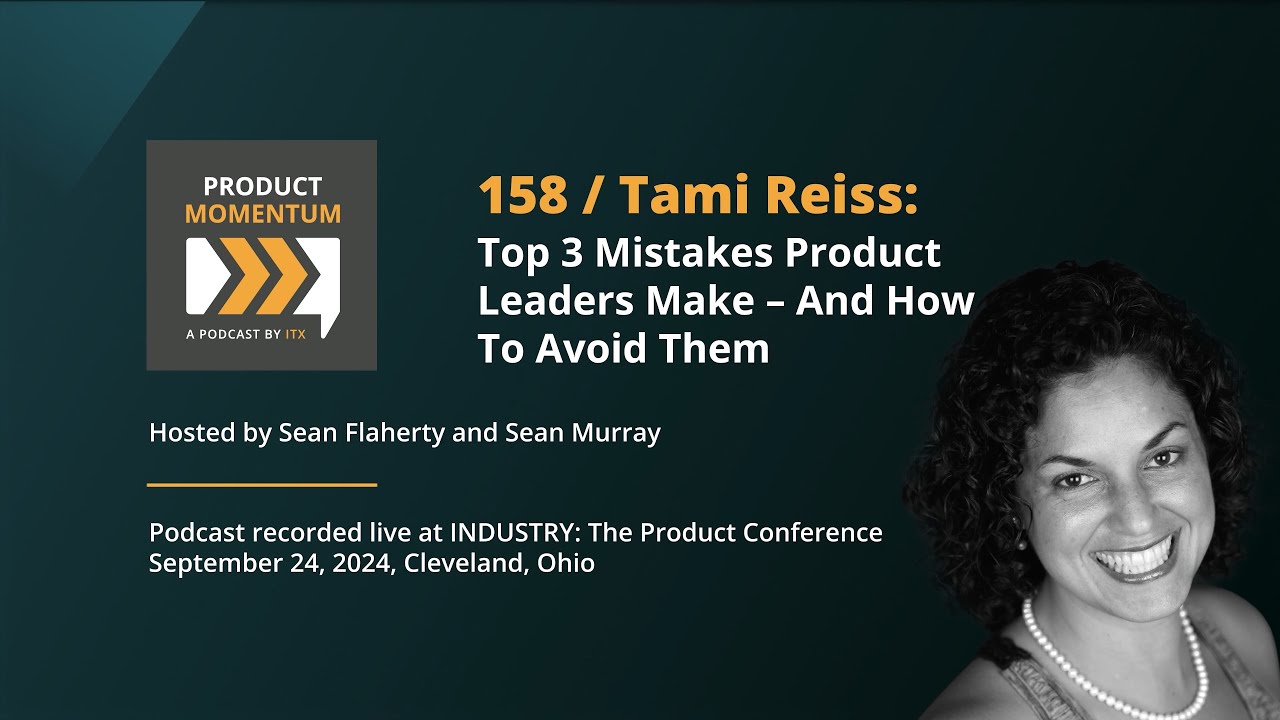
Listen
Podcast: Play in new window | Download
About


Tami Reiss, also known as the Product Leader Coach, unleashes the leader within managers, directors, and executives. After almost 20 years experience helping startups, established enterprise companies, and community organizations define their product strategy and set up product organizations for scale, she now helps others do the same. CEOs, CPOs, and VPs of Product work with her to develop cohesive product strategies, transform product organizations, and improve board relations. She has held many product roles within B2B SaaS organizations and consulted with companies such as Humana, Aetna, JPMorgan, TheKnotWW, and Cornerstone on Demand among dozens of others which adds to her ability to understand different perspectives and various industries.
Recommended Reading
Tami Reiss, also known as The Product Leader Coach, brings together the strategy, process, and mindset tools we need to perform our roles as product leaders with the ability to think and communicate like an executive. A coach is able to see the whole field, and they’re watching us, their player, from an outsider’s perspective. “Beyond that,” Tami says, “a coach is a great sounding board; the higher we go in our careers, the less we can turn to our bosses for advice. They’ve either never done our specific job, or we don’t want them to think we don’t know how to do it.” A coach can also help product leaders avoid these critical mistakes:
Lacking a Clear Vision.
“One of the biggest mistakes made by product leaders is failing to ensure there is a clearly defined vision,” Tami explains. Vision – that “story of the future” we’re trying to create in the world – helps people internalize what the world will look like because of the things we are building.”
Insufficient Understanding of Finance.
“The biggest jump product leaders have to make is understanding how to translate customer value into business value,” Tami says. Product leaders who lack financial acumen may face challenges in managing budgets, justifying investments, and driving profitable growth.
Overlooking Inorganic Growth.
“Product people spend their entire careers finding problems, building solutions, and launching products that solve those problems,” Tami offers. But they overlook the fact that sometimes you’re not going to be the person to build the solution.” Inorganic growth means you might have to find a partner; you might have to acquire the solution; or you might be acquired. Inorganic growth is about business growth, Tami concludes. It’s not about product growth.
Prefer the video experience? Check out the Product Momentum YouTube channel to catch our conversation with Tami Reiss and all our recent guests!
Save the date! ITX’s Product + Design Conference returns to Rochester, June 25-26. Find out more!
Podcast: Play in new window | Download
Sean Murray [00:00:09] Hey, everyone. I’m Sean Murray. And I’m Sean Flaherty. Welcome back to Product Momentum. A community of product people and a marketplace of ideas where leaders and learners come together to shape our way ahead. Our production team is the best in the industry, and we are dedicated to producing high quality content from thought leaders across the product development space. Check us out on your favorite listening platform or if you prefer the video experience. You can find all our latest episodes on the Product Momentum YouTube channel. Let’s get after it.
Sean Flaherty [00:00:46] I’m really excited for this interview with Tami Reiss. She has so much experience in the product space. She was gracious. We ran into her hearing industry. I’ve known her for a few years. Really brilliant mind.
Sean Murray [00:00:58] This was the energy podcast. I was like, You ready? Strap in. Like, this is this is an intense one, right? Yeah. If you like talking with hands, this is this is the one to listen to.
Sean Flaherty [00:01:08] She is passionate. Yeah. And she knows so much about the product space. She’s coached product leaders for many, many years. There’s a lot of depth in this podcast. Let’s get after it. Let’s do it.
Sean Murray [00:01:18] Tammy Reese is a product strategy leader with almost 20 years of experience working with tech companies to define their product strategy and set up product organizations to scale. Right. Recently doing a lot of coaching. So my first question is going to be why do product leaders need a coach?
Tami Reiss [00:01:35] Everybody needs a coach for everything they’re doing okay. If you think about the athletic world, you could be Michael Phelps. And he still has not one, but probably a dozen coaches he’s worked with. And the reason for that is what a coach does is they’re looking at the field or in his case, the pool, and they’re watching you as the player from an outsider perspective. And they’re saying, okay, I’m seeing everything that’s going on, the competition, the market as it’s changing other.
Sean Murray [00:02:06] Product.
Tami Reiss [00:02:07] Leaders, other product leaders, other companies. And what I see you doing isn’t properly the best thing you could be. It’s probably great, but there’s an opportunity to be better, to be more awesome, to be more efficient, to be more effective. And as a coach, you’re still on the sidelines. You can’t do it for the person. But what you can do is say, Hey, if you make this adjustment, so the way you say this, if you change this mindset in the way you’re approaching this, you will be more successful. And it’s really nice to have that person. But beyond that, it’s great to have a sounding board because the higher up we get in our careers, the less we can turn to our bosses for advice, either because they’ve never had our job, especially in product, or because you don’t want them to lose confidence in your ability. So you want to be able to talk to someone who’s been there, done that, who’s seen multiple different games and is able to provide you unbiased advice about how you can make your pitch a little better.
Sean Murray [00:03:13] Yeah, if I ever get back into rugby coaching, that’s how I’m going to explain what I’m doing. There you go. Things to try.
Tami Reiss [00:03:18] My job is to help you do your job better.
Sean Murray [00:03:20] Yeah, right. When I. You know, I met Tami at previous INDUSTRY events. We’ve had a lot of conversations over the years. Has been great getting to know you. And what I think is fascinating about you is you’ve been in the coach, you’ve been a product coach for like 11 years, which is pretty much the whole length of the industry’s been in existence. Right?
Tami Reiss [00:03:40] So it’s interesting. So I’ve technically only been product leader coach under my own shingle for think we’re going on three and a half years. Okay. But prior to that I was working within Insight Partners with their portfolio company as a property coach. And years prior I ran a consultancy where I was the product coach for all of our clients. And before that I was at Pivotal Labs where the product management consultants, we called ourselves player coaches because what we were doing was we were doing a little bit of the work, but we were always paired up with another product leader or a product manager, and we were coaching them in how to become more agile, how to become more lean. And so I’ve been doing that for a long time.
Sean Flaherty [00:04:26] While, and you’re having a tremendous amount of experience that you bring to the table. So it’s I’m excited that we have this opportunity.
Tami Reiss [00:04:31] Thank you.
[00:04:31] Share some of your knowledge with the world. So what do you see as the top problems in our space today? Like what are the biggest mistakes being made by product leaders today?
Tami Reiss [00:04:40] So I think one of the biggest mistakes product leaders are making is that they are not focusing on making sure there is a clearly defined vision, which is a story, not a goal, a vision, which is a story of the future that you are trying to create out in the world, and that it should be communicated in a way with pictures or visual imagery. It’s a vision so that people can internalize what the world will look like because of the things they are building, because of the products they are supporting, because of the features they are selling or marketing. And when you have that, everything else becomes easier and it’s worth the investment in time. It’s hard.
Sean Flaherty [00:05:27] Yeah. Do you have.
Tami Reiss [00:05:28] An example, and it’s scary.
Sean Flaherty [00:05:29] Giving examples of a great product vision? This is a great conversation. So.
Tami Reiss [00:05:34] So I work with a company that. Of all things. They build software that helps you put photovoltaic panels out. They work with engineers who are planning for like massive solar farms. And their vision is to make it easier and more effective to have a solar farm and be able to more accurately predict what that will provide so that a company who’s choosing to make an investment has a better idea of the ROI, they’re going to get out of it. How many kilowatts are they getting out of this investment? And they see a big problem in the market where that a lack of accuracy is a problem and they’re working on saving the world. Let’s be clear sourcing the more solar panels we have, powering things and batteries, etc., like that’s a great thing.
Sean Flaherty [00:06:28] So a great vision if I test my understanding here is about creating a space, a story that people can step into that shows them what the future will look like, which allows for a lot of creativity.
Tami Reiss [00:06:38] Not necessarily even in the future. Just what does the world look like? Yeah, it’s possible that what your product does is it helps somebody not be in front of their computer playing with your product. All right. Right. It helps them get out into the world, be with their family, get on vacation. Right. Like a lot of the tools around travel industry, the vision you’re creating isn’t how easy it is for me to book my plane ticket. It’s that I can actually go on vacation with my family or friends. And it’s the vacation I want to go on. Yeah. At the price point, I want to pay.
Sean Murray [00:07:08] Yeah. The best visions…those long term aspirational goals don’t necessarily have to be like, tethered by reality either. Right. You want to talk about was Google’s is like access to be an evolving engine in one place. Exactly right. Yeah. Instagram’s is share and capture the word capture and share the world’s moments. Right. So world. Right.
Tami Reiss [00:07:28] And they can shift. This is something that I think people miss. Is that just because you have a vision, if it’s not working, you can shift it. And I talk about how Tinder, which we’re all familiar with, their original vision statement, had to do with connecting the being a modern connection engine.
Sean Murray [00:07:49] Right.
Tami Reiss [00:07:50] And what they realized was their actual vision was for more people to meet in a world where it was getting harder to meet and to have real connections, which meant actually going on a date and having coffee or a drink or going to a concert together. And so they changed their vision statement to include.
Sean Murray [00:08:08] Very.
Tami Reiss [00:08:09] Real connections. And that changed their whole algorithm and their whole what they built. But it also changed their trajectory because when they started investing in the vision they wanted, which actually delivered customer value, which was more than just an online connection, it was an actual date that might lead to a long term partnership. They became more viral. They had more stories that they could tell of their success.
Sean Flaherty [00:08:33] I do think it’s important that the vision is able to tell the vision in the context of a story. Talk about that a little bit, why you think that’s important.
Tami Reiss [00:08:41] People love stories. Yeah. That’s what we remember. That’s what inspires us. John Doerr, father of OKRs, recently gave a Ted Talk and he just flat out said, We’re all doing it wrong. He was like, OKRs have become ubiquitous and the vast majority of people are doing them wrong because the intention was for them to be inspirational and aspirational. And most people are just saying revenue or churn or something else and no one gets excited by that. No, not even your CFO.
Sean Flaherty [00:09:13] No one gets up in the morning with a spring in their stuff saying they can’t wait to make money for the good advice. So there’s a Matt LeMay said you’re on the right track with setting your objectives when you’re uncomfortable, Right? You’re like, I don’t know. I don’t know. Whenever. When you got a 50-50 shot at this, right?
Tami Reiss [00:09:29] Yeah. I used to talk about how product managers have to balance two really big things, which is hubris and humility. Hubris that you could do something no one else has ever done. And the humility that whatever you’re thinking you’re doing is probably wrong and still doing it.
Sean Flaherty [00:09:45] And a growth mindset is how we learn. Yeah.
Tami Reiss [00:09:47] Like my four and a half year old will tell you mistakes are how we learn and the more we can help create cultures where that’s okay. Yeah. We’re so the key to making a mistake.
Sean Flaherty [00:09:58] Long as you’re learning.
Tami Reiss [00:09:59] Yes. And to define what failure looks like. I was coaching a VP of product the other day who said, Well, what if I fail? And I said, Tell me what you think you might fail at. And she said, Well, I’m pitching the investors on the board to give me a few million dollars to invest in my products. And what if they say no? And I said, that’s not failure.
Sean Flaherty [00:10:20] There’s something to.
Tami Reiss [00:10:20] Learn. Failure is showing up prepared. Yeah. Failure is not taking this opportunity to build more trust and confidence in you as a leader. Failure is not having a clear story that you’re telling. If they choose to invest in something else, that’s okay. They’re making a business decision, right? Yeah.
Sean Flaherty [00:10:37] Yeah. No, I got it.
Tami Reiss [00:10:39] But you also have to therefore have define success. Yeah. And success is having the executives trust you.
Sean Flaherty [00:10:45] You and giving giving you if they give you feedback, if they tell you what would change their minds or what would cause them to invest in it. Like you have something, you’re going in there with something to learn. Right.
Tami Reiss [00:10:54] So and if you don’t get that investment and you’ve actually built that trust, they might put you on another team. It doesn’t mean you’re out of a job. All right. But if you show up ill prepared, that’s a failure. You don’t get the investment and you probably don’t get it.
Sean Flaherty [00:11:06] And you probably did some damage to your reputation.
Tami Reiss [00:11:09] Exactly.
Sean Murray [00:11:10] I had an experience working with a client where we’re kind of flailing on a product for a little bit. Right. And so I took the…you know, I took the opportunity to say, look, I’m just going to there’s no vision or objectives for this product. I’m going to I’ll write the vision stack, Right. And we did that exercise. They liked it. They said, hey, dive a little deeper into what that roadmap looks like. We put that together for them and it turned out in the end, they’re like, Well, it costs way too much money and it’s not one of our top priorities. So we’re just not going to do it. Because you have described the right way to do it, but we’re not going to take the time to invest in that. But. Whatever you just did, we want you to go and do for every other product you’re going to work on for us, right? Describe it to us this way. Right. So we failed, but we earned that trust. And we learned.
Sean Flaherty [00:11:52] And you’ll learn something. Yeah. Anyway, it probably saved the company a bunch of money because they didn’t go down the rabbit hole and do the iterations, so not get the result they wanted anyway.
Tami Reiss [00:12:01] That’s what Matt was talking about, like when you’re trying to figure out tradeoffs. Which of these is actually going to deliver the value you want? Right. Just start there. You don’t need any additional frameworks. Yeah. Which is going to deliver the most.
Sean Flaherty [00:12:13] Value impacts.
Tami Reiss [00:12:14] Impact.
Sean Flaherty [00:12:15] All the stuff you.
Tami Reiss [00:12:16] Can’t understand and evaluate impact unless you know where you want to go. What are you trying to impact.
Sean Flaherty [00:12:23] The story just to.
Tami Reiss [00:12:24] Get closer to where you.
Sean Flaherty [00:12:25] Go? All right. So that’s one problem. What’s another problem? You see?
Tami Reiss [00:12:30] Not enough understanding of finance.
Sean Murray [00:12:33] Okay.
Sean Flaherty [00:12:33] Wow.
Tami Reiss [00:12:34] The biggest jump I see product leaders have to make in order to become executives is to understand how to translate customer value to business value. NPS. Some investors understand. Churn, they all understand retention. They all understand. Net revenue retention, they love. If you don’t know what any of those things are. They don’t love you.
Sean Flaherty [00:13:01] Yeah.
Tami Reiss [00:13:02] And the sooner you can learn to take your strategy and your impact and translate it into how is this helping the business? How is this helping grow revenue? How was it helping keep revenue? How is this helping us decrease costs?
Sean Flaherty [00:13:16] Yeah.
Tami Reiss [00:13:17] If you have PLG [product-led growth] motion, it sounds fantastic to product people. What investors want to hear is that you’re lowering TAC [traffic acquisition cost] . Or that you’re enabling land an expanse or net revenue retention. That is what they want to know. Yeah. And the sooner you can start talking in that frame of reference, the sooner they will start trusting you to lead the team with one of the largest budgets.
Sean Flaherty [00:13:44] I think there’s also a skill set around this in the same vein here on fluency of time horizons like you have. You need to understand the difference between short term metrics and the business and long term metrics and the business and the better job you can understand how to communicate that.
Tami Reiss [00:13:59] To the cash flow versus actual business value.
Sean Flaherty [00:14:04] And lifetime value.
Tami Reiss [00:14:05] And and the fact that a service revenue dollar is worth one tenth of an ARR dollar. Yeah. And if you can speed up things like getting a company, one of your clients to go from books to build, there’s high value there.
Sea Flaherty [00:14:21] Sure.
Tami Reiss [00:14:22] And I can’t tell you how many product people have no idea what I just met. So I learned that in like 2009 from a CFO; I was trying to pitch a CEO of the order of how I wanted to roll out features based on what I said was customer value. And I wasn’t getting through, but I was randomly sitting with the CFO talking about it, and he said, Wait a minute, if you do that. Then we’ll be able to start billing clients 6 to 9 months earlier. And all of a sudden light bulbs. Light bulbs. And my order made sense.
Sean Flaherty [00:15:01] Time horizon fluency.
Tami Reiss [00:15:02] I fell into that. Right. The mistakes we make, we learned.
Sean Murray [00:15:06] Now, I think especially the industry this year we’re talking a little bit more about revenue, right? And actually attaching revenue to your pitches and to it making it a normal part of your lexicon. Why?
Tami Reiss [00:15:19] Because too many product managers are getting fired for not delivering business value and not communicating their business. That mean.
Sean Murray [00:15:26] Yeah, yeah. The lid is off, right? Like the VC money, The undying VC money is gone. We’re not letting you know Google and an Apple determine what our product management practices are going to be anymore. There’s no longer just this, like, just focus on the user. Only take care of the user, delight the user. It doesn’t work like that, is it? Those are all products. I bet it does not work, right? Yeah. Yeah.
Tami Reiss [00:15:49] It’s so funny because I’ve always worked in B2B software and that’s never what you can do in B2B software. Like you have to be delivering value that someone’s willing to pay for.
Sean Flaherty [00:15:58] Or you’re done.
Tami Reiss [00:15:59] Or you’re done.
Sean Flaherty [00:16:01] It’s a very different market.
Tami Reiss [00:16:02] And not only do they have to be willing to pay for it, they have to be willing to continue to pay for it. You have to continuously create more value for them to fulfill more of their needs.
Sean Flaherty [00:16:14] Over time, it’s got to your value proposition as didn’t improve. Can’t stay static.
Tami Reiss [00:16:19] I’m very utilitarian. I’ve always enjoyed B2B software.
Sean Flaherty [00:16:22] I love that.
Tami Reiss [00:16:23] I’m very bad at what’s cool.
Sean Flaherty [00:16:25] Okay, so number one, vision, storytelling around vision and giving people a space to step into that allows you to tap into their creativity as a product leader. Number two. Making sure you understand the business mechanics like fluency of finance, financial firms, how you’re measuring things in both the short term and the long term. What’s number three?
Tami Reiss [00:16:43] Inorganic growth.
Sean Flaherty [00:16:44] Inorganic growth.
Tami Reiss [00:16:45] Product people have spent their entire careers finding problems, building solutions for problems, Launching solutions for problems. Iterating on said solution of a problem. Inorganic growth means sometimes you’re not going to be the person to build the solution. It means you might have to acquire, it might mean you have to partner. Sure. Might mean you get acquired or you sunset and you sell a piece of your business off to somebody else. And inorganic growth is about the business growth. It’s not about your product growth, your business growth, which is why you have to understand the finance stuff.
Sean Flaherty [00:17:21] Yeah, for sure.
Tami Reiss [00:17:22] And sometimes a market opportunity is best served by bringing in someone else’s knowledge.
Sean Flaherty [00:17:30] Sure. Like, don’t you have to build everything? Yeah. Does it make sense to buy it? Plug it in or.
Tami Reiss [00:17:35] And you know, when I worked at Insight Partners, very often we’d be hiring in CPOs for growth stage companies. And the question very often was, well, why can’t we just upgrade the VP of product? Why can’t we teach them the skills they might be missing? And more often than not, what they were missing was M&A. Sure. And M&A is not something you want to take a novice to.
Sean Flaherty [00:17:57] Right. So it’s a challenge.
Tami Reiss [00:17:59] It’s a challenge. It’s always a challenge. And very often we would be bringing in a CPO who had experience not just integrating after an acquisition or a merger, but actually being strategic, do being part of the due diligence conversations. Understanding the opportunities that are available, understanding the finances around that. And if you have any opportunity to take part in any M&A activity, even as a fly on the wall, go do it.
Sean Flaherty [00:18:28] You learn a.
Tami Reiss [00:18:28] Lot where experience is and you will learn also. And you will stand out amongst the crowd.
Sean Flaherty [00:18:35] Yeah, you will. Awesome. So Tami, what are you reading these days? What’s got you excited? What are you learning?
Tami Reiss [00:18:41] I’m learning about negotiation.
Sean Flaherty [00:18:44] Chris Voss.
Tami Reiss [00:18:45] Chris must.
Sean Flaherty [00:18:46] Never split the difference.
Tami Reiss [00:18:47] Or split the difference. If you’re not familiar with this book, which Sean and I obviously love. It is written by an ex FBI, CIA negotiator, a.
Sean Murray [00:18:56] Hostage.
Tami Reiss [00:18:57] Hostage negotiator who in that case, there’s no middle ground.
Sean Flaherty [00:19:01] Right? There’s no there’s no get.
Tami Reiss [00:19:03] Half a person back.
Sean Flaherty [00:19:05] No.
Tami Reiss [00:19:06] And the tactics he uses for influence are so valuable. In any sort of negotiation. And when we think about influence, that authority and product, there are so many lessons to be learned there.
Sean Flaherty [00:19:20] The number one thing I remember from that book is you’ve got to connect first. That’s one of my mantras connection before content and how it plays out in hostage negotiations. Like, yeah, he’s really figured this thing out. It’s really cool. Yet you got to read the book. It’s great.
Tami Reiss [00:19:33] But yeah, and that connection builds empathy. Yeah. So that you can narrow the person so that you can understand what incentivizes them, what drives them. And that’s what we do as a product people when we’re working with our stakeholders, our internal partners, our customers, we are trying to build empathy for them, to connect with them, to understand what they want and how we can align to theirs.
Sean Flaherty [00:19:53] There’s no negotiation without understanding incentives, none.
Tami Reiss [00:19:56] And so that’s another thing. Incentives. And because I work in B2B software, not enough product people understand the incentives of a sales structure. I understand how your salespeople get paid, how they hit their quota when they hit their quota, what their bonuses are, what their accelerators are. And if all these words are foreign. Go talk to your sales.
Sean Flaherty [00:20:18] But it’ll explain exactly the RINO problem, the real high value new opportunity that comes in the door. Like why they’re so strongly pitching that you have to build this feature.
Tami Reiss [00:20:27] Why they have recency bias, right? Because they have a quota to reach them right now. And if they don’t, they might be on the chopping block.
Sean Murray [00:20:37] All right. The last thing we asked all of our guests, how do you define innovation?
Tami Reiss [00:20:40] Woo! How do I define innovation? I believe and I say I believe because I do not think this is a one answer. I know this is the only answer. I believe innovation is the result of looking at a problem from a different perspective than it has previously been looked at and providing a solution which may be new, maybe from another place, maybe something else that solves the problem in like a ten x way. Okay. Right. Like so much better than anyone ever thought it could be solved. That, to me, is innovation.
Sean Murray [00:21:22] Awesome.
Tami Reiss [00:21:23] Yeah.
Sean Flaherty [00:21:23] All right. Well, I’ve been trying to get you on for a while, so I’m glad we were finally able to make it happen.
Tami Reiss [00:21:27] Thank you, Cleveland.
Sean Murray [00:21:28] Thank you so much for being here and for joining us.
Tami Reiss [00:21:31] Thank you for having me. Super Sean and Sean.
Sean Murray [00:21:33] This was awesome. Sean squared. Sean squared.
Tami Reiss [00:21:36] Bye, everybody.
Paul Gebel [00:21:41] Well, that’s it for today. In line with our goals of transparency and listening. We really want to hear from you. Sean and I are committed to reading every piece of feedback that we get, so please leave a comment or a reading wherever you’re listening to this podcast. Not only does it help us continue to improve, but it also helps the show climb up the rankings so that we can help other listeners move, touch and inspire the world, just like you’re doing. Thanks, everyone. We’ll see you next episode.