Listen
Podcast: Play in new window | Download
About


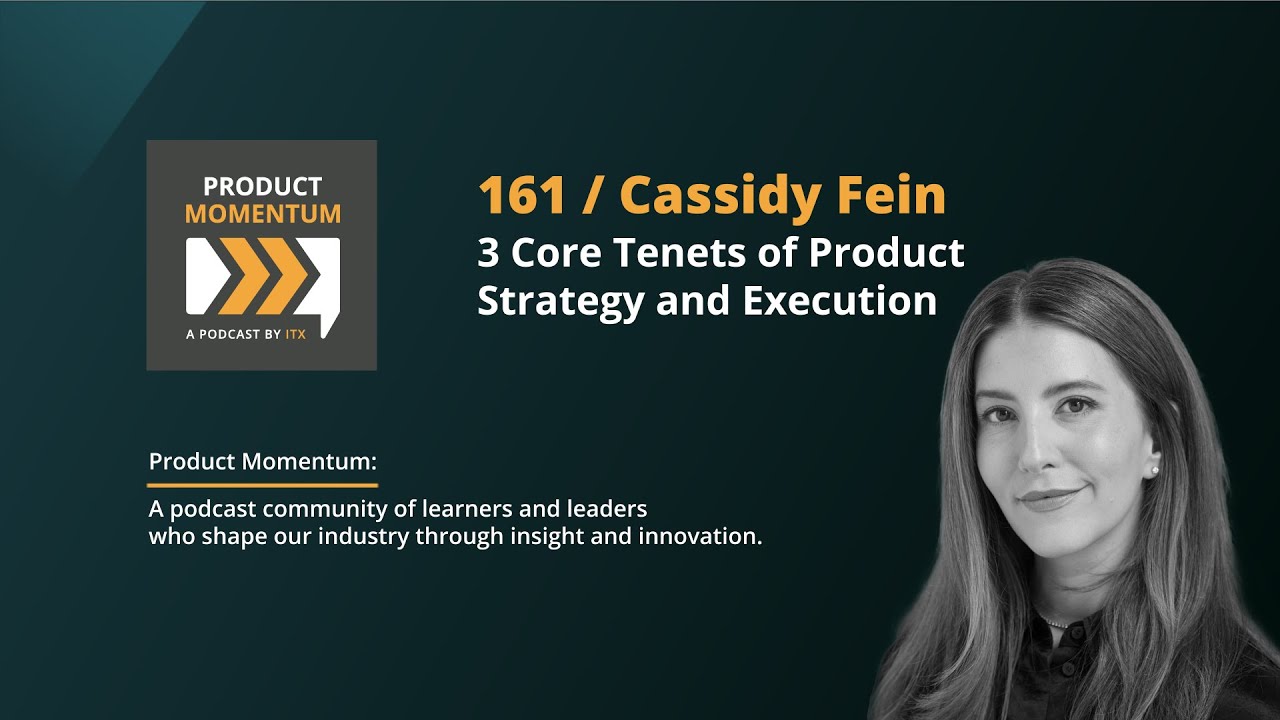
A product leader based in NYC, Cassidy Fein has more than 10 years’ experience driving product innovation, scaling teams, and delivering customer-centric solutions. Currently leading growth for Autopatch within Windows Servicing and Delivery at Microsoft, Cassidy has previously shaped platforms at Pendo.io, enterprise expansion at Vimeo, and student and instructor experiences at Echo360.
With her passion for product management and over 5 years of teaching experience with Mind the Product, Cassidy empowers the next generation of product leaders.
She’s a seasoned speaker, having inspired audiences at events like INDUSTRY, NYPC (New York Product Conference), PMF Zurich, and The Product-Led Summit. You may have also heard her on podcasts like Product Voices and WIN/WIN: Women in Innovation.
Recommended Reading
On Writing: A Memoir of the Craft, by Stephen King.
Good Strategy, Bad Strategy: The difference and why it matters, by Richard Rumelt.
Cassidy Fein is currently leading growth for Autopatch within Windows Servicing and Delivery at Microsoft. Based in NYC, she has over 10 years of experience driving product innovation, scaling teams, and delivering customer-centric solutions. Throughout her career, she’s demonstrated a passion for empowering the next generation of product leaders, especially through her teaching with Mind the Product.
In this episode, Cassidy sits down with Product Momentum co-hosts Sean Murray and Dan Sharp to take a closer look at product strategy – and its execution. Using Nvidia as an example, Cassidy describes how the chip maker applied three core tenets of strategy, as outlined by Richard Rumelt in his book, Good Strategy, Bad Strategy, to become one of the world’s most valuable companies. They are:
First, declare your hypothesis that gets at the root cause of the problem. Next, apply a guiding policy – your overall approach to solving it. Finally, execute a coherent action that not only makes sense to your team, but also aligns with everything your team is driving toward.
Here’s what else you’ll learn from Cassidy:
What Good Strategy Looks Like
Cassidy explores the characteristics of good and bad strategy, and explains how knowing the difference can empower teams. There’re a couple ways to look at this, she says.
“First, a good strategy should be easy to understand,” Cassidy adds. “You shouldn’t have to have a deep, complex understanding of your space and the technology within it to be able to explain it to someone else. A good strategy is also actionable; it includes all the things you and your team are doing to ladder up to fulfill that strategy.”
Creating a Local Strategy
When the overarching company strategy is unclear, teams should work to create their own local strategy.
“I try to empower folks to understand how, by creating a local strategy, they can make their teams understand what it is that they’re trying to accomplish. As long as you’re able to protect your local area, protect your space, and make sure that that it’s cogent,” Cassidy explains, “you’re likely to have better success.”
The Consultant’s Mindset
When product managers adopt a consultative mindset – i.e., understanding their market, competition, and how their products generate revenue – it helps in making strategic decisions that align with business objectives.
“Thinking like a consultant, especially for product managers in a junior position, means being up to date on the competitive analysis of similar products in the market, of your pricing and packaging, and how your sales team is incentivized.”
Usability vs. Business Value
Cassidy addresses the tension between usability and business needs, making clear it’s not an either-or question. A successful product, she says, should meet customer needs while also driving revenue for the business.
“The question of which is more important is a bit of a fallacy,” Cassidy explains. “I don’t think we get to choose between the two. If we’re going after a successful product, we need to find the right balance between the two.”
Continuous Learning and Improvement
Our conversation concludes with Cassidy’s recommendation for resources that product managers can utilize that will enhance their strategic thinking and storytelling skills.
ITX’s Product + Design Conference returns to Rochester, June 25-26. Be sure to stay up to date with all the latest updates on Keynote Day agenda and speakers. Learn more here!
Podcast: Play in new window | Download
Sean Murray [00:00:09] Hey everyone, welcome to Product Momentum. I’m Sean Murray, Director of Product Management here at ITX.
Dan Sharp [00:00:15] And I’m Dan Sharp, a Product Manager at ITX. It’s our privilege to continue the product momentum journey. A platform that celebrates the thinkers and doers who are shaping the future of software development.
Sean Murray [00:00:25] Our goal is to introduce you to industry leaders, innovators, and practitioners, and bring you their insights, advice, and innovations. We talk with experts from product strategy, UX research and design, security, engineering, leadership, and more. We’ll discuss how their approaches to problems help empower teams and build trust. And we’ll explore trends, tools, and techniques that your team can use to deliver the software solutions your users need today. So tune in, stay curious, and join the conversation.
Dan Sharp [00:00:53] You can catch us on your favorite listening platform, or if you prefer the video experience, you can find all our latest episodes on the Product Momentum YouTube channel.
Sean Murray [00:01:01] And if you like what you hear, be sure to subscribe, like, comment, and share. That way, we can be sure to provide you with the best podcast experience.
Sean Murray [00:01:13] Dan, we just got done with Cassidy Fein. An amazing episode all talking about what good strategy looks like and other ways to help your company perform better with better strategy.
Dan Sharp [00:01:24] Yeah, Sean, I had a blast. Obviously loved the strategy conversation. One of my big takeaways was if I’m a product manager, maybe kind of starting my career or working in the local setting and the strategy’s not clear, feeling empowered myself to create a local strategy so that I can better share context and motivate and empower my teams. We also had a great reference in there to product discovery and Captain Cook. So you’ll make sure to give that a listen.
Sean Murray [00:01:50] Empowering teams, explicit and actionable strategy. This is an awesome episode. Let’s do it.
Dan Sharp [00:02:04] Joining us today is Cassidy Fein. Cassidy is a product leader based in New York City. She’s got over a decade of experience driving product innovation, scaling teams, delivering customer-centric solutions. Currently, she’s the principal lead product manager at Microsoft, leading growth for AutoPatch in Windows service and delivery. But before that, she was shaping platforms in teams at Pendo, Vimeo, and Echo360. And there’s more. Cassidy’s passion for product management has led her to numerous teaching and speaking engagements over the past five years, including you’ll have the chance to see her this May in Australia at Leading the Product. So welcome to the pod, Cassidy. Thank you very much.
Cassidy Fein [00:02:42] Thank you. Good, guys. How are you? It’s great to be here.
Cassidy Fein [00:02:46] We’re livin’ the dream. Yeah, we’re pumped to have you on here.
Cassidy Fein [00:02:51] No, excited to be here. I love looking through your previous recordings. It’s just a laundry list of like good product people. Like, yeah, yep, yep. Yep. So happy to be part of that crew. So thank you.
Sean Murray [00:03:03] So I would think I’d jump right in here. Yeah, I know that one of the areas that you really focus on is product strategy. A lot of product folks out there, especially who are early career, right, a lot of the product focus is on implementation execution. You know, so what advice might you have for early career product manager who’s maybe sitting down in a review with their boss and gets the, hey, you know, you’re great at, you know delivering stories, delivering functionality out there. But we would like it to be a bit more strategic. Right? Like how could they grow their career?
Cassidy Fein [00:03:35] Yeah, yeah, I have so many thoughts in this space, and that’s why.
Cassidy Fein [00:03:39] The current talk I’m doing and area I’m focused on addresses this concern. It’s something I see consistently in folks I manage or, you know, colleagues that manage their own folks. And it’s feedback I got myself early on in my career of, hey, you’re doing great. You know, we’re seeing impact on the work you’re delivering. You know we want to get you ready for the next, you know, level up. But we need you to be more strategic. And it’s just one of those pieces of feedback that on the surface feels like it should be super actionable. And like, yeah, totally, I’m going to just go and be more. And then you dig into it and you realize like, what does this actually mean? Like, what am I supposed to be doing that then all sort of adds up to quote unquote, being more strategic? And so the way I kind of break this down in my talk and to other folks is it’s really sort of a two-sided coin. And the first is. Are you doing, are you creating, are you consuming, are you driving good strategy versus bad strategy? Do you know the difference? Kind of what comprises a good strategy versus a bad strategy. And then the second piece of what I’m coining and this may evolve as I get better at sort of pitching it, but Thinking more like a consultant or how you’d be more strategic for your business and really kind of thinking through how your product, how your products, your product line, your company, you know, what sort of role it holds in this space and the competitive space in which it belongs to. You know, very simple questions like how does your company make money? How does your product contribute to your company making money? You know, how is your product then priced, packaged, structured, incentivized to be sold? Um, how are your salespeople telling the story about your product? Not you, not your customers, but how are you salespeople telling that story? And I think just, you know, for better or for worse, you know, I think pre, pre COVID and a bit during COVID, we really went far on one side of the seesaw of kind of customer need and, you know, business value. We would really fall on the customer need side. And I would argue it should never be kind of a one or the other sort of choice. It’s this constant balance you need to strike. And so I think I’m happy to see that there seems to be this push in the industry more broadly towards, hey, let’s better understand the business. Let’s focus on the business value. And I think impact is kind of now becoming more of a spicy word, but how are you driving that concrete impact by way of. You know, dollars, ARR, growth and anything like that. In terms of early stage folks, what they can do, I think the first thing that’s important is to take a step back and understand, am I operating within a space that has a good, clear strategy? So first understanding what good strategy looks like, it should be fairly easy to understand. You should not have to have a complex… Understanding of your space and the technology within it in order to understand your strategy. In fact, most lay people should be able to understand your strategy and is it good? So is it actionable? Are the things that you’re doing and your teams are doing in a day-to-day basis adding up and laddering up to that strategy? I think the real answer for a lot of folks may be, no, I’m operating within a vacuum. I don’t really know why I’m doing what I’m doing. We have nine different strategies. Our strategy is to make more money. Our strategy to be the best blank, which is, you know, my favorite now these days is like the AI for blank or the open AI for blank. It’s like, well, sure. Like, you open AI, it’s one of the most successful private companies to date. What does that actually mean? And in that case, you find yourself in a really challenging situation, right? Cause you’re probably too junior to be able to kind of push up the stack and say, Hey, our strategy sucks. Let’s get a good one. Um, by the way, here’s what good looks like. So I am try to empower folks to better understand how can they, you know, create almost what I’m calling a local strategy. So how could you at least ensure that your teams or, you know, your partners, if you’re an IC, so you’re, you’re a developer and you’re designer understand. When it is that you’re trying to accomplish and how. And as long as you’re able to sort of protect your local area, protect your space and make sure that that is cogent, then you’re probably gonna have a better time than trying to kind of rage against the machine, if you will. And I think that second piece of thinking more like a consultant, it is a lot more actionable ideally if you are in that junior position. You should be up to date on the current competitive analysis of your market of similar products in the market, of your pricing and packaging and how your sales team is incentivized. And if not, there are a bunch of different sort of strategies or processes, if you will, that I can recommend that you go and educate yourself on those things. At the end of the day, again, if you don’t intimately know the stories that your sales teams are telling prospects and customers about your product or your product line. You’re not going to be able to drive that successful impact.
Dan Sharp [00:09:08] Yeah, that’s awesome. I know, I’ve sat in a chair where, I haven’t gotten so much like be more strategic, but I’ve gotten, can you be more decisive? I’m like, I don’t think that means what you think it means. Yeah, yeah. Yeah, I love the idea of making sure that you’re aware of what’s going on like from the business goal standpoint and being able to drive like context to the teams, even if it’s in the local area and that local domain. Yeah, talking about business value. What advice might you offer for a product leader, product manager who is working on solution space with a design team, and being able to kind of tactfully manage that, you know, that tension that exists between mitigating usability risk, making sure the solution is going to be good for clients and the end user, but also that is actually going to drive revenue for the business.
Cassidy Fein [00:10:00] Yeah, I actually, you know, not to actually your question, but I see that question as a bit of a fallacy. I don’t think, again, you need to kind of choose between the two. Like, I think if you are going after a successful, you know, product idea or well vetted sort of space, then again, it is this this balance, you should be able to have a line of sight to how you make money and how that money will grow over time. In addition to how you’re solving a real problem for customers, but it needs to be, you know, customers are going to have infinite problems, some of which are not solvable by your team, some of your team doesn’t want to solve. I constantly go back to, I think, you know, Marvin Cadian’s sort of four tenets, and his four big risks, I think is what he called them, of understanding value, business viability, feasibility, and usability. Um, you need to do that legwork and understand those things and how they kind of tie into one another, because if you’re just solving a problem, because you as the PM think it’s interesting and the dev team is kind of excited to, you know, create some new tech around it and, you know, Laudita Bob’s your uncle. And now you have this thing where you’ve built it and you hope people will come and use it, but they’re not going to. Because you didn’t think through cogs, and now it’s so expensive to run that you actually can’t sell it, or you literally can’t run it effectively in the scenarios that your customers want to be able to use it. So I guess my answer to your question is, I think it’s by following the normal sort of product development processes and sussing out these things early on through customer conversations, through an inherent understanding of your sales. Motions and pricing of packaging and, you know, working with your dev and design partners, especially in the dev side, to understand kind of bugs and other relative costs incurred and, the viability of what you want to make. All of those things need to kind of work together in some sort of weird jumbo Frankenstein yin-yang in order for you to have a successful kind of end product. You’re going to have bad time if you’re trying to sort of use one over the other, If that makes sense.
Sean Murray [00:12:16] I want to dive into, you mentioned something there about, you know, you just don’t want to build something for the sake of building something because you think it’s cool, right? Yeah. How do we balance creativity with adhering to the strategy or plan, right. I’ve latched onto a phrase recently, the map is not the territory, where, you know, just because it’s not on the map doesn’t mean that what’s in front of you isn’t there. How do we balance we want you to? We want you to think creatively, we want you to do new things, we want you find things that are going to help us, but still follow some form of cohesive strategy.
Cassidy Fein [00:12:53] Yeah, it’s a fair question. In my mind, it goes back to do you have a healthy discovery process? So that creativity should be fostered and fed as part of that discovery process. And generally through, I’d say again, the product development life cycle, like you’re going to find things that aren’t on your map, right? Like you’re gonna kind of reach new territories. I joke with my husband, he’s reading some classic dad literature right now of like, you know, John Cook exploring, you know, seven cities and whatever, and is telling me the other day, they’re traveling from Australia, I think, back to the States, and they just stumbled upon Hawaii. And they were like, wow, this is pretty sweet. We didn’t even think this would happen here. You want to leave room for your Hawaii, right? And I think that that happens as part of a natural, healthy discovery process, as well as just being open to any new signals or unknown unknowns that you’re going to naturally run into as part the product development lifecycle. That being said, I would argue it’s not really creativity so much as just sort of. Meandering if you don’t have that clear strategy, or if you’re like, well, let’s kind of dig into this area, you know, which I don’t know if it has a clear end, you know, result of solving a customer’s problem in a way that’s viable for our business. Like, I think some of that exploration is appropriate as part of discovery, but at a certain point, you got to kind of like throw down the towel. And I think that’s where there should be room for teams for things like We at Microsoft have FixHack Learn, we have kind of other open sort of room for side projects. But if you’re going down these kind of paths of exploration and you’re not getting anything back, at a certain point, you’re gonna kind of cut tail and keep exploring other areas that are returning on that investment and driving you towards that broader strategy.
Dan Sharp [00:14:44] Yeah, I like the Captain Cook analogy too, from a product discovery standpoint, right? Because Captain Cook wasn’t planning on going to Hawaii and he never left Hawaii. Why would he? Yeah, so there’s something to be said about discovery in there.
Sean Murray [00:15:00] So when you mentioned product discovery, I don’t know if you saw Dan’s immediate reaction. Dan is like our internal champion of product discovery at ITX.
Cassidy Fein [00:15:07] There we go, Dan.
Sean Murray [00:15:08] You immediately made his day his day is made that’s value really in the day on the east coast So Dan’s gonna have a great rest of the day also when you’re mentioning meandering It’s kind of like change for the sake of change and it makes me think of like Barbarians at the Gate and Ross Johnson the the CEO that they follow through that whole thing who was just known for Let’s just go do this crazy thing You mentioned earlier an important thing to do with your teams is empowering them to create their own local strategy, right? Have an overarching strategy to work with. So we are going to operate. We wanna make sure that we’re operating the best that we can with what we know now. How do you exactly empower teams to do that? What’s the direction that you give them?
Cassidy Fein [00:15:50] Yeah, so I want to, I guess, adjust out of that. I push on teams to drive a kind of local strategy when the global strategy is not clear, or if the global is not particularly actionable in terms of how they themselves can drive a concrete value. I think if you have that kind of healthy, broader strategy, it almost becomes duplicative or an unnecessary additional effort to try to kind of create a secondary strategy if your primary strategy is already like, Yeah, I know this makes sense, I can ladder up to this. In that scenario where you don’t have that clear global strategy or, you know, let’s say you’re a internal tools team and you know you just need something a little more of a translation layer for your team in order to better understand how the work that they are doing is driving real concrete value both for your business and for your customer. You know that’s where I’ll work with these teams to make sure that they’re clear on those things and that they were clear on why what they’re doing is laddering up to it. I think in terms of. Actual creation, it just goes back to the tenets of good product strategy. Is it explicit? Is it easily understood from a layman’s terms? And is it clearly actionable? So we’ll go through the tenet of good strategy, which I regularly reference. Richard Rumelt’s Good Strategy, Bad Strategy. It’s still baffling to me how many folks haven’t read it or aren’t aware of his work. And it’s just irreplaceable to at least my work. But what he talked about is first, I think, separating this idea that strategy is this magical, mystical thing that always has to come from top down. And that is this weird amalgamation of your mission and vision and roadmap and OKRs and operational effectiveness. So like being agile is your strategy. Like my favorite is kind of someone complaining like, well, my CEO had some shower thought this morning and they came to my team and said that this was our new strategy. None of those things are strategy. All of those are separate. A good strategy needs to have these three core tenets. He breaks them down. First of having a diagnosis, so a hypothesis of what is causing your situation, the situation being the thing that you’re trying to resolve. The second being a guiding policy, so an overall approach of how you resolve that diagnosis. And then the three is a coherent action. Coherent meaning that it makes sense and it is also everything that all of your teams are kind of driving towards. So how that guiding policy is going to be carried out. And the example I always kind of like to go back to, especially, well, interesting kind of market performance has been a little bit more volatile these days, but Nvidia and Jensen Wong, I think has an excellent kind of strategy that they’ve maintained pretty consistently. Their diagnosis was something along the lines of, you know, when they first launched. You know, they were a fledgling chip company. They were not performing well against the competition and they realized something needed to change. So their diagnosis was effectively, we are losing the performance race in 3D graphics chips and we’re losing it specifically to this competitor. And I believe the competitor was 3DFX Interactive. From there, they had a cogent guiding policy which was to release a faster, better chip. Three times faster than the industry norm. They kind of understood the levers they could pull. And at the time, the industry, the norm, I believe for new chips was 18 months or so. And it’s because the technology that required utilizing those chips wasn’t transforming, you know, kind of frequently enough to warrant needing newer chips. Nvidia launched at a time where that assumption was no longer true. And so they came in and realized that if they could provide better chips at a quicker pace, at a faster cadence, They could then offer their customers more value and they themselves could also realize that value that their customers are realizing. So by realizing this, they then wanted to create some coherent actions to then make this happen. They broke out their dev teams and kind of form separate teams working in overlapping schedules in order to accomplish the sort of six month cadence of release rather than the broader 18 month cadence. They put their money where their mouth is, they built new facilities so they can avoid those delays and can chip in software driver creation that they were experiencing previously. And then they wanted to control more of the tip to tail of the actual supply chain. So they regained control of some driver development from some of those kind of branded add-in board makers that they we’re utilizing before. And all of this has just compounded year over year and year over and year and allowed them to be the successful company that they are today. And notice that none of us have, well, maybe I’m speaking for you, Sean or Dan, but. I don’t have experience in creating 3D graphics chips, but I completely understand and agree with what this strategy is that Jensen has laid out. And it’s clear to me, if I were working in Nvidia, what I would need to do in order to collaborate with other teams and drive value as part of this diagnosis and guiding policy. And I kind of like to point back to something that he said that I think is just brilliant. Strategy isn’t what I say, it’s what my employees do. And that really is, I’d say one of the biggest key tenets of a good strategy is it needs to be clear what you need to do and you feel empowered and have the appropriate sort of things around you to just go do it. The other piece I kind of love on this strategy is I feel like so many times CEOs will come out with this bizarre giant, you know, sort of weird amalgamations of strategies of we’ll be the best blank or the AI for blank or whatever. And then it’s like, oh, by the way, go do more with less. It’s like no, you’re going to probably need to make major structural changes, either in your staffing, in your processes, in both. If you are going to adopt a largely new strategy based on a dark horse event or based on the major evolution of technology or of the competitive space or something else. I think it’s so interesting. We’re living in a time where pretty much the entire industry is turning over. Because of the advent of AI and what that means in so many different corners of technology and all those different spaces and health tech. And we work with companies that run managed software for mining rigs. So harvesting oil, everything is changing because of AI. And so you do see these interesting sort of reboots of strategy that sometimes make a lot of sense and sometimes they don’t.
Sean Murray [00:22:21] One of the keys to a good strategy is to have the strategy should be a framework for how you’re going to achieve like business goals or business objectives.
Cassidy Fein [00:22:30] That’s correct.
Sean Murray [00:22:30] What we see a lot with our clients is that the product teams for our clients are being asked for strategy, but there are no goals that they’re supporting, or the goals are kind of nebulous. What strategy for, well first, sometimes those goals do exist, but they’re on a PowerPoint slide that we haven’t been exposed to, so a lot of times goals are communicated up, but somehow they don’t make it down, so sometimes they’re in a drawer if you ask for them. So strategy one might just be ask for the them, but what are some strategies for the extracting. As you are now in the senior leadership role, what are some goals for extracting, for like the people on teams who are being asked to be more strategic, for actually going out and how do I get those objectives out of my leadership team if I haven’t gotten them yet?
Cassidy Fein [00:23:13] Great, yeah. So, you know, I think what’s most important is first to just understand if your leadership is operating within reality. If your executive team is being open and honest about what is working well in the business and what is not working well, then you’re more likely to have a strategy that is realistic and rooted in reality. If your executive team is not being frank about. You know, previous investments that may not have performed as well, or, you know they have some half baked AI idea that they want to kind of shove into some other products. And by the way, that’s your responsibility now go do it. You’re gonna have that time. And so I’ll come in, obviously, with my own biases, my own assumptions. I’m a human being, we all have them. But really just trying to see if execs will pass the smell test of yes, I love my products, I also understand what is working out well and what isn’t. The second is, I think, revisiting those truths or assumptions that we hold to be self-evident. And so, in my previous NVIDIA example, I talk about how NVIDIA was able to capitalize on this market where its competitors weren’t because they did not revisit the assumption that there is no inherent value in creating chips more frequently than every 18 months. But the technology had changed so much, just like it is for us at AI basically every day, that they were able to take advantage of that. And so it’s always worthwhile to revisit the assumptions upon which you’ve based your previous strategies or current strategies and make sure that those are still true. What I mentioned in my talk is something that some guy called Jeff Bezos said, where It’s not necessarily thinking through what you think may change over time, but what you know inherently will always be true. He mentioned this and the importance of safeguarding certain tenants of Amazon services. Customers will never want to pay more for the same thing. Customers would never want the same things slower, unless obviously they’re given something else in return. I think now you can choose slower shipping in order for like prime credit or something. I use it for. You know, episodes of Bluey for my daughter. But like, these are tenants of things of customers that are immovable, they will always be true. And so you can always build a successful strategy around those things. Those are really kind of some of the things I focus on with executives, if we’re in a place where you’re gonna have to shake that strategy out of them a little bit.
Dan Sharp [00:25:57] Yeah, love that. Want to shift gears a little bit. A lot, I feel like a lot of the stuff out there is always focused on product management where you’re building apps, pixels that I use you’re seeing. Yeah, and you’re in that spot where you are really focusing on infrastructure. I’m curious, what lessons have you learned in product and the other enterprise infrastructure space? Maybe things that surprised you or that you’d want to share.
Cassidy Fein [00:26:22] Yeah, um, what surprised me? I think what has surprised me is how sometimes emotional the connection is that users have to their enterprise software. And I’ll explain that a little bit further. I think folks make the broad assumption that enterprise software is boring and ugly and stodgy and behind the times and in reality. I love enterprise. I’m obsessed with the enterprise. My entire career for the most part has been B2B enterprise SaaS. And with a few kind of, you know, explorations here and there of B2C consumer, turns out I hate advertising as a primary model of revenue, so I’m not interested in that anymore. You know, platform, turns out B2c platform is just really, you now again, challenging in general. B2 C just doesn’t give me the same level of satisfaction that you get in being able to call up a customer and say, hey. I see you’re having problems. Is this working for you? It is not working. What’s going on? And so I guess what has surprised me about that is how baked into certain users kind of workflows these systems can really become. And because some of these systems, you know, changed over every day, every week, sometimes every year, they become really entrenched and in some ways, honestly, becomes part of their identity. It’s how they do their work. Is how they are successful in their work. And I always bring that understanding with me when I’m speaking with customers, because it is, first of all, always such an amazing experience getting to speak with customers. Especially customers that have such a passion about your products and have such an intimate knowledge of your products. But also coming with, not phrasing it the right way, but a humbleness of… You know, understanding of, I’m just a PM coming in with a few years of experience in this space, and you’ve spent, you know decades, literally utilizing these tools, in some cases, to help, you know yourself and your organization and your customers be successful. So I think what’s surprised to me is kind of the the genuine emotional connection to some of these tools when folks kind of come in from the B2C side of this assumption of like, ah, it’s this ugly interface, you kind of click around on and get shit done, and then he got home. That’s really not the case for so many folks. So I think that that’s what surprised me the most in a pleasant way, yes.
Sean Murray [00:28:49] Thank you so much for joining us today. This has been really great. I’ve really enjoyed our conversation today. You are speaking at Leading the Product coming up this May. Do you want to tell us anything about that conference and what you’re going to be talking about?
Cassidy Fein [00:29:03] I am, I would love that. I’ll be speaking more about product strategy, what good strategy looks like, how to transform bad strategies, that’s what you’re working with. And most importantly, the second kind of piece of that tenant of how to be more strategic within your product practice from the business perspective. So how to make sure you as a PM are driving more business impact and are what I like to call thinking as a consultant. So really seeing the whole board and kind of. You know, thinking through everything that you need to understand as a PM from your business perspective. I’ll be speaking at the SIDD location on May 16th and the Melbourne location on May 23rd. And we’d love to see y’all there.
Sean Murray [00:29:42] Great opportunity to see Cassidy, learn, and then maybe you can tell from my rugby jersey in the back, go catch a game on the weekend, right? Great opportunity. So I had some takeaways. I’m the scribe of the takeaways, which is ironic because I broke every finger in this hand playing that game. But I had, I had some takeaways that I really liked. So one was know what good strategy look like, what good strategies looks like. It needs to be explicit and it needs to actionable. Two was to empower your team to contribute to local strategy. Uh, three, knowing how your company makes money, right? And also how, how does it package and price its products? Right. And then that kind of ties into number four, which was making sure that you have a connection with sales and understand like how are, how is what you’re building going to contribute to that packaging and pricing strategy. We actually had a guest on a few podcasts ago, James Whitman, who wrote a book called launch code and the title of that podcast, I tried to get it changed to go have a sales, uh, go have beer with sales. And that James also said that normally sales will expense it. So there’s an opportunity there, how to connect with sales. Say like, Hey, do you want to go get a beer? And then you also recommended a book, good strategy, bad strategy. And then lastly, I, we noted that I have a skillset gap in creating 3d graphic chips. So, uh, something for me to, you know, to use AI to read up on over the
Cassidy Fein [00:31:02] It’s something for all of us to get better at first.
Sean Murray [00:31:04] Right. And I feel like it could be a valuable skill down the road. Thank you so much for joining us today. We had an awesome time. Dan’s got one last question and then we’re out.
Dan Sharp [00:31:13] So yeah, we talk about good strategy, bad strategy, biographies of Captain Cook. But yeah, curious, what’s on your reading list?
Cassidy Fein [00:31:21] What is on my reading list? So I actually recommend to a lot of, to folks I coach, I coach part-time for select clients. If you’re interested, you can reach out at costofine.com. But some of the things I recommend, my background is actually in film, in development and screenwriting. And so I’m all about honing your craft as a storyteller. It’s a tool that will always give you like wild dividends throughout your career. And some of the books I recommend are things as simple as On Writing, from Stephen King and Save the Cat, by Blake Snyder, which is effectively how to create sellable and also good screenplays. And so I’m rereading Save the cat, just making sure my own advice is still good advice and turns out it’s still a great book. So that’s what I’m reading.
Sean Murray [00:32:05] Thank you again for your time today. Have a great time in Australia.
Cassidy Fein [00:32:09] Thank you. Thanks, Sean. Thanks, Dan. Really enjoyed the time today.