Listen
Podcast: Play in new window | Download
About


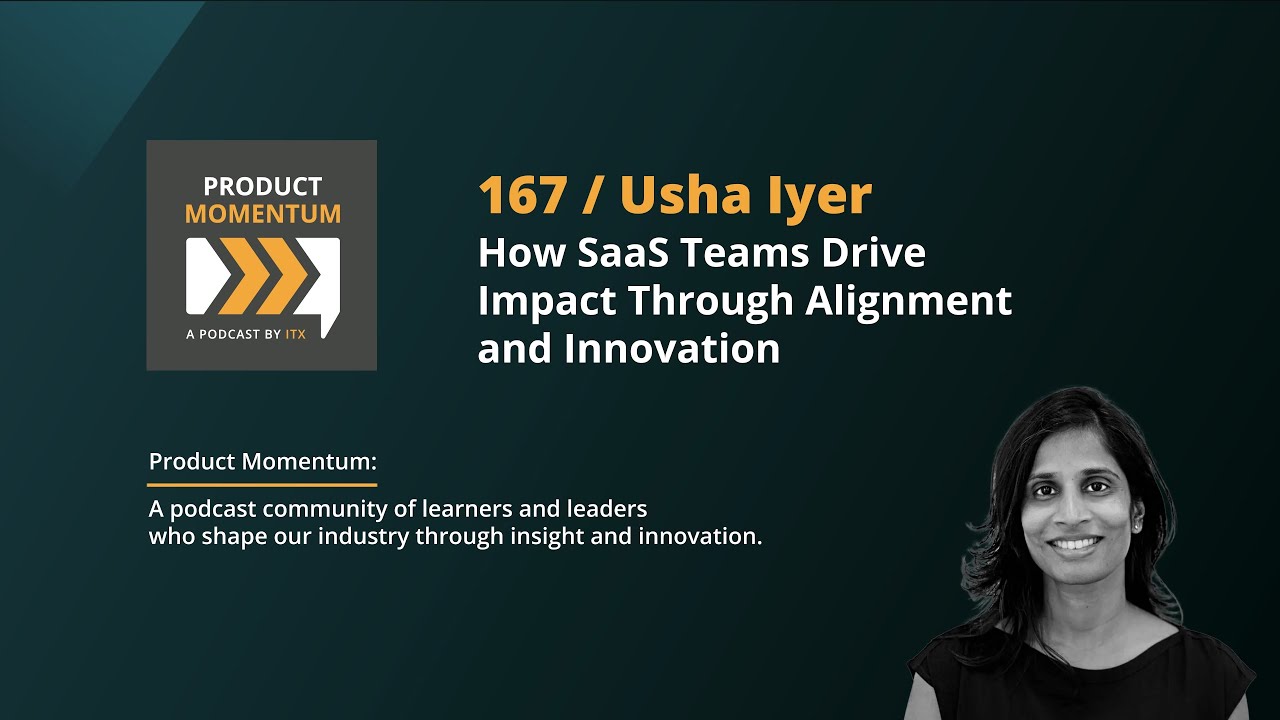
Usha Iyer is Hivebrite’s Chief Customer and Growth Officer, leading go-to-market, customer success, and revenue strategy for a global SaaS platform powering over a thousand online communities. Starting as a coder and product manager, she transitioned to growth and revenue leadership, bringing a product mindset to the customer journey. Usha connects user needs with product teams, driving business outcomes through early experimentation and clear, useful feature design.
Usha Iyer is Hivebrite’s Chief Customer and Growth Officer, leading the community engagement platform’s go-to-market customer success and revenue strategy. On June 26, her opening presentation kicked off Keynote Day at ITX’s Product + Design Conference. Right after she exited the stage, Usha joined Sean Murray and Dan Sharp for this episode of Product Momentum, recorded in front of a live conference audience.
Our conversation with Usha follows the customer journey, meeting at the intersection of product management, business growth, and customer success. And it covers key themes like connecting product work to business outcomes, the Bow Tie Model for customer journey alignment, and AI’s role in optimizing business processes. At the close of the conversation, Usha offers practical advice for product teams on engagement and roadmap management.
Here’s what we learned:
Product’s Connection with Business Impact
SaaS product teams need to focus on the outcomes of product work that drive real business impact. Even small, seemingly minor changes to your product can significantly affect engagement and business metrics.
“Oftentimes, you’ll find as a product person that the smallest, most inconsequential feature that you develop actually has the biggest impact,” Usha says. “The least amount of effort sometimes gives you the biggest satisfaction…. So it’s important to connect the dots and go from what you’re doing day to day, the output to the outcomes.”
Aligning with Go-To-Market Stakeholders
To deepen (even expand) business acumen, Usha recommends that product teams collaborate with their counterparts in the go-to-market organization.
“Learn to align with your marketing team, your sales teams, your customer success teams,” she advises. “Ask to join discovery calls with prospects, or do a ride-along with a sales rep to gain direct market insights.” Engagement fosters empathy, strengthens business alignment, and deepens understanding of customer needs and industry dynamics.
The Bow Tie Model
Usha introduces the Bow Tie Model as a framework that coordinates product, marketing, sales, and customer success around shared business goals. In addition, she emphasizes leadership alignment on key metrics like GRR, NRR, and ARR to create feedback loops that enhance the customer journey and drive sustainable growth.
“It boils down to leadership at the go-to-market level and the product level,” she adds. “We’re all working toward company success, so if we can internalize that and build it into the culture of the organization – including your product and engineering activities – it becomes a flywheel.”
Growth Drivers in SaaS Companies
As Usha points out, SaaS companies’ main growth drivers are retention, expansion, and new business; but then she introduces a fourth: efficiency.
“Investors are getting a lot more stringent about where they put their money,” she continues. “Whereas top line metrics drive revenue metrics, which drive your presence in the market, efficiency drives your residence in the market.”
AI-Assisted Organizational Buy-in
To gain organizational buy-in for adopting frameworks like the Bow Tie, Usha suggests leveraging AI to connect diverse data sources – such as sales conversations, marketing signals, and product usage – to generate actionable insights. AI tools accelerate the process by automating tasks like generating QBRs and providing sales teams with tailored pitches.
“The answer lies in being able to take your product metrics and align it to the company metrics,” Usha says. “That’s really where it starts. That’s how we drive change management. And AI can play a big part: you can take any metric and connect the dots with another metric pretty easily with AI.”
Unable to attend ITX’s 2025 Product + Design Conference? Explore the highlights.
Podcast: Play in new window | Download
Episode 167 – Usha Iyer
Sean Murray [00:00:09] Hey everyone, welcome to Product Momentum. I’m Sean Murray, Director of Product Management here at ITX.
Dan Sharp [00:00:14] And I’m Dan Sharp, a product manager at ITX. It’s our privilege to continue the product momentum journey. A platform that celebrates the thinkers and doers who are shaping the future of software development.
Sean Murray [00:00:25] Our goal is to introduce you to industry leaders, innovators, and practitioners, and bring you their insights, advice, and innovations. We talk with experts from product strategy, UX research and design, security, engineering, leadership, and more. We’ll discuss how their approaches to problems help empower teams and build trust. And we’ll explore trends, tools, and techniques that your team can use to deliver the software solutions your users need today. So tune in, stay curious, and join the conversation.
Dan Sharp [00:00:53] You can catch us on your favorite listening platform, or if you prefer the video experience, you can find all our latest episodes on the Product Momentum YouTube channel.
Sean Murray [00:01:01] And if you like what you hear, be sure to subscribe, like, comment, and share. That way, we can be sure to provide you with the best podcast experience.
Sean Murray [00:01:14] Dan, we just recorded an amazing live episode with Usha Iyer. She was amazing. She brings really great insights from a different part of the business than we normally get to talk to. What’d you think?
Dan Sharp [00:01:27] I feel like my business acumen just leveled up like 30 points in that half hour. I had some great questions from the audience. I personally love talking about the impact, the continuity in the journey between acquisition of new business to sustaining and growing that business. Just a ton of good stuff there.
Sean Murray [00:01:45] She’s amazing, this episode’s amazing. Let’s get after it.
Sean Murray [00:01:58] We are here with Hivebrite’s Chief Customer and Growth Officer, Usha Iyer. Uh, she is a leader in go-to-market customer success and revenue strategy, but she also started as a coder and a product manager. So you are one of us. Welcome.
Usha Iyer [00:02:15] I feel so welcome.
Sean Murray [00:02:17] Welcome back into the fold.
Usha Iyer [00:02:18] Please, quarter ends. I’m really happy to be here.
Sean Murray [00:02:22] Great to have you, right? This is when we should get everybody on the podcast at quarter end, because they really would rather be here than dealing with that. We are live at the ITX Product + Design Conference in Rochester, New York. And you just are fresh off the stage from giving an amazing opening keynote. Uh, thank you so much for being our opening speaker. Your talk felt more like an MBA class than a keynote. So thank you. All of you enjoy your new degree that you got from, uh, from Usha today. There’s a real big theme that I’m seeing in the conference scene and in the podcast scene over the last year where we are really trying to get a deep understanding of product’s connection to the business. Why has this trend become so prevalent over the past year?
Usha Iyer [00:03:06] Yeah, I think the SaaS industry has evolved, right? So ultimately, what you do in product has to translate to business impact. And that’s what drives sustainable growth. And that is why the connection between product and business becomes that much more important.
Sean Murray [00:03:22] We sometimes get so wrapped up in the delivery aspect of product management that we forget like we’re in a capitalist market, we’ve got to make some money here. And those are really hard discussions to have. How can product really help move that needle between really like the delivery of what we’ve gotta focus on and like the day to day to the bigger picture that we need to provide as a business.
Usha Iyer [00:03:46] There’s many ways to do it, but I would just say this. Oftentimes, you’ll find as a product person that the smallest, most inconsequential feature that you develop actually has the biggest impact, okay? The least amount of effort sometimes gives you the biggest satisfaction of what you do. So it’s really important to connect the dots and go from what you’re doing day to day, the output to the outcomes. And these are like Jordan that you hear everywhere, but it’s true when you really take that as a manifesto and go and adopt that in what you’re doing on a daily basis, you’ll see like you can get so much more done with so little work. That’s a motivation if not anything else, right? To be able to really connect the dots and get ahead of the work and really start thinking about what is the impact of the world.
Sean Murray [00:04:34] You have a good example of like a small change that had a really big impact that maybe people didn’t understand that impact going into actually the release of that feature.
Usha Iyer [00:04:43] I mean, there’s a lot that come to mind, but very recently we made a very small tweak to watch shows on the home screen of our mobile app, and we saw adoption go up by 20%. That information was a piece of information that was appearing when you scroll further down on the page, but then when we brought it right up front, we saw that people stayed on the app and came back and re-logged in multiple times. I mean, little tweaks, that’s a design tweak, obviously, of where you present the information and what is the user looking for. But there’s so many things like that in our daily life that I see where the usage is directly correlated to just how you present that information, how you think about the customer experience, how you put yourself in the shoes of the customer.
Dan Sharp [00:05:31] I love that, you know, talking about, you mentioned the idea of product teams walking the store. Um, yeah, how, what advice do you have for product teams and just becoming more engaged in what’s happening at the business level and being able to separate from that day to day delivering features mindset.
Usha Iyer [00:05:49] I mean, it helps, first of all, for you to just do something different from being stuck in the daily grind, right? That’s inspiration in itself. You get out, you go and see, I mean with AI these days, you can see so much of what’s happening in your product funnel, in your sales funnel. You can see the types of organizations that are trying to do business with you. Go and pick any one of those organizations and go and talk to your sales rep and say, hey, can you bring me into the next discovery call that you’re going to have with this prospect? 30 minutes of your time. I guarantee you will be worth hours and hours of requirements gathering from the field. Just put yourself out of the comfort zone, put yourself in the shoes, walk in the shoes of your counterparts in the go-to-market organization, and you could learn a ton more just from absorbing that versus trying to study it offline.
Sean Murray [00:06:38] That’s awesome. Our, uh, one of my favorite podcast guests was James, uh James Whitman. And he said, uh one of the easiest things to do to gain a pulse of the business was go have a beer with sales. Right. One, uh. One, you’ll get valuable insights from them and they’ll tell you what they think can move the needle and market, but also they can probably expense it.
Usha Iyer [00:06:56] That’s a good one.
Sean Murray [00:06:57] Say you’re a little runny and you’re happy, or…
Usha Iyer [00:06:59] Although a lot of stuff happens virtually these days, yeah, for sure.
Dan Sharp [00:07:03] I want to talk a little bit about the bow tie model, right? You’re talking about how the world’s changing, right. Client acquisition through client success is really being considered more of a journey now. Yeah, I’ve seen in my experience, right, you have sales teams that have a certain motivation, you have service teams that have a similar but different motivation. How as product teams in the middle, can we kind of balance those tensions and help make sure that that journey from qualified lead to… Yeah, expanded client are good.
Usha Iyer [00:07:35] We talked about the bowtie a lot because the bow tie is essentially meant to bring more of that end-to-end seamless journey for the customer. If you put yourself in the shoes of the customer and then you use that as a learning to align your marketing teams, your sales teams, your customer success teams, then it automatically translates into less friction when you’re working internally within your product, with your product and engineering teams. So it actually boils down to leadership at the go-to-market level and the product level really aligning and understanding that we’re all working towards the common set of goals. We are all working towards company success, that GRR, that NRR, that ARR metric that we are all looking to achieve to drive outcomes for the business. So if we can internalize that, build that into the culture of the organization, set up an end-to end journey model using a bowtie or whatever other framework suits you, and then align your product and engineering activities. To those stages in the bowtie, it just starts to become a flywheel. And these little feedback loops start to kick in and become larger and larger and bring that seamless aspect to the entire journey.
Sean Murray [00:08:47] We have, uh, we were saying that we’ve adopted ITX because we teach a lot of models and the bow tie is another awesome model to have in your tool set. That all models are wrong, but some models are useful.
Usha Iyer [00:08:57] Yeah, absolutely.
Sean Murray [00:08:57] Right. And so I love having a new model to work with. Dan and I do this a lot, the podcast thing. But one of the great things about being live is that we get to take questions from the audience. So we’ve got a cool tool up here. We’ve got some questions queued up. Dan, do you want to go with the first one? First one that you see?
Dan Sharp [00:09:16] So, all right, this one says love the keynote, love the bow tie. If you had to make choices on where to focus in the bowtie, you’d have resource constraints, right? Cause finite resources, where’d you start?
Usha Iyer [00:09:27] I would say focus on implementation, because that’s when the customer has signed that piece of paper. They’re ready to start using your product, but as we all know, implementation cycles tend to take longer than what was originally anticipated. There’s always surprises, and if product can play a role, it’s in really accelerating that first time to value in the implementation process. I would start there, and you would learn so much from that that you can bring back best practices. Back into the acquisition cycle as well as in the customer success cycle just through the learnings that you get in implementation.
Dan Sharp [00:10:00] I love that. Like the first time you’re using your product. Like that’s your true first impression.
Usha Iyer [00:10:04] They’re experiencing it, they’re touching it, they’re feeling it and they’re configuring it and that’s the time when you want to make that journey as quick as possible.
Dan Sharp [00:10:12] Votes keep coming in, the top ranking keeps changing. I like it. So here’s another good one, right? Bow tie model is newer. How can we get buy-in from the organization to adopt this framework? And how can we potentially use AI to streamline that model?
Usha Iyer [00:10:33] Two different questions. Yeah, the first, I think it all depends, like I said, on how well your leadership can align on a common set of metrics. Every company has growth metrics. The answer really lies in being able to take the product metrics and align it to the company metrics. The minute it can do that, I think then the rest is easy, right? That’s really where it starts. That’s how we drive change management. And AI plays a big part, because like I’ve said in my talk, You can take any metric. And really connect the dots with another metric pretty easily with AI. The number of leads that are coming in through the door will inform you on how much business you can generate from those leads pretty quickly these days. The time to really deduce those type of conclusions has really gone down. So you’re able to, in real time, understand is the bow tie set up in a way where it is gonna lead you to the outcomes you’re looking for or not. You can use AI in many different ways. We also use AI and our company to generate scripts for our sellers to be able to pitch and deliver the right messages based on the right prospects. You can use AI to inform customers on what they should be doing in their usage of the product to use more, get more out of it. You can use AI to really drive end user usage. There’s a lot of different ways that you can insert AI into that customer experience as well as into your go-to-market operation.
Sean Murray [00:11:59] I love starting with the foundation of the metrics that you’ve defined, right? I think success metrics are the best way to kind of transition from, I feel like an order taker, I’ve been told to go do this, here’s the project, go execute, right, go break this work down and do the agile thing, right. Now, if, if you want to move out of that, that order taking mindset, now it’s like, all right, is what you’ve asked me to do valuable, what are the, What are the signals? What are the goals, what are the signals that we think we can see from our users? And do we have metrics that could support tracking, tracking that progress towards goals? Um, I just, I think that it’s a little bit of a lost art and there is a really big opportunity if you’re trying to make a jump in your career, really understanding success metrics. So having that as the basis for the bow tie is awesome.
Usha Iyer [00:12:51] Yeah, that’s great. What other frameworks do you guys use at ITX?
Sean Murray [00:12:55] I teach something called The Vision Stack, which is pretty fun. It’s a good way to understand like, Hey, you have high level business goals. How do you connect your high level of business goals all the way down to the projects that you’re executing on a daily basis, right? Everybody here in this room works with somebody or is somebody that works in a cubicle that is like writing code, testing code, writing requirements, right, managing things through a backlog, right. Or designing, right or, or coming up with the designs that the product is going to use to write the requirements, Ultimately, if you are in that space, a way for you to feel valuable and validate and that your work is valuable and that your effort is validated, is by knowing, like, how am I helping to push the business forward, right? So that’s one that we use. And then if you get the opportunity to talk with Sean Flaherty today, he’s got about a million models that he can work with, so he is the big model guy. But Vision Sack is one that we. Have been working a lot to instill with our clients. Where it’s like, even if you start at the roadmap level where you’ve got, I’ve got this mixture of initiatives and capabilities, but also projects and business cases that we need to justify. How do we get those delivery aspects out of our roadmap and make our roadmap more of a strategic document than a delivery document? If you can start there, then maybe you can reverse engineer that into strategy and into goals. And if that doesn’t work out, okay, we change our goals. And then our strategy can change and then roadmap can change in kind.
Usha Iyer [00:14:21] Yeah, what you’re saying makes a lot of sense as you’re doing long-term planning and long- term goal setting as well. And in the short term, oftentimes it helps to take metrics like that. Like for example, usage of the product and translate it into one of those three buckets that we talked about this morning, the three main buckets of growth for a SaaS company are retention, expansion, and new business. Does increasing product usage increase retention or does it increase expansion? You could be then building the product in very different ways to achieve those outcomes. If you’re looking to drive more retention, you’re not gonna go charge your customers more money for it, but you’re gonna then be able to use those customers’ learnings from the customers using more and more of your product to then drive depth of features, to increase that usage even more. But if you feel like that can generate more revenue because it’s generating more value for the customers, you wanna design the feature in a way where it unlocks as you go. And you’re able to charge your customers for usage. So it depends on what outcome are you looking to drive for your overall business that can influence how you design your product.
Sean Murray [00:15:30] You mentioned the three elements of growth, but you’ve inserted a fourth, efficiency. Tell us about that.
Usha Iyer [00:15:36] And that goes back to my point about implementation too. Efficiency has become a big driver of success for SaaS companies these days, because they don’t have unlimited funding. Investors are getting a lot more stringent about who they put money into. And so the efficiency really drives sustainable growth. That drives the flywheel of growth. Whereas top line metrics drive revenue metrics, which drive your presence in the market. Efficiency really drives your residents in the market. So there are two different measures of success and they both need to move hand in hand for companies to last for a long time.
Sean Murray [00:16:12] Residence in market this episode is a quote machine. It is this is great. We’ll see you from the floor
Dan Sharp [00:16:19] Actually, just quick one before we get back into the question there. I mean, I think there’s have a secret sauce in there with the other, the business impact and how, if we can bring that back to our teams, right? Like that’s kind of the secret to empowerment, right. Like if you have a goal that you’re striving for, now your teams are thinking about how to solve problems with more depth and less about like, what was the, what, what’s the scope that was handed to me? Um, and I think that’s, that’s really cool and powerful. All right. We can, we can do.
Usha Iyer [00:16:46] Yeah, it makes, yeah, it brings purpose. It brings meaning. It’s the, I refer to one of our customers, the Blanchard community and the founder of that customer, Ken Blanchard, said exactly that. The minute you can convert your individual goals to organizational goals, you find purpose. It inspires you. It drives you towards driving those company outcomes and delivering greater and bigger things.
Dan Sharp [00:17:10] All right, we do try and keep a practical insights here on the pod question that shot up the leaderboard. What is the AI tooling that you use to connect all of your field data to wait for your product managers?
Usha Iyer [00:17:22] We use a platform called DUST and it’s basically a, think of it like a really big repository of all the intelligence that we gather across the institution. Whether it is through sales calls, conversational intelligence coming from sales conversations, whether it is signals coming from our marketing website, whether is data that’s sitting in Jira and Confluence, whether it’s our product usage data, all of that information goes into DUST. And we are able to now use assistants in DUST to then be able to serve different needs in the business. As an example, we now have an assistant called a QBR assistant. What that does is just before a quarterly business review call for a customer success agent, we actually, a customer successful manager, that person goes and runs that assistant in DUST, and it generates an entire QBR report with all the slides pre- generated which tells that person about how the customer is using our product, has product increased, usage increased or decreased, what are some opportunities where they could use more of our product. You know, how does that benchmark against other customers usage and they have a ready-to-use report that they can now go and have a conversation with the customer. We also are starting to send those out because our level of confidence in that information is going up so we are able to drive that through just emails that go out to customers regularly, that tell them how they’re using our product, for example. So that platform is helping us to serve many different needs. Our sales team members are getting just-in-time pitches on how they should be pitching our product to a customer based on a similar customer that we already have as a customer in our organization. So it’s really connecting the dots without having a lot of humans requiring to do these activities.
Sean Murray [00:19:18] QBRs is an engagement product brought to you by AI. We live in the future.
Usha Iyer [00:19:23] No, it empowers the human, right? Ultimately, you still want somebody to talk to the customer, but imagine if you can do all the work for that person before they get in front of the customer. That’s what they’re using AI for.
Dan Sharp [00:19:33] Have one here that’s great, you know, trying to make sure that some of the folks in the conference from the dev side, you get a part, but yeah, you have a background in coding and how did you take that and grow into product and then go to market?
Usha Iyer [00:19:46] Well, I wish I could say was, you know, orchestrated or something. It just happens that no, no, I think it really comes from my love of working directly with customers. So even when I was a coder, I would try to find the smallest opportunity to go and, you know, just shadow, uh, you know, customer success person or a salesperson and understand what the customer is trying to achieve. It also comes, I think from my nature where I don’t blindly trust information. So. So yeah, it helps to hear it firsthand, right? There’s nothing like talking to customers, even end users firsthand. So yeah. That’s what sparked my curiosity. I’m also a people person. So I learned more by talking than by reading. So, you know, put all those elements together and it just made sense for me to start to build, move into a role where I started to get out of coding and do more of solutioning, which was a lot of fun because solutioning brings you closer to product management. So that was my journey. I went from. Developer, to solutions engineer, to then ultimately to becoming a product person and then a strategy person. And like I said, now I’ve moved over to the dark side.
Sean Murray [00:20:54] So be curious.
Usha Iyer [00:20:56] Yeah, curiosity.
Sean Murray [00:20:57] There’s a lot of people here who fit into that same cohort that are in product where we didn’t have like formal training in product just kind of like found our way here. So, uh, I know that there are more college programs, like offering that, or more colleges offering that as a program, but so many of us just came from some other background, right. And engineering, right? I think I was a systems administrator for a while. And then like, I found out that I was doing product and like, Oh, okay, this is what I, right, what I do now.
Dan Sharp [00:21:23] I found that I was doing product like a year and a half. After I was doing product.
Usha Iyer [00:21:27] The beauty of being a product manager is you get to do different jobs on any given day. It’s not really one and done. You’re writing specs, you’re working with customers, but at the end of the day you’re solving problems. And that’s the fun part.
Sean Murray [00:21:42] All right, I think we’ve got time for one more.
Dan Sharp [00:21:44] Um, yeah. So one of the challenges we mentioned with go-to-market and you mentioned roadmaps, right, and how roadmaps are usually out of date about 30 seconds after you hit send. How do you work with product teams from the go-go-to market side to keep roadmaps up to date, keeping them aligned and maintaining that alignment between what the teams are trying to do and what you’re looking for from growing the business.
Usha Iyer [00:22:06] So what is a roadmap? It even starts over there, right? You can’t, if you take the mindset of saying your customer needs to understand how you’re building every single feature to the nth level of detail, you’re always going to get frustrated because that feature evolves as you develop it, right. In the SaaS world, you’re solving problems. You’re not building features. So if you can express your roadmap more in terms of problem statements. Rather than actual solutions. I think it keeps you away from getting to that trap of having to keep updating your roadmap all the time as your design and solutions evolve. So that’s the first step. Build your roadmap more in terms of key themes and problems you’re looking to solve. And then as you get closer and closer to the delivery cycle, that’s when you start to share more of the how. We share the how more. You know, in terms of our immediate PI planning cycle, we run two month PI planning cycles and every cycle we know exactly what we’re going to be delivering in every sprint. And that’s the time when we start actually showcasing the product until then we’re talking about the problem that we’re looking to solve.
And that more or less remains static. You set your big goals, you set your roadmap themes, you do your planning once a year, you might adjust it at most couple of times a year. And that becomes the basis of your roadmap. And then what gets filled into every bucket evolves as the year goes. And maintain that in a dynamic environment rather than generating slides. So you can just share that as and when it changes. And get your customers to understand why it changes, you know, you’re not signing a contract for every single feature with our customers. They are buying a SaaS product, and they know a SaaS is an out-of-the-box product. And they know and trust us to be the thought leaders Developing that product by learning from thousands of customers in the market so then you you don’t have to go back and actually take every feature request exactly the way the customer expresses it to you.
Sean Murray [00:24:08] A stickier roadmap based on problem statements means that the projects that you have underneath it, right? Those can be, those can change your priority, right. Because the way that you need to solve that problem can change, but that problem still be, is still at the forefront, right, that’s still the most important thing and that priority can be much stickier.
Usha Iyer [00:24:25] Absolutely. And there’s one more thing we don’t take the time to do, which is go back and look at everything that you’ve delivered and make your customers understand how much you’ve been able to deliver and what value you’ve created for them with what’s already being delivered. That’s a huge way to build confidence in your customers for them to know that what you’re doing is going to make sense even in the future.
Dan Sharp [00:24:47] All right, love that. The importance I’m telling.
Sean Murray [00:24:48] Not just of what you’re going to do, but what you’ve done. Well, thank you so much. You just did a keynote. Now you’re here. The wait’s off for today. I hope you have an amazing rest of the day.
Usha Iyer [00:24:58] One more session to go. Can I get out of that?
Sean Murray [00:25:01] We can, we can just keep going here. Pete immediately shakes his head. Like you’re going to get us in trouble with those questions. So, so thank you so much for being here and thanks to the crowd for all of your insightful questions. We really appreciate you being a part of the podcast today.
Usha Iyer [00:25:19] Thank you guys!
Speaker 1 [00:25:26] Well, that’s it for today. In line with our goals of transparency and listening, we really wanna hear from you. Sean and I are committed to reading every piece of feedback that we get. So please leave a comment or a rating wherever you’re listening to this podcast. Not only does it help us continue to improve, but it also helps the show climb up the rankings so that we can help other listeners move, touch, and inspire the world just like you’re doing. Thanks everyone, we’ll see you next episode.