Listen
Podcast: Play in new window | Download
About


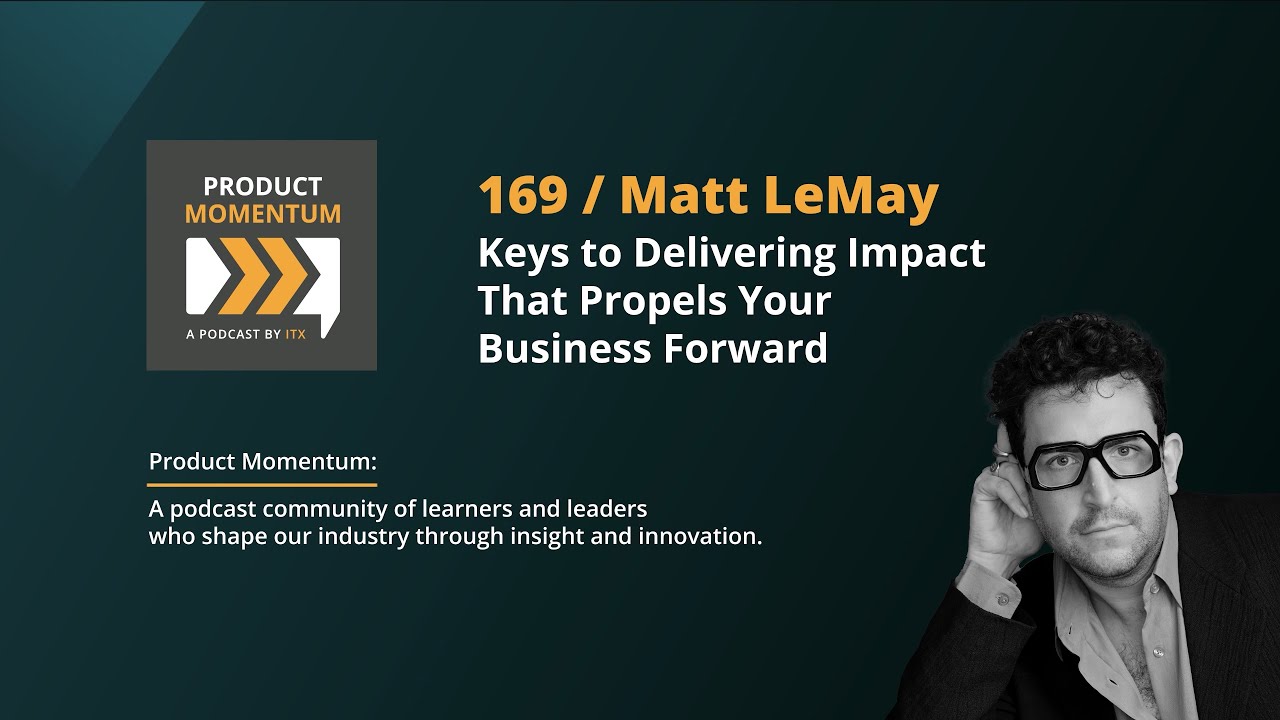
Matt LeMay is a product leader, consultant, and author with over a decade of experience. He has worked on acquisitions by Google and Intuit, advised Spotify, and built product teams for startups now worth hundreds of millions. He also held key product roles at Songza (acquired by Google) and Bitly. Matt is the author of three books, including his new release, Impact-First Product Teams: Define Success. Do Work That Matters. Be Indispensable. He also created the One Page / One Hour Pledge that aims to boost efficiency by encouraging quick sharing and collaboration.
If you were the CEO of the company where you work, would you fund the work your team is doing? In the early pages of Matt LeMay’s latest book, Impact-first Product Teams, readers confront this existential question. And it hits pretty close to home: am I worthy of my company’s investment?
As he explains to Dan Sharp and guest co-host Nathan Shapiro, the book is organized not around frameworks, but around the questions and challenges posed by product teams who want to be able to answer ‘Yes.’
In this episode of Product Momentum, recorded live before delivering the closing keynote at ITX’s Product + Design Conference, Matt urges product teams and individual contributors to tie their daily efforts to the company’s desired business outcomes. He also encourages product leaders to be clear about their expectations: “It’s okay to demand concise, clear answers about how they’re cutting through irrelevant distractions to focus on what truly matters,” Matt says.
Here’s what we talked about:
Supporting the business model. Product teams and ICs need to be able to draw a direct line between their work and how the business makes money.
“The business is model is intrinsically customer centric,” Matt says. “It’s how we exchange value. To understand the business model, we need to understand our customers. If we don’t understand them, we can’t succeed at implementing our business model.”
Avoiding OKR overload. OKRs, like everything else, are best when used in moderation.
“The ‘by the books’ optimal number of objectives is five,” Matt explains, “with three to five key results. If you have many more than that. you’re not actually measuring anything. I’m sorry. If you have 25 things that matter, then nothing matters.”
Cultural hurdles to impact. Team members who claim their company isn’t doing product “the right way” create unnecessary obstacles to a strong organizational culture. As do product leaders who leave to their teams the task of making sense of every new strategy that’s dropped at their doorstep.
“It pains me to hear people say that because I believe each and every one of us has the opportunity to do meaningful work that makes our organizations better,” Matt explains, adding, “and I think we should ban executive off-sites …. If [leaders] can’t figure out what’s needed within the context of the people doing their day-to-day work…and if your instinct is to close yourself off from the people who will apply your strategy, then you probably don’t really know how strategy works. I will never budge on that.”
Be sure to catch our entire episode with Matt LeMay, where he discusses:
- How to ‘manage up’ with clear value.
- Using data to estimate impact and validate hypotheses.
- Measuring impact of platform teams.

Nathan Shapiro, special guest co-host for this episode, is the Head of Product Management for the combined Paychex and Paycor where he leads a diverse team responsible for shaping industry-leading Human Capital Management platforms. Earlier this year, Nathan was named an HR Executive 2025, Top 100 HR Tech Influencer, and 2025 Forbes Technology Council member.
Podcast: Play in new window | Download
Intro [00:00:09] Hey everyone, welcome to Product Momentum. I’m Sean Murray, Director of Product Management here at ITX. And I’m Dan Sharp, a Product Manager at ITX. It’s our privilege to continue the product momentum journey, a platform that celebrates the thinkers and doers who are shaping the future of software development. Our goal is to introduce you to industry leaders, innovators, and practitioners, and bring you their insights, advice, and innovations. We talk with experts from product strategy, UX research and design, security, engineering, leadership, and more. We’ll discuss how their approaches to problems help empower teams and build trust, and we’ll explore trends, tools, and techniques that your team can use to deliver the software solutions your users need today. So tune in, stay curious, and join the conversation. You can catch us on your favorite listening platform, or if you prefer the video experience, you can find all our latest episodes on the Product Momentum YouTube channel. And if you like what you hear, be sure to subscribe, like, comment, and share. That way, we can be sure to provide you with the best podcast experience.
Dan Sharp [00:01:13] We are here with Nathan Shapiro at the ITX product and design conference, where we just had an amazing conversation with Matt LeMay about how important it is to bring impact to product teams. What do you think?
Nathan Shapiro [00:01:26] You know what, Matt had kickass shoes and kickass insights. I think it’s an awesome conversation and one that everybody needs to listen to.
Dan Sharp [00:01:33] Yeah, so let’s get after it here.
Dan Sharp [00:01:43] Back joining us as co-host on the podcast today is Nathan Shapiro. Nathan is the head of product at Paychex, where he is leading a diverse team of professionals who are shaping industry-leading human capital management platforms, Paychex FLEX and PayCor Perform. He focuses on innovating solutions that are usable, friendly, and work for average people in their day to day. Also, This year, 2015, he was awarded top HR Tech Influencer by HR executive. He’s also a contributing member of Forbes Technology Council.
And with us today, super pumped, we have Matt LeMay. Matt LeMay is an internationally recognized author, product leader, and coach. He has worked with companies, starting from seed level startups to Fortune 500 shaping product practices. He is most recently the author of this tremendous book, Impact First Product Teams: Define Success, Do Work That Matters, Be Indispensable. This book is rapidly becoming must read for those of us in the product industry. I think, Matt, if you do one more, you actually get the distinguished product merit badge where you’re writing all the time, Mr. Prolific. So let’s get to it. Before I just came here, I was stack ranking my backlog. So. Like you? Yeah, like you do. So I’m just curious, like, you know, what’s the deal with this impact first thing?
Matt LeMay [00:03:16] Sure. So I wrote this book first and foremost because a lot of my friends were getting laid off. You know, it’s been a tough time in the product world these last couple years. And I think the biggest shift I’ve seen is that for a long time, product folks kind of felt like if we did things the right way, we’d be safe. No pun intended. That if we followed the best practices, if we do things the way that was really our job, to make sure our company was led to make sure that we were doing things the same way as those best-in-class companies and to complain loudly and relentlessly if our companies were not doing those things.
But, you know, product management is first and foremost a business role. We’re there for a reason. Companies have made an investment in us and our teams. And I think that over the last decade or two, we’ve gotten really far removed from the actual business impact of the work we do. I know most of the time I was working as a product manager. You know, I spent a lot of time worrying about whether I was writing user stories the right way. A lot of time worrying about whether I own the roadmap, a lot of time worrying whether I was doing product strategy the right way. But I was spending a troublingly little amount of time with my team saying, okay, if we have a backlog of things to build, how many of them are actually going to result in a meaningful impact for the business, how many of them are actually going to help the business succeed on its own terms? So the idea with this book was to give product teams a way to have that conversation that’s not fiddly and framework oriented, that’s over complicated, that doesn’t add more layers of abstraction, that doesn’t give people yet another framework or best practice to stress it out, but really just centers those simple conversations and makes the connection between day-to-day work and business impact as straightforward and understandable as possible.
Nathan Shapiro [00:05:05] Oh, that’s awesome. I, uh, I’ll be honest. I was a little skeptical going into the book. I thought I might read another book about how to build an airtight ROI. Once I got into it, it was much more around nurturing that connective tissue throughout the business and it’s something that’s really timely for us. We’re going through a product transformation. So, you know, I really liked that, that idea of you need to understand the commercial aspect of your business to figure out how do you impact that without getting so overly biased on the nuts and bolts of a P and L. So can you talk a little bit around some practical ways that individual contributors can get closer to impact?
Matt LeMay [00:05:42] Yeah, I mean, the first thing is to understand your business model. Like there’s a story I tell in the book that I think about a lot. I was working with a company and I was in a meeting where the executive leadership team was, was talking to the CEO. And one of their engineering leads said, I’m really worried that we don’t have engineers talking about the business model and the CEO kind of paused. Wait, wait, wait. I got to stop you there. I have product managers coming to me every day, bitching and moaning that we are too business focused and not customer focused enough. And now I have an engineering lead coming to me and saying, we want engineers to be talking about the business model. Like, make it make sense.
And this product leader, she took the question seriously. She paused for a second and she said, I think I understand the confusion here. When people say we’re too business focused, they mean we’re too focused on internal politics. We’re too focused on the org chart. We’re to focus on whatever executive is fighting with whatever other executive this week.
Matt LeMay [00:06:35] But the business is model is intrinsically customer centric. The business model is how we exchange value. And if we want to understand the business model, we need to understand our customers, because if we don’t understand them, we can’t succeed at implementing our business model. So I think I don’t have a background in financial modeling. I don’t have an MBA. I’m a musician and a writer. But I think the understanding that product people need is not a terribly complex one. It’s just a pretty. Simple basic understanding of like, can you draw out the business model on a piece of paper? Do you understand what the business does to make money? And do you understand? What the business needs to achieve to be successful? What is expected from the market? What’s expected from investors? What’s expecting from shareholders? If you can draw a direct line between your work and those things, that’s a really good thing for you.
Nathan Shapiro [00:07:28] Skeptical again because if you’re a musician and a writer, you know nothing about making money.
Matt LeMay [00:07:33] I know a lot about losing money.
Dan Sharp [00:07:35] That actually leads into a follow-up we had come in here, right? So I’m an individual contributor. I’m learning the business piece. Then how can I kind of manage up and have my leaders and company leaders trust that, as a product manager, I can actually handle the direction of the product?
Matt LeMay [00:07:53] Yeah. So I’m going to be talking about this quite a bit in the keynote. That’s up next. Spoiler, spoiler alert. Um, a lot of these strategies, initiatives, objectives, et cetera, that come down from executive leadership. Once you’re actually in the room, when those things are developed, you understand pretty quickly why they don’t make sense.
You know, I think there’s this tendency among individual contributors to feel like we have to do the job of making sense of everything that’s handed down to us. If we have a strategy that doesn’t align with our objectives, if our domain doesn’t align with a bet, then we have to stress about it and try to make sense of all of it. I don’t think that’s possible in most cases. I think that the best thing for an IC to do is to draw that direct line between here’s what my team is doing, here’s why it matters to the business, here’s the why the investment that the company has made in my business is a good investment. Because if you can make that case directly and make it in clear enough and simple enough terms that people can understand it, then that’s going to resonate with your manager, It’s going to resonate with the CFO. It’s going to resonate with the CEO. It’s gonna be simple enough that everybody can understand why your team is valuable. Once you get to, well, you know, here’s our slide deck with our 25 OKRs and our Miro board with the other additional 10 goals that we came up with. That’s why our team is important. Then I think it’s much harder to make that case and to make the case directly.
Nathan Shapiro [00:09:11] There’s something that you talk about in the book and it’s, um, it’s a very humbling thing, but you talk a little bit about like challenging, why should my team be an investment for the company and it it’s really interesting to be able to take that step back and think about it, not just from we’re going to go do, we’re doing to do great things, but like, why are we worth investing in? Um, and I, it got me thinking and it was pretty interesting to take that step and you’ve really got to challenge yourself and put yourself in a vulnerable spot, but if you can’t answer that with conviction, It doesn’t necessarily mean the team shouldn’t be there, but maybe you’re working on the wrong things. Exactly.
Matt LeMay [00:09:44] So the book is structured around questions, not frameworks, because I think questions are what provoke the conversations we need to have. And the first question in the book, is if you were the CEO of the company, would you fully fund your own team? And I really like that question because it shifts your perspective a little bit, and gets you thinking, if you are personally accountable for the existential success of the business, would consider the team that you are currently on a good investment?
And I’ll tell you, twice in my career, I’ve had teams I’ve worked with. Functionally disband themselves after asking and answering that question. Not in a bad way. One team per your point just kind of said, like, we’re focused on the wrong thing. We could have a hundred percent success with the little thing we’ve been given and it wouldn’t justify the investment of this team. So they asked for a bigger remit.
Another team. This was interesting. It was a team of seven really highly skilled experienced engineers who had been given kind of this special ops function, you know, the company said we have a lot of things that need help. We’re going to put these seven engineers on a team. And have them figure out where they’re needed and then help those teams. The problem was they were spending 90% of their time figuring out where were needed and then 10% helping those teams, so they looked around and said, this would be better if we just figured out what teams need us, staffed ourselves to those teams for a year, and then figured it out again a year later, and they wound up having a lot of success doing that, and I was in enough leadership meetings at that company that I can say it’s a good thing that they had that conversation proactively. Because there were certainly people who were looking at this team of seven very expensive, very senior engineers and saying, why are we putting all this money into this team if you can’t tell me what they’re doing?
Dan Sharp [00:11:23] Yeah, you mentioned the 25 slides of OKRs, you know, and as we talk about impact, I’m curious your thoughts, right? How do teams just avoid the OKR theater trap? How do we make sure that we’re measuring and talking about the things that are actually helping us meet our company goals?
Matt LeMay [00:11:39] The way that teams do OKRs is so bizarre to me. It’s so bizarre. You know, one of the first questions I ask, actually when I was in San Francisco, I did a conversation with Christina Wodtke who wrote Radical Focus. The video of that just came out. You can look it up. I was looking back over it this morning for inspiration because Christina is always inspiring. And one of things that we were talking about is that, you know, when it comes to OKR theater, there’s this kind of play acting this once a week, like we really, like, we’re going to really care about our OKRs. But then when you ask a team, how do you use your OKR’s in your sprint prioritization, your sprint planning? They look at you like you have three heads. They’re like, what do you mean? We don’t, we don’t look at our OKRS until it’s OKR season. It’s literally called OKR Season when we’re doing prioritization. When we’re grooming our backlogs, we just like go by vibes or like we do points or we do something else, but like the OKRs are there for us to think about once a quarter when we have OKR season.
And, and Christina was like, yeah, if you’re doing it right, then you are always thinking about your OKR’s. And I think she will tell you, and nearly everybody who writes and thinks and consults well about OKR will tell, you, you probably have too many of them. If your team has like, you know, the kind of by the books way is a maximum of five objectives with three to five key results. Like if you have 25 key results, you’re not actually measuring anything. I’m sorry. Like if, if you, if, you have 25 things that matter, then nothing matters, but it’s easier and safer to have 25 things you can measure than to actually commit to one thing. So I think, you know, there’ve been studies done on this. It’s, it’s a cognitive truth that we aim to solve problems by adding, not by subtracting. It’s what our brains are wired to do. But when it comes to OKRs and setting goals, I usually tell teams start with one objective. Just one, and then see what happens. See if there’s something else that you’re missing, but start with one, start with the thing that matters the most. And it is really, really, hard to do that. Um, there’s another thing that I think about a lot. If anyone’s read the wisdom of insecurity by Alan Watts, it’s a spiritual book, but it’s the book I found really helpful. He talks about the law of reverse effort, which is to say the harder we try, the worse we make things. I think OKRs are the number one manifestation of the law of reverse efforts in business. The longer you spend in OKR season, the worse your OKRs are. If you spend like a week meticulously setting your OKRS in a hundred slide deck, it’s worse than if you spend an hour just picking one thing that matters and then seeing how it works. So don’t outsmart yourself. Don’t try to like make this serious strategic seeming work stretch on for as long as you can. Just try to get to the one or two or three, but preferably one thing the matters and then see how it guides your work.
Nathan Shapiro [00:14:36] Let talk Data for a second. So I am, uh, I’m a strong believer that really good product people have a good sense of intuition and I think sometimes where I see product people or teams fail is where it, it’s like, almost like it can be mechanical and everything’s going to tell me exactly what to do and there’s no hypothesis. And I could see teams that want to transition to be impact first struggling with the, I have to have all the data that tells me exactly how I can quantify and one of the things that was interesting, you tell a story in the book and it was. Hey, if you don’t have the data, just go grab some data that can help you form a hypothesis…publicly available data. And, you know, you even talk about, Hey, I know it’s biased, but it’s enough to start to work something to validate my intuition. Um, can talk a little bit more about that. And like, have you seen teams struggle in the way I’m talking of like not having all the data and struggle to be impact first or over-index on having to be able to fully quantify the impact before starting and experimenting.
Matt LeMay [00:15:32] So this exact dynamic played out in one of the workshops yesterday in a way that was really cool to see. So in the workshop yesterday, we, please don’t be my team. Please don’t be my team
Nathan Shapiro [00:15:40] It was me, actually, it was amazing.
Matt LeMay [00:15:44] And in the workshop, we had a team, you know, we were pretending to be Spotify. And we were kind of going through, like, if we have this impact we seek to drive, if we’re trying to, for example, drive more subscribers, if we have a particular goal of, let’s say, you know, a million new subscribers, what are some things we could do? And one of the things we were prioritizing from our backlog was sending out an email that would, you know, help try to get people on board. And it was interesting. Almost every team immediately stopped because they were like, well, I don’t know how many people are going to open the email. We have Google let’s look up like what the average open rate is and then they’re like oh well it’s 15 percent like let’s estimate high right let’s say it’s 20 percent if we have you know 600 million subscribers 20 percent of that’s a lot we could get a lot of people you know engaged in this but then you look up well what percentage of those people are likely to subscribe not just open and then you Look up conversion rates from email and it’s like suddenly you go from I’m stuck I don’t have a number to oh big number good to a small number bad. And, in a lot of cases, that’s what that process looks like. You know, if you’re trying to estimate the impact of something, it’s called estimation for a reason. A lot of what you’re tying to do is just figure out if something has a chance of being impactful enough to be worth pursuing. So in a lot cases, you know, you can find data that’s, you’re estimating up because you want to say, what’s the best case scenario here? One of the questions in the book is what’s the most impact we could reasonably expect something to have? And in a lotta cases, even when you go by those very generous estimations, You realize this thing that seemed like a quick win or a low-hanging fruit, or like, we should just do this because it’s going to be really easy and valuable actually isn’t going to have nearly enough impact to be worth doing. But I think the challenge, as with many things in product management, is just to get unstuck, just to not let yourself say, well, there’s no, there’s nowhere for me to go. Just look it up, figure it out, make a, make a guess, look at a few different options, see what makes sense. A lot of product management is just being brave enough to take that next step. And to say how you got there and what assumptions you made.
Nathan Shapiro [00:17:43] If you’re worried about like doing the math, like it’s pretty easy. You just say, Hey, I got this number and you’re doing pretty basic arithmetic.
Matt LeMay [00:17:50] Yeah, again, I am not good at math, but I find this math actually kind of, it feels more like puzzle solving the man. If that makes sense, like you’re kind of looking at the different pieces of this and you’re like, okay, how do I get from this thing to this other thing? How do I get from whatever work I’m looking at to whatever unit of measure the business really cares about whether that’s subscriber growth or revenue or profits. So it’s, it’s I think actually kind of a fun little puzzle if you approach it as a fun, little puzzle, but you have to be willing to make some guesses and do some research and do the best you can.
Dan Sharp [00:18:23] I love that. I feel like, you know, I’m bringing that level of impact down to the team. It’s empowering, right? No longer taking this idea of like, Hey, just build, build this for me. Like now like, here’s what we’re trying to solve. And now right now you’re engineers, right, you have like this amazing resource with you, like you have very smart, dedicated people now they’re helping software because they’re bought in, right. That that’s super helpful. Want to make a little bit of a right hand turn for another audience question. Right. Not everything that we work on is product people. It’s customer facing. Sometimes, you know, we’ve got to do this super important, but super, um, yeah, unsexy work of just rewriting applications. How do you communicate business impact? Yeah. When you’re doing something like a full rewrite or redesigning a legacy app. And how do you make sure that you’re not just, you know, quote unquote, lift and shifting to actually providing a new set of value.
Matt LeMay [00:19:17] I want to see if I can find, there’s a sub-chapter in this. Um, I’m not going to go digging for it now, but I’d basically say something like at every event I speak at, there is somebody who works on a platform team or a team with an internal product. And these people haunt me and ask me like, how can we measure our impact if we’re doing it? So thank you for that question. Cause I think it is a really good question. Interestingly, a lot of the work I’ve been doing the last year as a consultant is with platform teams is with folks who are working with internal customers. And what I find in their case is that they’re not going to own the impact, right? They’re not gonna say we do this and it has this immediate customer impact, but the teams they work with do, and if you can talk to those teams and say, what’s the impact you could have with our support versus the impact that you would have without our support, then you can communicate the impact of your team in those terms that matter most to the business. So I was working with a private equity firm a while ago and you know, the folks who they’re supporting are the folks making these billion dollar deals. And those people are very valuable. So they realize if they can save those people a certain number of hours per week, those are very, very, very valuable hours. And if they could estimate the value of those hours and say, look, we talked to these people and they said if we can automate this process, it’ll save each of them one hour a week. That doesn’t sound like a lot, but if you’re saving a hundred people an hour a week, and those are highly compensated people, you can make the case So that’s actually a really good investment to make. And that that’s immediate direct cost savings for the business. So again, I think a lot of it comes down to just talk to the people you’re working with. Have this as an open conversation. Don’t feel like you need to run off and under cover of darkness, come up with a perfect number. Like go talk to the teams you’re supporting. Talk to those internal customers and say, Hey, what difference in your impact would it make to have our help? And then you can have that conversation. In terms of which will make sense to the business.
Nathan Shapiro [00:21:12] Pulling right in my heartstrings. So I got my starting product, starting our platform product. And actually, I was writing an annual performance review yesterday for the gentleman that leads it. And this was a big struggle for us. How do we quantify our impact as a team that’s largely enabling? And yesterday, I Was going through and it was like, OK, executed this thing and unblocked this team, $8 million in ARR, $7 million in new revenue. And you start to look at it and it’s like. Holy cow, actually, when you look from a platform perspective, the impact is even larger, but you just have to kind of trace it to that always. Um, and, and the initial part is sometimes it’s an unblocker because things are sequenced. You’ve got to build the foundations and the platform capabilities, but starting to look at it that way also has helped us understand the business better because we were started as a platform team. It was very much a seedling, get this thing going. And we spent a bit too long, not understanding the business fully. And the commercial aspects of the business and as we’ve invested more time there, it’s been much more fulfilling, but we’ve been able to be a lot better as a team too. So, I love it.
Dan Sharp [00:22:18] Yeah, it’s interesting. I, you, you just kind of triggered a thought where, you know, sometimes, sometimes, especially like when you’re working in a platform space, your time to like, you know, having that impact might be longer, right? How right, especially as product teams, can we help to be patient in the fact that right up, we’re not, we’ll not going to grow revenue 50% on a platform effort in this quarter, right. Like it’s going to take six months.
Matt LeMay [00:22:42] It’s interesting. I worked with a team a while ago because we all know we’re supposed to ship more frequently, right? Every day. We all know. We’re supposed minimize time to value. We’re suppose to actually get things into the hands of customers. And on platform teams, sometimes that feels impossible. That doesn’t mean it’s impossible. I worked for the team that was re-architecting an advertising platform, a B2B ad tech platform, and they had too many goals. So we figured out the one goal they had. And it was a very ambitious revenue goal. And once they understood how ambitious that revenue goal was, once they understood what was actually expected of them in the next year, suddenly they were like, well, we can’t wait a year to launch this. Like the company’s invested too much. They expect too much of us. We can’t just say hope for the best. And then in a year, hopefully we’ll 5X our profits. We need to validate things sooner. We need do more user research. We need see if we can monetize intermediate things. Because we need to see if we can get… Smaller shipments out to our customers to see if that’s actually mute. So in a lot of ways, I think sometimes the answer is like, you can’t ask for that much patience if a company has made a huge investment and you’re saying, give us a year to do anything and you don’t know if that is going to be successful. That’s a problem. Like that’s really a problem and I think once a team understands that…once they understand, well, you know, are we going to the business and saying, give us a, year and the, you Thank you. Hundred million dollars you’ve invested in this may or may not have a return, are we comfortable actually asking for that? Or do we want the conversation to be, hey, look, this is a big investment. Can we break this down into smaller chunks? Can we pilot this with a smaller group of users? Can be validate things a little bit sooner so that we feel confident and we as a team feel like we have a better chance of actually delivering a return for the business.
Dan Sharp [00:24:31] Circle back to that like would you fund the team question there? Yeah?
Nathan Shapiro [00:24:33] Yeah, I’m gonna ask you a question So I think a lot of our listeners and you’ve invited me back. So now it’s we said is yeah Working in enterprise companies. Yes, and so You kind of have this tendency where as you look at the impact How do you how do you educate teams on how to like manage overlapping impact or chasing the same impact where all of a sudden you’re reducing the impact like we’ve this is something we’ve seen with like overlapping ROI is where At some point there’d be no people left if you like get all the operational expense savings. So in a more complex and larger organization with like a large product platform, like how do you recommend teams work through that in terms of aligning?
Matt LeMay [00:25:15] I’m really glad you asked that. There’s a really, again, baffling dynamic I see at a lot of companies where first they say we have to set our goals so that there is zero overlap between teams’ goals and then they say, why do we have so many silos and teams aren’t working together? That’s like, well, you, you literally design things that way. Because if teams have goals, which they can achieve without ever working with another team, then why would they ever want to work with another team.
If you atomize and cascade goals down to the point where there’s zero overlap, then you are basically encouraging those silos. You’re building those silos into the ways that teams operate. That overlap is what compels teams to actually work together. That overlap. Is not a bad thing. If teams are actually communicating with each other, there’s an exercise I’ll run a lot where I’ll have teams put their most important goal upon a wall, and then other teams will walk around and circle the ones that they’re most worried about that they feel the most intention with. Um, you know, the classic example is you might have one team that’s responsible for a customer lifetime value, another that’s responsible for user growth, and if you grow with a lot of low quality users, then the customer lifetime value is going to go down. So having those two teams talking to each other and saying like, Oh, okay, if there’s overlap, can we work together? Can we do something? You might’ve been pursuing one solution. We might’ve in pursuing another, but maybe there’s another we can work on together, which is actually going to be more impactful that overlap. I actually think is a feature, not a bug. So long as teams are talking to each other. Talking to each other on the order of goals and impact, not just on tactics and dependencies and are saying like, yeah, this is okay. This might open up opportunities for us to do bigger and more interesting things that we just wouldn’t be able to think about if we were fully constrained by one team’s non-overlapping purview.
Dan Sharp [00:26:59] Cool. So, yes, we spend a bunch of time talking about individual contributors, kind of flip it up a level, help you write your next book. So what can product leaders do to help product teams be able to better draw that connection between what they’re doing at a day to day and what the company goals are?
Matt LeMay [00:27:17] So this, this is not going in the talk. So this is exclusive for the people here, but like, honestly, the most, one of the most impactful things I’ve seen product leaders do is just not let teams waste time talking nonsense. Like I’ve worked with a lot of leaders who think, Oh, the team came to me and they presented 35 slides and like none of them actually had impact, but they tried really hard. And I’m like, no, don’t let them do that. Don’t let him distract you with a bunch of crap and like I don’t blame these teams because they’re doing what they see leaders doing like the leaders are presenting 35 slides of crap and they’re like, well, we want to be the next generation of leaders. So we’ll present 35 slides crap because that’s what we do. You know, one thing I’ve seen in a lot of companies is that there’s this sort of informal power structure where there are two classes of people, the people who present and the people who critique. And the goal is to become the person who critiques, to become a person who sits in judgment of other people’s slides ever and asks, like, well, will it scale? Is this like, talk to me about how this is, but like, just get right to the point. And if teams are not answering the question you need, then give them the constraints and the structure be like, cool, I need a one sentence answer to this question. I need to understand this thing. I don’t want to hear anything else from you. Like I appreciate the effort, but we have so many company cultures that celebrate theater that celebrate where, you know, somebody will present 30 slides to leadership. The leader doesn’t yell at them. And then they’re all on Slack being like, fireworks emoji. We crushed it. And it’s like, you did not crush it. I know that this team has spent a month making these useless slides rather than shipping software. And then like your leader had a nice day. So suddenly you think that you’re, you’re doing a good job. Like, like for leaders, I understand we don’t want to be micromanagers. We don’t wanna be harsh or difficult with our teams, but we need to be clear about what we expect from teams. And if they try to distract us. With shiny things. We need to be like, that is very shiny, but I need to know this. I need you to have a point of view on these things. Awesome. Thank you, Coach. Time for one more, Nathan, to bring it home.
Nathan Shapiro [00:29:26] Oh man, you’re gonna put it back on me. I thought we were going back to the audience. I think let’s talk culture. Yeah. And, you know, for, we hit on some of it, but for organizations and teams that really wanna make the shift. Yeah. Impact first. And let’s like talk what you think one of the biggest hurdles you see at the team level from a cultural perspective is. And then one of the biggest things you see at an executive level from a cultural aspect that are hurdles to like really be cognizant of this as you start the transformation.
Matt LeMay [00:29:59] So at a team level, I’m going to cheat a little bit. One is teams that say our company doesn’t do product the right way so there’s nothing we can do. I think that is probably the most harmful thing I’m seeing in product management discourse writ large. If people who say well we’re not you know I saw somebody say that you can’t really call yourself a product manager if you do this so I’m not really a product manager or I heard that there are companies that are better than other companies and we’re never gonna work like them so there is nothing I can do, we’re a feature factory, we are hopeless. None of my efforts matter. I, it, it pains me when I hear people say that because I really do believe that each and every one of us has the opportunity to do meaningful work and to do work that makes our organizations better. I will never budge on that.
You will never get me to say otherwise because I have seen it firsthand. And I’ve seen people who are like, Oh, they’re just product owners do strategic meaningful work. I’ve seen project managers step up in a team where the product manager is struggling and work together to define impact in a way. That the team was previously unable to do. Um, I think this idea that there is somewhere out there, like a secret best way of doing things. And if your company doesn’t do things that way, you don’t matter. Um, I really, really dislike that. And I think it causes a lot of harm.
Um, the second thing I’ll say is like teams are just afraid to put numbers on things. Like they’re afraid. And I get it. Like it’s, you know, it’s scary to put a number on things it’s scary. It’s like. Well, we want to increase revenue. And it’s like, how much? And they’re like, ah, I don’t know. But like, put a number on it. If it’s the wrong number, you’ll find out and you’re better off finding out than not finding out, right? You’re better of saying, we’re going to increase our profits by $10,000. And the company is like, what are you talking about? We, we invest a million dollars in this team. We need to see this return. Oh, okay. Cool. Now I know that. But if you don’t put a number on it, and if you don’t do that first, then you are leaving room for the organization to have unexpressed expectations that you will fail to meet. And that is a risk that I don’t think is worth taking.
At an executive level, it’s, it’s, it’s this additive mindset. It’s more crap that gets added without any thought to what it will mean for teams on the ground. It’s the executive offsite syndrome where five people who hate each other go to a sad hotel somewhere and like, drink and ignore each other and are sad and can’t wait to get out of there. But they wanna make sure their perspective is represented. So they come back with a thousand slides of utter garbage and then hand those slides of utter garbage off to their teams and their teams are miserable because now they have a hundred slides of garbage, a very important garbage that make no sense and that actually tell them like 20 different things that are all in conflict with each other. So I think like I posted this on LinkedIn a few years ago that we should ban executive off-sites and people got really mad about that But I kind of stand by it. I think like if you can’t figure out what is needed within the context of the people doing the day-to-day work then that’s a problem like if your instinct is to close yourself off from the people who will apply your strategy for the sake of developing a strategy Then you probably don’t really know how strategy works.
Dan Sharp [00:33:19] Tremendous. Thank you for coming to the pod.
Matt LeMay [00:33:21] My pleasure.
Dan Sharp [00:33:22] Great conversation. Thank you so much.