Listen
Podcast: Play in new window | Download
About



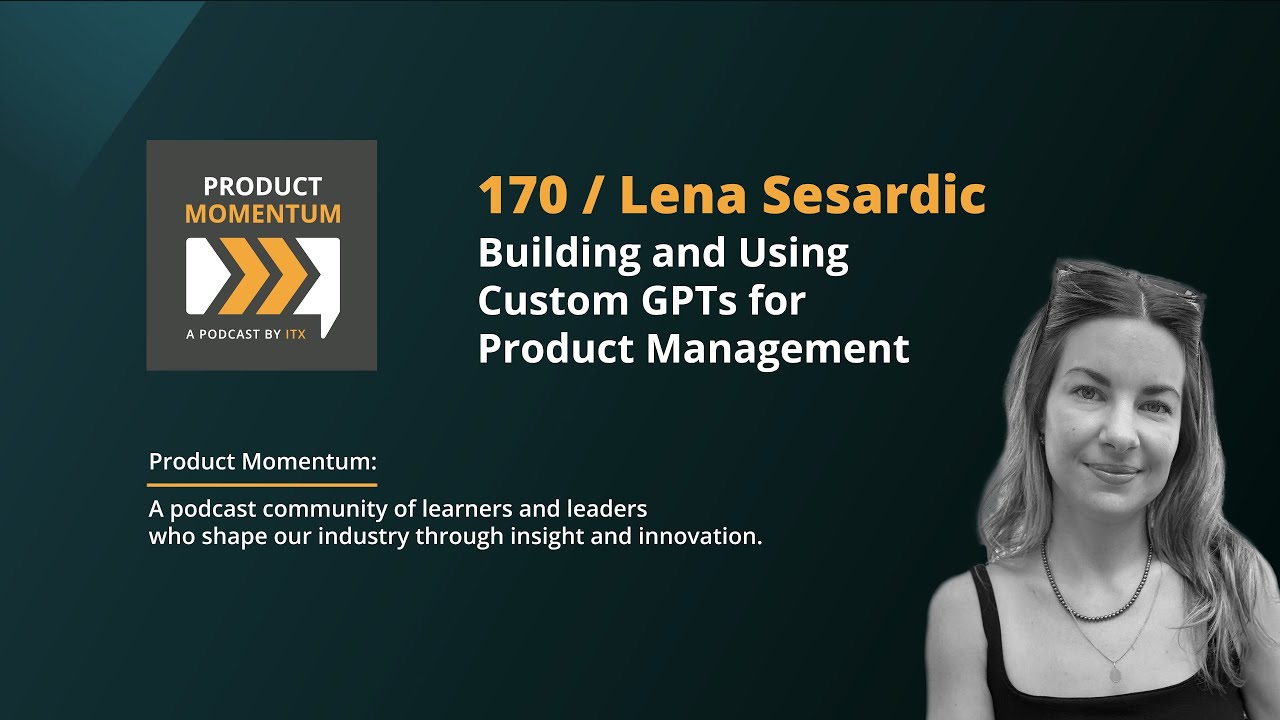
Lena Sesardic is a former tech product manager who now builds custom GPTs, AI-powered products, and helps people actually use AI to work less and think bigger. After 5+ years building in the startup world, Lena saw how much time is wasted on stuff that AI can now handle — so she flipped the script. Now she coaches entrepreneurs and creators on how to step fully into the visionary role, while AI takes over as the operator. Whether it’s designing smarter systems or building your AI “team,” Lena helps clients reclaim their time and build what actually matters.
If you could hire an employee who never gets tired, never loses focus, and instantly adapts to your workflow, would you do it? In the latest episode of Product Momentum, Lena Sesardic leans on her experience as a tech product manager and business-savvy entrepreneur to explore this tempting proposition through the lens of custom GPTs – specialized generative AI bots now reshaping how product teams operate.
The episode isn’t a technical tutorial on how to build custom GPTs – though Lena does walk us through her 6-step framework. It’s more a conversation – peppered with easy-to-understand examples – that help us think in new ways about the nature of our work.
Here’s what we talked about:
Supporting creative and strategic bandwidth
Lena describes custom GPTs as “little AI employees” that can take loads of work off your plate. By delegating tasks like writing user stories or analyzing estimates, product managers can free themselves to focus on higher-order work: roadmapping, stakeholder management, and creative problem-solving.
We can train custom GPTs to be our “collaborative thought partners,” Lena adds, “sort of a second brain that can then free up our bandwidth for more creativity, more user connection, and more talking with your actual users or stakeholders.”
Demystifying misconceptions
Lena dispels concerns about the level of technical sophistication required to build custom GPTs.
“A lot of PMs I know think [custom GPTs] are very technical,” she adds. “I used to think I had to be able to code to create a custom GPT. But the more I worked with them, I realized, ‘oh my gosh, I can totally build these and take a bunch work off my plate.'”
Lena’s 6-step framework for building a custom GPT
Start a conversation with ChatGPT (Lena recommends a Plus subscription) to help you build your custom GPT.
- Cast the role. Decide the expertise you need from your custom GPT.
- Develop the system instructions. Add context; define the input-transformation-output formula to generate the results you want.
- Map out the workflow. Be clear about your desired outputs. And remember, as with any AI tool, iteration is key.
- Add intelligence. Upload additional frameworks and other documents to guide your GPT.
- Install the brain. Copy-paste the system instructions from your ChatGPT conversation into your custom GPT.
- Put your GPT to work. Feed it real world data. Test it. Return to the conversation and describe what you’re seeing. Find out how to tweak it until you’re satisfied.
Lena’s is a message that resonates: by embracing custom GPTs, product managers can amplify not just their operational efficiency, but their capacity for meaningful innovation.
The Product Momentum team will be heading to Cleveland for INDUSTRY on Sept. 9-10, recording live, in-person episodes with several conference keynote speakers. Be sure to stop by Product Momentum’s Podcast Zone to say hi!
Podcast: Play in new window | Download
Sean Murray [00:00:09] Hey everyone, welcome to Product Momentum. I’m Sean Murray, Director of Product Management here at ITX.
Dan Sharp [00:00:14] And I’m Dan Sharp, a product manager at ITX. It’s our privilege to continue the product momentum journey. A platform that celebrates the thinkers and doers who are shaping the future of software development.
Sean Murray [00:00:25] Our goal is to introduce you to industry leaders, innovators, and practitioners, and bring you their insights, advice, and innovations. We talk with experts from product strategy, UX research and design, security, engineering, leadership, and more. We’ll discuss how their approaches to problems help empower teams and build trust. And we’ll explore trends, tools, and techniques that your team can use to deliver the software solutions your users need today. So tune in, stay curious, and join the conversation.
Dan Sharp [00:00:53] You can catch us on your favorite listening platform, or if you prefer the video experience, you can find all our latest episodes on the Product Momentum YouTube channel.
Sean Murray [00:01:01] And if you like what you hear, be sure to subscribe, like, comment, and share. That way, we can be sure to provide you with the best podcast experience.
Dan Sharp [00:01:14] We just had a really cool conversation with Lena Sesardic about custom GPTs, how she went from a tech product manager in coaching and building these. I learned a lot, I’m really optimistic to use them. What are your takeaways?
Sean Murray [00:01:32] The biggest thing for me is the mindset of how you want to use these custom GPTs to expand your own expertise, but also to really kind of like cross some functional boundaries and get into stuff that you’re not real great at. Right? So how can you use a GPT to really do a job that you’re not prepared to do? And Lena has a whole framework. It’s an excellent episode.
Dan Sharp [00:01:57] Yeah, I love that like custom GPT as a way to break out of your own personal silo. It’s a great conversation. Let’s get after it. Joining us today is Lena Sesardic. She is a former tech product manager who now builds custom GPTs and helps people actually use AI to work less and think more. After years of building in the startup world, saw that a lot of time gets wasted on stuff that AI can now do. Lena’s pivoted to coaching entrepreneurs and creators so that they can step more into the visionary role and let AI take over as an operator. So welcome back to the pod, Lena.
Lena Sesardic [00:02:41] Hi, thank you so much for having me. It’s so good to be here. I think it’s been about five years or so. Really feels good to back.
Dan Sharp [00:02:47] Yeah, we’re super pumped to have you and have you here talking about AI and GPTs, right? So know that you have been doing a lot of work now on building out custom GPTs and helping people to do that. Before we got to dive into that journey, though, I think it would really help the audience if you could just explain what is a custom GPT, right, and when should I consider using that instead of just firing up perplexity and then typing away?
Lena Sesardic [00:03:14] Totally out. So a custom GPT is honestly kind of like a bot. It’s almost like a specialized version of a ChatGPT conversation that always operates in a certain way. And the goal of it is to ideally take a specific task off your plate. And so it gives you some control over how you want the experience to be, what you want that specific GPT to actually be trained on so that you don’t have to constantly retrain it every time you start a new ChatGPT conversation. so it’s almost like a mode i want to say and a lot of people would call them bots, um but i think they’re really a lot more than a chat bot because you have those chat bots on the website but these are really you can program pretty advanced logic and it can really come close to really replacing almost like a very, very admin junior role on your team or something like that. So it’s almost like, I’ve lately been calling them little AI employees. And so I think it can really take big chunks of work off your plate. And the nice thing is that you actually don’t have to code in order to create them, which was a misconception I actually had before I started building custom GPTs.
Sean Murray [00:04:34] What was the genesis of this idea for you? How did, what was the thing that like turned the light bulb on that said, this is something that we can market and work with people on.
Lena Sesardic [00:04:42] I mean, it’s a long story. I’ll just try to kind of like really condense it here because it’s been kind of is relevant to the past five years. So I was a product manager in tech for five, six years, built a bunch of products, ran innovation teams, absolutely loved it. Then I became an entrepreneur in 2020. As you know, five years ago when I was on this podcast, I was talking about the book I self-published on the making of product managers. So I did a bunch of different entrepreneurial projects and most of my time I spent as a business coach. Specializing on LinkedIn initially, and then kind of expanding. So I’ve had a whole entrepreneurial journey and this is actually the latest sort of iteration, if you will, of my entrepreneurial career where I decided to pivot my business. When you’re doing things for a long time, you kind of get a little bit bored. You wanna refresh yourself, reinvent yourself. And so I decided to reinvent myself with the positioning of AI because I really just I was a little slow to adopt AI to be completely honest with you. Like when ChatGPT first came out, I wasn’t really in the zone, if you will. But at the end of last year, I really just went completely, you know, really deep with ChatGPT and I felt like that was the missing piece for me to pivot my business. Also because I am a product builder at the of the day. And so I think the thing that really attracted me to building custom GPTs and I also build automations and kind of more advanced things too, but really GPT’s has been the kind of stickiest thing with my audience. I think it really allows me to now finally actually use my product background in a really practical way to build these products, market them, iterate on them. So it kind of honestly just came at the perfect time and is really, yeah, allowing me to use, I think my full repertoire of skills. So that’s kind of like the condensed version.
Sean Murray [00:06:33] Uh, I know we want to get more into like how you used your product background to kind of like perpetuate this idea and really launch it into market. I want to learn a little bit more about, uh, custom GPTs first. So I know that we are thinking about them as, as many employees. What are some of the, like, what are you, some of your favorite direct applications that you’ve seen based on the people that you’ve been working with?
Lena Sesardic [00:06:57] So, I mean, in terms of the product world, I think some really simple applications that I’ve seen is, for example, something as simple as writing user stories. Whenever you are doing something really repetitively and there is a little bit of thinking involved, like you still need to give it input, but you’re sort of outputting something in a very consistent format, that’s a really great opportunity for a custom GPT or really AI. So one use case could be, you know, taking complicated documents, messy documents for feature ideas or your stream of consciousness notes or something or screenshots and turning that into really easy to read, developer friendly, complete user stories for assigning work to your development team. That could be like a really simple, I know for me, writing user stories was just always a nightmare, you’re always gonna forget something in the story, so really just that consistent process. I think the, so there’s a bunch of kind of admin related tasks that you can outsource to a custom GPT, so it could be anything from, you know, like analyzing estimates, like all these different use cases, but there’s another sort of, you know, category of use cases that I feel like not a lot of people are thinking about with AI and kind of ChatGPT specifically is really training it to be more of a collaborative thought partner. So I think a lot people are outsourcing things to AI that are really low level and should be outsourced to AI because AI is the operator. You’re the visionary, but you can actually have AI do more. And one of the really big advantages I’ve seen is of using AI in that thinking partner mode. So it could be something like strategizing your roadmap or even strategizing how to get stakeholder buy-in, loading it up with all the information about the project, who the individuals are, what kind of things maybe they’ve mentioned on a call and then creating a strategy for how do you actually, you know, get everyone on board? How do you make sure that everyone’s concerns are addressed? How do prioritize things accordingly? So it really becomes kind of like your second brain that can then free up your bandwidth for more creativity, more user connection, like talking with your actual users or stakeholders. So I would kind of honestly group the two use cases into kind of more operational level, but then this collaboration partner strategy that I think not a lot of people, like I feel like people are still under using AI for its thinking abilities, like its co-thinking abilities.
Dan Sharp [00:09:39] So I’m curious, like with those use cases for custom GPT, like how are you training? Are you training kind of on your notes and kind of your widespread product business context?
Lena Sesardic [00:09:50] So the first thing that I would look at is what is the framework that you wanna apply. So let’s say for user stories, maybe you have a certain framework, maybe for, I don’t know, prioritizing features, you have certain framework. So I would pull that framework into some sort of a format that is easily consumable by GPT, some kind of a plain PDF with very clear information synthesized. So you wanna always layer a framework because if you want it to think like you, you need to look at how am I making decisions and put that into a GPT-friendly format to consume.
Then I mean, the other thing that I would also think about which is so second nature to us product people is the experience, right? Like what is the actual experience that you’re gonna walk the user through? What I usually do when I’m building a custom GPT is I’ll get it to after I’ve described what the GPT is. I will get it to actually, and like what I wanted to do, I will it to map out a sample conversation. Like what does it actually look like to, you know, talk with this ChatGPT to use it, and then really make sure that that experience is really good, right? So those are some of the things that I would think about when I’m building custom GPTs for those use cases, just to make sure that you’re actually getting high quality responses and you’re not just having to redo the work yourself after everything.
Dan Sharp [00:11:16] Right, it’s not not fast if you’re just doing the work after it does.
Lena Sesardic [00:11:19] Yeah, but a lot of people are using AI, but then they’re redoing the work. And, you know, it’s, it such a pity. And a lot at the time I find they blame AI and, you know, sometimes yes, AI just is not quite there yet. You know, God forbid, it God forbid it’s not, you know, literally a human, but I think people forget how much you really have to iterate with the, with the AI, like a lot of the time science will say, oh, you know, I told it to do this, but now it’s not doing it. Why isn’t it doing it? And. Because it’s a computer, you know, this is you have to actually understand the logic and work with it and iterate with it, it’s not going to get it right from the beginning. So I think like iterating and testing on it is something that is actually like kind of more, you have do a lot more of it than you think. I think that’s been a kind of something that’s been a little unexpected maybe on my, on my side.
Sean Murray [00:12:11] I really like this concept of collaborative thought partner. We had a past guest and you’ll notice from all of our episodes. One of my favorite things to do is quote past guests. Uh, but actually in our, like our pre-production and post-production media and Luke Stiles, uh, introduced us to a concept that was, uh that came from Ethan Malik, a group that put together this paper, like the Harvard business review and the Wharton School of Business put together this thing on the cybernetic teammate. And they did a whole study at Procter and Gamble about Here’s 800 people that are using AI and their jobs and who are who the people that are getting the most out of AI. And it turned out that the people that were getting most out of AI were the people using AI as a teammate or collaborative thought partner. Right. So I am a product guy, right. But I am not a schedule and budget guy. I have never been, and I probably never will be. That’s just not in my skillset. That’s not stuff that I like to do. I like the spend the money. I don’t like to worry about how much money I’m spending. That’s that is project management, right? That is keep that is core project management principles.
So when I create artifacts, or when I create presentations, I want to be able to ask AI, hey, you’re a project manager…let’s put them in the role of you are a project manager…and you are constantly skeptical of my work. What am I missing? Or what doesn’t work in this presentation for you? And maybe, like you said, god forbid it’s not a human. Maybe 70% of the feedback is not great. But that 30%? That’s going to cover gaps that are just going to make the presentation or whatever I’m working on so much better because I’ve closed because I’m used AI to close those gaps and cross a functional boundary right into an area where I’ve really never been comfortable and I don’t have a great skill set.
Lena Sesardic [00:13:47] Totally, totally. I love that example. Yeah, I think that you can really, I mean, it’s kind of like borrowing someone else’s brain in a way, right? So you’re really building this network of GPTs that think like you, or some of them maybe just think like the person who you need on your team, that’s not you, right. So I think you can really create a fully, fully functional, full team if you leverage AI. So, I really, really love that example.
Dan Sharp [00:14:14] Yeah, that’s super cool. I’m curious talking about custom GPTs as kind of bot-like. How much do they overlap, like kind of the concept of agentic AI, or are they different concepts?
Lena Sesardic [00:14:28] I think there are different concepts. So with agentic AI, it’s really where the AI is able to make high level decisions that typically at the GPT stage, you would outsource to the human, right? Like, this is where they have autonomous thought, they’re able to kind of go to a crossroads and actually think about it. And my understanding is, you know, you can sort of like map agentic behavior in the GPT, let’s say you create like a decision tree, and you’re like, in all these situations, this is how you’re going to act. But you know, I’m maybe not an expert and like literally the difference between agentic AI and non-agentic, AI, but my understanding is like, agentic ai would be where the AI is able to operate even if it doesn’t have the decision tree or doesn’t have that specific contingency. But it’s like it’s trained on your way of thinking and your maybe like past decisions. So it’s able to look at a new scenario and actually decide and think about kind of what would you do type of thing, right? So that’s kind of my understanding, but custom GPTs I would a thousand percent say, I don’t really think they’re agentic behavior. And I think a lot of people talk about AI agents, but really they’re just talking about AI workflows with “if this, then that” logic.
Sean Murray [00:15:47] So if I’m, maybe I have experience using GPT or some sort of chatbot version of AI, how do I get started? Like what are the first three, give me three things that I need to do in order to get started in making my own custom GPT.
Lena Sesardic [00:16:03] Uh, so the first thing you’ll have to do is pay for ChatGPT plus because you’ve not paid.
Sean Murray [00:16:10] I just told you I’m not a budget guy, but it is spending money.
Lena Sesardic [00:16:14] Yes, you’ll just spend it. It’ll be someone else’s problem. If you’re going to create custom GPTs, you need a plus subscription, just covering the bases here. The next thing that I would do, I would obviously tell you to follow my six-step framework for how to build a custom GPT that thinks like you.
The first step is you go into the chat. You go into a conversation with ChatGPT where you say, hey, I want to build a custom GPT, and the first thing that I would recommend doing is I like to call it step one, cast the role. So you want to decide what kind of expert role does this GPT need to have? And so, for example, I actually built a custom GPT that builds custom GPTs as you would as a product person. And the first step is what do you want the GPT to do? And once you answer that, it’s what kind expert role does it need to have like what professional thinking do you wanna embed into it?
The second step would and then again you’re doing this all in the chat right so you are designing and the whole goal is you’re answering you’re going through giving it all the context and at the end you’re gonna end up with what are called system instructions it’s just basically like word-based instructions or the GPT I would not recommend writing this on your own I would just have ChatGPT generate it. And so you cast the role; next thing you want to do is want to think about the input-transformationtoutput formula for the GPT. So what are you actually giving the GPT? Are you uploading documents? Are you uploading some kind of information? What do you actually want the GPT to do with that input? And what’s the output? What format is it in? When should it be produced, kind of like the brain mapping, if you will, of the GPT.
Then step three, now you kind of have the functionality, you know, what’s being inputted-outputted, then I would basically map out the workflow, just say, Hey, what, what would it actually look like to use this GPT right now, it’ll give you a sample conversation. And now you iterate from there. You’re like, actually, I want the user to be told this when they do that, or like, don’t skip to this, or don’t let me do this until I’ve confirmed this or something like that. Iron out the experience.
Number four is you can make it smarter by again, like I mentioned before, uploading frameworks, maybe you have some kind of documents of frameworks, Maybe you want to do like slash commands or something you want it to be easy to use.
And then step five is very simple. You install the brain. So you get the system instructions from the ChatGPT conversation. You literally copy and paste like, I don’t think that we should be manually changing anything in the system instructions. Just have ChatGPT produce it.
And then the sixth final step is just literally put it to work, feed it real world data, test it, go back to the conversation, say, hey, we tested it. This is what we’re seeing. Why is it doing this? Can we tweak it? How would we tweak? It. How do we make sure it’s going to work well? Um, so honestly, that’s kind of the process I would follow, uh, from start to finish, and you can do that all in the, literally in a conversation. It’s like you’re talking to a friend. I will literally be on my couch. I live in a co-living, so I have roommates and they’re always floored when I do this. I’ll just be on the couch, on my phone, text to speech, to ChatGPT. And I will have built a custom GPT and like 15 minutes. And they’re like, did you actually just build a custom GPT? So it’s really easy. You can literally do it. Like you’re talking. To a friend, so that’s kind of the process I would follow.
Dan Sharp [00:19:40] That is super cool. Yeah, kind of shifting gears a little bit, right? You mentioned iteration as maybe a misconception that with AI, you just put it in and you get out and output and you’re good to go. Yeah, I’m kind of curious what other, maybe misperceptions there are about using custom GPTs that people should be aware of.
Lena Sesardic [00:20:02] I think maybe sometimes people might think that they’re not as powerful like they think oh you know can I really actually code or not code but like program advanced logic or is it just like a little bot that’s like the little chat bot that I use on websites that are like not very not very smart right like they’re not generative AI necessarily so I think people don’t I mean in general I think people don’t. Fully grasp how much is possible with AI. But I think with custom GPT, sometimes they assume that they need to be really simplistic.
But then I think on the on the other on the other side, or actually, sorry, before before I talk about the other side. I just want to show an example of one of my clients, she has a delegation agency for interior designers, we’re building a custom GPT that does all the pricing for her clients and writes the brief for their interior design projects. Like this is pretty advanced logic, but we’re able to, we’re still testing it. It’s still kind of a little off with the estimations. Again, we need to iterate and make the logic better, but it’s, it’s a pretty advanced thing and it’s going to really increase your bottom line and get people to delegate more. So you can actually build pretty sophisticated custom GPTs, but what I was going to say before is on the other end, I think a lot of people think they’re very technical and so misconceptions, and that was my own misconception, I thought you had to be able to code to create a custom GPT. And when I realized that you just literally write the system instructions, that made me realize like, oh my gosh, like I can totally build a bunch of these and take a bunch work off my plate and actually be the ideas person in my business instead of just the operator stuck in the weeds, right? So I think kind of misconceptions on both spectrums, if you will.
Sean Murray [00:21:48] You’re saying there is hope for me in managing a calendar if I can, if I can train a custom GPT to be my calendar person.
Lena Sesardic [00:21:57] Yeah, yeah, you would need an automation to actually connect to your calendar. So you can use a tool like Zapier or Make, but you can 1000% like you don’t have to be the person that doesn’t know how to schedule like AI can just do it for you and, and the nice thing is because if that’s not your zone of genius, I mean, like, why try to, you know, force yourself to get better at it or just constantly be trapped as the person who like, you can have AI do that part of the job and you focus on the thing that you’re good at, right? Like, I think. I think that’s the biggest opportunity because even like business owner or especially product manager, I know that like when I used to work in tech as a product manager like we are just so busy. There’s so many things and there’s so things maybe that are not in our zone of genius. And I think it’s a very taxing job. And if we can use AI to offload some of the things that are lower level or just are not on our zone of genius, I think that we can. Really be better product managers because what we need to be doing is being out there talking with stakeholders, looking at the data, not, you know, fumbling in Jira trying to get the user story right in the formatting. I still remember the finicky formatting in JIra tickets.
Dan Sharp [00:23:10] I’m home to work with the Sean bot.
Dan Sharp [00:23:12] Yeah, the Sean Bot would be nice. Also, I just need a bot that will, I just a GPT that will have me not commit to new things. So just, hey, you don’t have time for that. I just need, I need something that says that. You don’t capacity, don’t say yes to that.
Lena Sesardic [00:23:28] Yeah, I actually have there’s a GPT that I use in my business. I’m not joking probably five times a day. It’s called the 10x business coach GPT and honestly, it’s pretty simple. I just loaded it. The 10x is easier than 2x framework from the book. I don’t know if you guys have heard of the 10 x It’s a pretty good book. Honestly, okay So I just voted the framework and now it’s my business coach Like I used to pay multiple four figures a month for a business coach and now This thing is honestly better because it’s always available. It’s got really creative. And so you can literally have, again, I think that is an area of custom GPTs that people are under using is this mindset coaching strategy, visioning, you know, like dealing with complicated situations, maybe with stakeholders trying to weigh how to like, you know. How to play your cards right or something like that. I think that’s a whole area that is very underutilized because everyone’s like, I want to automate my calendar. And it’s like that’s great, but there’s this whole other area that can really, I think quantum leap you as a product manager, as a business owner by really being the stinking partner.
Sean Murray [00:24:38] Tell me about the process of launching this new business of yours into market. So getting through like the introduction phase into growth, how did you understand that there was a market for this and how did find potential clients?
Lena Sesardic [00:24:50] It’s really funny. So I mean, I’ve been an entrepreneur for about like five years, actually over five years now. And I think having been a product manager, I really do believe that I just, I have a sixth sense for when I can snap, like I can just sniff out demand. I know a lot of people have that and, and over the past few years, I’ve, I built a lot. I even actually saw, I lived in Mexico last year. I actually even had a scooter rental business. I was renting out scooters like little. I’ve always been a bit of a like, I can just, I can just feel the demand because I, I know customer research. So I think that’s partially experience, but also just the feeling that you get with it. I knew that, you know, AI was obviously everyone on this earth knows AI is, is, you, blowing up right now, but there was this one LinkedIn post that I wrote and literally three minutes, I, decided basically earlier this year, I’m going to start talking about AI literally. I already had an audience, right? Like Instagram. LinkedIn, especially TikTok, like I did have an existing audience. I wasn’t started from scratch, but I one day just decided I’m just gonna start talking about AI. I really wanna be in AI. I don’t really maybe know that much, but like, I’m gonna start and document my way, like build in public my way and to becoming someone that people might listen to about AI, and so I just started posting on LinkedIn three times a week and I had this one post where. I just kind of honestly randomly wrote my really messy six-step framework that I put together for custom GPTs after like building a few, doing a course. I was like, I’m just trying things. And that post went viral. I think I have like a hundred followers from that one post or something. So I instantly, I was okay, custom GPT’s, people want this stuff. And from there, honestly, I just do it. We do as product people. I just moved quickly, failed forward, just like literally put out an offer. I decided to do some free sessions. I did some free ChatGPT coaching sessions, built a bunch of custom GPTs, got great signal, created like a fire around me, I guess, or whatever. And then I just like launched a group program. I was like, hey guys, like we’re gonna be doing the second brain project program, you’re gonna build a second brain with custom GPT’s, it’s four weeks, here we go. Did a big free training, like just. And I did the marketing. So obviously I have some marketing background, but honestly, the biggest thing, the biggest that I will always come back to is just moving quickly, moving quickly testing very quickly. And that is where AI, honestly, the speed at which I’m moving in my business right now is incomparable to what I was doing before. Like how much I’m able to experiment and all that kind of stuff.
Dan Sharp [00:27:31] Yeah, that’s awesome. Yeah, you mentioned early on in our conversation today about how you’re a slower adopter in AI. Yeah, and I’m wondering with your experience working with clients, what sort of aha moments are they having to say like, oh man, like yeah, AI and GPT is like, this is something that I really want to get after.
Lena Sesardic [00:27:54] I think like the aha moments are usually when they realize, I think when they realize how easy these things are, especially when, cause all my clients are using my GPT builder. Um, and so when they use that, they’re like, I can just literally throw out a GPT in like 20 minutes in an afternoon and for a new idea that I have, so I think, like just how easy they got to be. And then the other aha moment that comes to mind, usually I’m seeing is when they realize how much money they can save really from not having to hire multiple freelancers and that’s the same kind of in a company too, right? Like you can now actually build an expert freelancer as a GPT and you’re paying like what, like 50 cents per month for it because you’re paying 20 bucks a month for ChatGPT, and you have all these employees, you know, like think the cost saving and. How good they are, I think that’s usually kind of the aha moment.
Dan Sharp [00:28:51] Also, I appreciate here, Matt, coming to the conversation about custom GPTs is like, oh man, this seems like a really daunting topic. So it’s like really cool to hear how accessible it is and how quickly you can spin one up as long as you pay for the GPT.
Lena Sesardic [00:29:05] Yeah, exactly.
Sean Murray [00:29:07] That’s step one, pay for it.
Sean Murray [00:29:09] Step one, pay for it.
Lena Sesardic [00:29:11] Not sponsored by OpenAI.
Sean Murray [00:29:16] I really want to thank you for being here today. This is really engaging topic. I think that there are a lot of takeaways in the sense of you just need to try this, right? You’ve presented a framework for people to get out there and attempt to do something that they want. Where can people hear more about what you’re doing right now?
Lena Sesardic [00:29:34] The best places to find me are right now. I’m very, very active on TikTok. So I’m creating a lot of content over there. Also active on LinkedIn. So that’s a great place to get me. Those are probably kind of like my top places. Yeah, that’s where I am.
Sean Murray [00:29:51] And are there any other second brain workshops coming up that people can tap into?
Lena Sesardic [00:29:56] The next second brain project program is probably gonna be in January. Okay. And until then, I have several things that I’m doing. I might be dropping some free workshops over the next few months around like custom GPTs or AI. So definitely will be talking about that on TikTok and LinkedIn. So yeah, lots of different things coming.
Sean Murray [00:30:19] All right, so some takeaways for me today, just this kind of idea of the collaborative thought partner, but also I really like the way that you said that we’re essentially borrowing someone else’s brain, which is a great way to think about, you know, that crossing functional boundaries, right? Someone else’s brain is going to be better at project management or design or project management, right. I just think that there’s, um, I think there’s a lot to that. Uh, iteration is key. Especially when you’re working with AI, right? Make sure that you’re getting the result that you want and keep working with it until you get the result you want. I really like you talk about some of the steps. You talk about the steps in your framework, but I think either the third or fourth step was a lot about providing context, right. So what are the models you wanted to use? What are the documents that you already have that support the work that you are doing? And how can you give that either examples or context to the machine? I thought that was great. And then just from your business sense, really just always know your market and be able to sniff out demand. I think that that was where you have that sixth sense, but that is really something that you need to do. Just because there’s a market for something doesn’t mean that there’s necessarily demand for it. Those are two different things. So I just really appreciated your take on that.
Lena Sesardic [00:31:35] Thank you, very good summary.
Sean Murray [00:31:37] And then the last thing that we always ask is, what are you reading right now? What’s on your bookshelf?
Lena Sesardic [00:31:43] I’m reading a book called Quit, actually. I forget who it’s by. I think it’s Annie Duke, actually, one of my friends recommended it to me because he thinks I’m a really good quitter. Like, I know when to quit something, even though, yeah, so I think that it’s really cool. Yeah, I’m still at the very, very beginning, but it’s kind of a different take on quitting, you know? So.
Sean Murray [00:32:10] I’m gonna venture a guess that you are the first podcast guest that has said that I’m really good at quitting stuff.
Lena Sesardic [00:32:16] Probably.
Sean Murray [00:32:16] By far
Sean Murray [00:32:17] The first one.
Lena Sesardic [00:32:18] That’s about a wrap.
Sean Murray [00:32:20] 170 episodes in and we’re just learning that you got to be a good quitter to be good in this business. I really like it.
Lena Sesardic [00:32:26] I need to know when to walk away. I think a lot of people spend a lot of time on, you know, like sunk cost fallacy. So yeah, it’s a fine line.
Sean Murray [00:32:38] Well, thank you so much for being here with us today. Great episode.
Lena Sesardic [00:32:41] Yeah, thank you for having me. It’s been incredible.
Outro [00:32:49] Well, that’s it for today. In line with our goals of transparency and listening, we really wanna hear from you. Sean and I are committed to reading every piece of feedback that we get. So please leave a comment or a rating wherever you’re listening to this podcast. Not only does it help us continue to improve, but it also helps the show climb up the rankings so that we can help other listeners move, touch and inspire the world just like you’re doing. Thanks everyone. We’ll see you next episode.