Listen
Podcast: Play in new window | Download
About



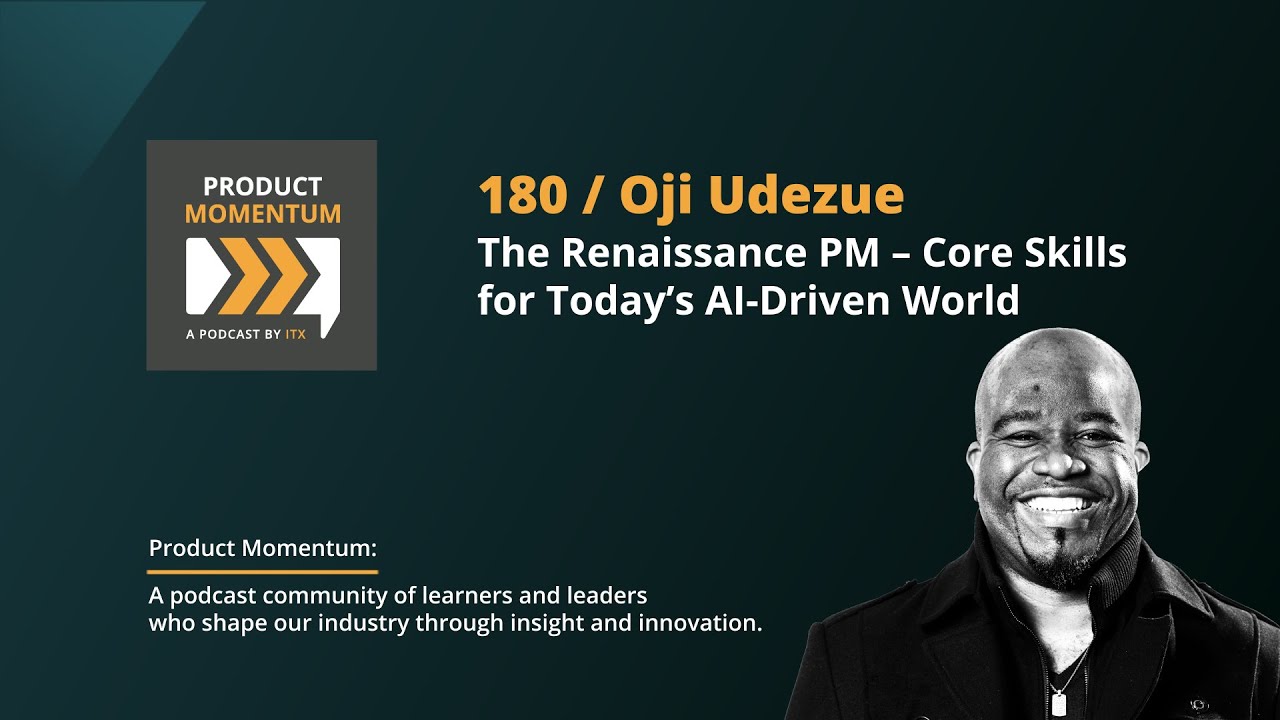
Oji Udezue helps transform products into market-defining successes with board and executive product leadership experience at Twitter, Calendly, Atlassian, Typeform, and Microsoft.
He has found success through his ability to bring cross-functional expertise that spans design, product engineering, marketing, and sales enablement – the complete tool kit for building exceptional software companies.
His product leadership philosophy – captured in the book he authored with Ezinne Udezue – Building Rocketships: Product Management For High-Growth Companies – delivers actionable frameworks that transform startups into market-dominating forces through product lead growth.
Oji also mentors the next generation of product leaders; sharing battle-tested wisdom through ProductMind’s Substack and strategic advisory work, his unique combination of enterprise-scale experience and start-up agility makes him the go-to advisor for founders and product teams ready to launch their own rocketships
Recommended Reading
The Product Momentum team first met Oji Udezue following his keynote at INDUSTRY 2025. And we just knew we had to have him on the pod. Oji is a highly skilled product leader whose CV includes companies like Calendly, Atlassian, and Microsoft. In addition, he co-authored (with wife, Ezinne Udezue) Building Rocket Ships, Product Management for High-Growth Companies a manual for product leaders, product managers, and executives who want to build faster, better, and more profitably (raise your hand if that describes you!).
In this episode, we begin broadly by discussing the evolving role of product management in the era of AI. We then pivot quickly, drilling into some of the new challenges that require today’s product leaders to:
- Readjust to the accelerated pace of product development in today’s AI-empowered world (the three-speed problem),
- Re-emphasize product management’s core principles that remain constant, and
- Reconsider what counts as essential skills for today’s product manager.
AI’s Impact and the Three-Speed Problem
Companies do three things to build great technology products, Oji says: customer science, construction/development, and go-to-market. Each step on this cycle moves at its own pace. Before AI, engineering speed was the process bottleneck. But with AI-driven automation, construction has become much faster, creating new challenges in synchronizing these three phases.
“We’re all going to spend a lot of time balancing that equation,” Oji adds, “finding the practices, the team structure, the team ratios, the new AI tools that help us keep this thing fast but then speed up customer science and GTM.“
Essential Skills for Today’s ‘Renaissance PM’
The AI transformation calls on product managers to add new arrows to their quiver of skills – e.g., curiosity, humility, agency among them. In the same way we transitioned from a pre-internet to internet environment, Oji adds, AI “requires brand new thinking.”
But the old skills still apply: “These are worth bringing up because a lot of PMs don’t have them: communication, creativity, the ability to ship, and leadership – being the kind of person people want to follow – all of that has to do with judgment. The role is evolving into that of a “renaissance PM” who blends traditional skills with new AI-related capabilities.
Evolution of the PM Role
Has the PM role evolved so much that the skills required to perform it are now preeminent to the role itself? Is that where AI is taking us?
“I’ve always thought the skills…the mindset…was way more important,” Oji offers. “The title just gives us a way to put it in a box. The title is nothing without the skills. That’s why I wrote the book. Because I want more people to have the skillsets” required to succeed in this new world order.
Podcast: Play in new window | Download
Dan Sharp [00:00:07] Paul, welcome back. We just had an awesome conversation with Audrey Udegbe. It was fun. It was funny. We talked about three speed problem, how AI is making delivery development so much faster, how we speed up the parts of the process where humans have to talk to humans to figure out what to build and how to get it in customer’s hands.
Paul Gebel [00:00:32] Well, I, I’ll get the, the fun stuff out of my system first, because the, the sci-fi reference at the end, the broken earth trilogy and, and just on a serious note, thinking about things in the fictional space as a storytelling medium, I think is underrated. So I think product managers need to read more fiction, full stop. The other thing that I was kind of struck by is how the, the thinking about product in the future as, as a sparring partner via AI, the idea that product might be ephemeral in the sense that we’re thinking about things in basically 40 year old processes, the mythical man month and the engineering bottlenecks are now largely obsolete and now we have to get used to a new speed and decision making at that scale and that speed is gonna take some real grit for product managers to start to think through. So I had a blast with this conversation. I think Oji is a brilliant thinker for the right person in the right moment to be, to be sharing this kind of knowledge. Absolutely.
Dan Sharp [00:01:38] Let’s have a listen.
Dan Sharp [00:01:47] Today’s episode, we have a special guest joining in the co-host chair. Paul Gebel, original co-host of Product Momentum is joining me. And today we have Oji Udezue. He helps transform products into marketing defining success. He’s led product teams at some of the most recognizable companies out there. Calendly, Atlassian, Typeform, and Microsoft. I have two of those tools actively open on my computer right now. He’s also a co-author with his wife, Ezinne. Written, Building Rocket Ships, Product Management for High-Growth Companies. Have it right here, a book that lays out frameworks for returning startups into market-dominated forces throughout product-laying growth. Beyond that, right, Oji is a mentor to the next generation of product leaders. He’s a pioneer in applying AI tools for building better products, and I’ve had the privilege of hearing him speak at multiple INDUSTRY conferences, and we’re really thrilled to have you on the show today.
Oji Udezue [00:02:42] Thank you. Thank you, Daniel. Um, that was a really great intro. Um, I don’t think I have anything much more to add unless we want it.
Dan Sharp [00:02:51] No, I mean, let’s let’s jump right in. You know, a lot going on in the world seems like AI advancements are coming daily, hourly. I’m really curious to hear what your thoughts are on how that’s impacting us as product folks, right? What’s changing, what’s staying the same?
Oji Udezue [00:03:10] So I think this is a moving question for me. I get asked this a lot, but I think the main thing is, is sort of defining what product management is from first principles and then trying to see if AI does anything to it, right? I think that’s a fair way to think about it. And so I think of product management as pointing technology much more closely to customers, meaning that we divine customer pain, customer need, what makes their lives less toilsome, what makes them more delightful, what makes him feel like, oh my God, this was like five times better than what I did before. And this is something we call the zone of benefit. And it makes them want to lean in. Once they want to, you know, to think about the first time you downloaded Napster, I guess I’m trying my age and how you felt it like, oh my god, I gotta have this, that feeling. And then the second part is. We try to make it so that the companies we work for, whether it’s yours or a startup or something else, make money from that innovation, from that feeling. That’s really it, right? Customer happiness, shareholder happiness, and probably your happiness because you’re the biggest shareholder. In the middle is customer science, building orchestration and go to market. The tools are changing, but the fundamentals aren’t changing at all. I would say. And so the only difference is product managers have to learn the new tools of creativity, the new tools of value, the tools of selling. But I think the overarching thing that they learn to do this apprenticeship, this special apprenticeship is not going to change very much, I think just how to do it will change.
Dan Sharp [00:04:54] We were having a conversation recently with Teresa Torres about discovery and AI. And she made a quip about how we, with AI tools, you know, we’re all so fast. People are like, Hey, I can come up with an agent that will represent my customers for me. How do we make sure, you all, as it gets easier and easier to, you know, kind of talk to a pretend human that we don’t lose the sight of the interactions with real humans our real users, real customers.
Oji Udezue [00:05:25] Yeah, I saw that kerfuffle on the internet. It’s such an interesting, uh, thing where the product subculture is so big now that we have fights in public spaces. Quite a, a really amusing, uh I was just, um, you know, I was just in a conversation with Melissa, who was a good friend of mine. And I saw a post she made. So I was talking to her like this week, but I saw the post she made and Teresa jumped in.
Um, look, I think it’s really simple. I don’t think….The pattern for using AI in general is not generative. We call it generative stuff, but the way you use it shouldn’t be generative at all. I think you create the core IP and then use it as an assistant to make it better, to find variations and so on and so forth. So I would not start talking to synthetic anything for anything. I think that’s a huge mistake. But often if you’re a founder or you’re even a feature PM, you have very small sample sizes, right? If you’re building something new, synthetic data, synthetic users can be used to scale your already synthesized human driven insights, right? Because really synthetic data is about mirroring the variation in humans about a thing, but if you don’t have the nucleus of the real human about the thing, what are you scaling exactly and how can you even compare if the scaling is off kilter. And so don’t start with synthetic anything, start with the real and then use synthetic to scale it. So that you can tell when the scaling is going off the reservation.
Paul Gebel [00:07:13] I think it’s really profound the way that you’re talking is reminding me of a thought I heard recently about how now that intelligence is commoditized… Intelligence used to be a rarity Expertise used to hard to gain through you know school hard knocks.
Oji Udezue [00:07:35] I fairly PM expertise by the way because you know you can be a PM for 10 years and still be a shitty PM because the people who taught you aren’t that good and there is no universities to teach you so sorry I didn’t mean to interrupt you.
Dan Sharp [00:07:48] No, I just got our tagline.
Paul Gebel [00:07:53] That’s absolutely the valid take. And that’s kind of where I’m headed because now that intelligence is so commoditized and widely accessible, wisdom doesn’t scale as fast as intelligence and your comment about first principles kind of reminded me of that. So I’m curious what, what your thoughts are on how for the past 10, 15, even 20 years, expertise with tools and processes used to be synonymous with expertise in, in product. But now that… Tools, processes are outpacing those first principles so quickly, how do we build those checks and balances into our organization so that the product has a fighting chance of even retaining first principles before boardrooms and shareholders and stakeholders get a hold of how fast and commoditized things can start to move.
Oji Udezue [00:08:43] Yeah, we had, I think one of the conversations we had leading up to the, we talked about judgment, right? And I think the thing that we said was that if judgment, if AI tools are so prevalent, like what, how, what does judgment is and, you know, look, I think I keep saying like PMs are the judgment layer of the creative process of building technology companies. So I think, um, that’s our job. And because, you know, one of those things we say at Product Mind is that things are moving fast, but you can move fast in the wrong direction. And so it’s about fight is about PMs are what point organizations that build technology or could in the right direction. And I think it requires a judgment. It requires taste making. This is why we love Steve Jobs because he was a taste maker.
Oji Udezue [00:09:32] The other thing that I think is people need to understand what judgment is, right? Judgment is continuous good decisions. That’s what it is. It’s not one good decision, it’s not two or three. It’s a lot of them, where you’re mostly right. And you know, the other thing about judgment is that it has to be speedy, right? If you make one good and only one good decision every three months, then that’s terrible. What you need to be doing is making one good decisions every day, right. And then after 30 days, you make 30 good decisions and boom, now Bob’s your uncle, you’re in business.
Judgment comes from maybe two things. One is listen to people who are smarter than you. Right. Uh, because you don’t want to make bad decisions just because you were a dumb ass and you didn’t listen, no matter how smart you are. The second thing is just doing stuff and making mistakes because if you’re paying attention, you’re going to get the feedback loop. Right. If you do a lot of experimentation, you gain judgment for free versus gaining judgment for. On the dime of your customers, for example. What you have to do, not just think, or perseverate, what you gotta do. And then you get to the point where your intuition about the thing, about what customers want, about what they care about, the frameworks you’re using, like one I use all the time is simplicity, and this idea of cognitive load. Like I look at the thing and I’m asking myself, can people do this thinking or they can do it with their spinal cord? That’s simplicity. If you can do with your spinal cord, then you don’t, you’re not thinking it’s intuitive. You just, you feel it. And there’s some user experiences where you feel that, for example.
So judgment is always going to be required in an age where AI is speeding up everything, judgment is going to premium, humanness is going to be premium and judgment is one of the big parts of humaneness when it comes to the creative process. If you think all those NFTs, they’re worth a lot of money. Just check out what a Bastiat is going to be like in 10, it’s going to be like a billion dollars. So anyway, there’s gotta be more crashes is it will come from scar tissue. And how the boardroom will appreciate it is that it will create more returns. Right. Because it will be right.
Dan Sharp [00:11:53] You said a couple of things there that really struck me, right? One is as product managers, kind of making sure that we’re hooking ourselves up with product leaders who are providing good mentorship. But you said something else that really struck is you build judgment by messing up, right, like you learn good decisions by making bad decisions. When you’re mentoring product leaders, what advice do you have for creating a space that allows product managers to make that decision to make mistakes.
Oji Udezue [00:12:24] I think the first level is sparring, right? Make decisions and share it with your team. And they will tell you whether it’s a bad decision or not. And even if, you know, the person always says it’s bad decision, they’re wrong, maybe they’re five people, you know, wisdom of the crowd and all that stuff, right. And you know it’s, the more powerful thing about that process isn’t you’re wrong. It’s why do I think you’re wrong? And then engaging in the debate that says, you know what, I don’t think you are wrong. Like, no, think about it this way. Nah, nah, nah. You are wrong. Think about it that way.
So I think that’s the first level. The second one is just experimentation. Like don’t release things to 10,000 people. Try and release it to five. Right. Again, don’t underestimate, release stuff to the finance department. They don’t know what’s going on on the product. They don’t give a shit. That’s not their thing. They’re trying to do the money. And so when you poll them and ask them questions or show them something that functionally they are like external people and they will tell you whether it’s shitty or not. And then five real customers, 10 real customers. Cause they’re always willing to co-build with you. It’s a privilege. They’re like, Oh my God, really? I can, I can weigh in this early. I feel special, right? And that’s good. And then of course, you know, I worked on Windows and sometimes we release things to a billion people and we screw up, right. I remember being in war rooms in Windows where we shipped a bug or something and then someone really reaming you out because what, you Oh. Well, using the bucket billion people at Microsoft was just another Tuesday, so like we had a way to deal with.
Oji Udezue [00:13:58] Ha ha ha.
Oji Udezue [00:14:02] So, um, yeah, I think those are the levels of sparring that you can do, you know, to gain, um, to gain wisdom without necessarily blowing up the world.
Dan Sharp [00:14:14] Yeah, it’s funny you said there as a day to day product manager, nothing makes me more nervous than like kind of running an idea and not having anybody challenge it. It’s like, guys, please, please challenge this. It’s probably not that good an idea.
Oji Udezue [00:14:29] Yeah. Oh, it just has nuances you didn’t think of, right? Like, that’s the nature of the game. This is why, by the way, not being political, we still need a lot of diverse brains. You know, I mean, I think diversity is no longer a popular thing for us to talk about. But in the creative process of technology, building technology comes very specifically, you can’t just think from every angle. What else? I actually think that the reason that Microsoft screwed up gen one of Xbox is because they didn’t hire people who look like gamers. They just didn’t. We’re tastemakers. It was just a bunch of technology people trying to build a great fast platform. It was, it sucked. But over in Nintendo land, they had the people who were very creative that looked like their customers. And that was, that was the difference.
Paul Gebel [00:15:19] As you’re, as you’re talking, I’m biting my tongue off not to go down a video game rabbit trail, so I’m going to reel it back into, into product land. So I don’t get distracted. The idea that people that you’re mentoring and the guidance that you are providing, I think one of the opportunities with AI in thought workers toolboxes, especially in product is that You mentioned five, 10 beta users can be valuable and internal finance people are functionally external users, I love that. The other thing that AI provides is we can now, whether through agents or just very little sophistication required, prompt some training, some, you know, like a piano player practices scales for eight hours a day, largely what product and design and engineers do. They’re performing live for the first time in front of the client. We don’t get to practice scales where we’re kind of doing it live all the time. And now with AI, we have the ability to hone our chops a little bit. And while synthetic data has its short fallings, you’ve outlined a couple already, I do think that there is an upside where AI can help us hone our craft a little and be more of a place to challenge our assumptions, to improve our confidence. How do you view AI as a training tool, not just a synthetic data set or a faster QA? How can AI be used to help bring product up overall as a kind of that piano player practicing their scales analogy, or does that land in mentoring conversations that you have?
Oji Udezue [00:16:57] Yeah, I think, I understand what you’re saying. I’m not sure that I fully agree. I think that, like, I, I think AI has limitations in giving you judgment. I think AI has advantages in scaling customer science, but I don’t know that it’s a shortcut to the practice itself. The only way I can think of it as a practice is there is this idea, like everything we build seems so permanent, right? It feels like. Because of how long it takes, it’s a certain gravitas to a thing. If it takes a month or two, you don’t want to break it. It feels precious. It feels like china to you. But if it takes day, it feels more impermanent. It feels more disposable. So you can punch it a bit and you can shape it however you want. I think that’s the way I think that AI will accelerate the craft is we will embrace impermanence and then use. The early variations as a way to find the perfect thing.
And I think that that process of using AI to churn out, the danger with churning out many variations is that you get fatigued, right? You get fatigued. But if you do it properly, not too much, but not too little, you can use it to practice, like the scales then. You can use to test, even this is something super simple. You can make 10 variations of a document with Claude or with OpenAI. And even if it’s not about what, you know, it’s so solving a thing, even if it’s just about which variation of this does my boss like, now you have 10 ways to figure out, right? And there’s something important there because very quickly you find out the right one, um, I’m an little PTSD from writing specs, you know, back in the day and then being afraid and getting into a room and being reviewed by 10 people who could decide your bonus or your salary. But you only made one, there’s only way, what you know how the trick is you sort of you review before the review, what if you reviewed multiple different versions and you know feedback so by the time you got to the actual review you reviewed the perfect one, that kind of thing can help you…
Paul Gebel [00:19:10] Yeah, point well taken about, it’s certainly not a shortcut to judgment and I would never imply that. I think what you’re getting at about generating 10 versions of the PRD is more along the lines of this idea that I’ve heard called proto-thinking. So it’s not thinking, it’s thinking about how we think. So when you’re prompting an AI, you’re not telling it necessarily all the steps. You’re thinking through how you think about problems and that externalization of thought is, is what’s been valuable for me because now I, I, you know, it’s kind of like the explain like I’m five trope. I have to tell someone else, I have teach someone and you know, you develop expertise by teaching. So AI for me has become a boon because now, I’m able to tell someone else how I’m thinking about a problem, which has in turn made me a better problem solver because I’m getting it out of my head. I’m not staying up here. I have to be able to explain what the problem is in ways that I never used to have to before.
Oji Udezue [00:20:15] I like, I like that idea of, you know, and this connects to something we already talked about AI as sparring partner. Yeah. Right. Yeah. Um, I think it’s just because of the modality we use now. I’ll use AI a lot to architect stuff. Like I have my architect brain and then what I have to explain to someone who’s going to do something is like a contractor and I think you’re right. The act of explaining it sometimes clarifies your thoughts, just like, you know, some I remember walking on a pod, like one PM, a few developers, the developers don’t really function as that. I need another PM. And those other PMs are busy building their thing. So AI as a sparring partner is pretty dope, I like that.
Dan Sharp [00:20:58] When you want to shift gears a little bit, you know, at INDUSTRY, you’ve been speaking about the three speed problem. I’d love to, I mean, I personally don’t have to get a refresher on it. Um, and for the right listening who weren’t at INDUSTRY. You know, what is it? Why is it important?
Oji Udezue [00:21:13] Yeah. Yeah. So, uh, let me just set it up. So for the past 30 years or longer, actually since the digital revolution, we, we’ve been constrained by engineering speed, right? The biggest cost to the technology company is paying developers or hardware designers or whatever it is, right. Cause I’m not assuming it’s all software. And so this is where the ratios come from, you know, one PM, seven developers or whatever that looks like in terms of our averages. Uh, so fewer developers, fewer designers, because building is difficult and building is difficult because of the way that we program CPUs, but in a world where code is just language and architecture, meaning you can speak Tagalog or Indy, but if you have an engineering mind, a constructor’s mind, the master constructor’s mind, let’s go back to Lego, then you can write code, you don’t need to learn syntax anymore. Yeah. You just, that’s, that what code is.
And also one of the big capabilities of large language models is content generation. And that content can be English or it can be Hebrew or it can be code. Of course, it can also be pictures and architectural plans or whatever else you train it for. Well, that means that we now have infinite code engines, basically. And so code is not going to be scarce within five to 10 years. It will be just everywhere, and it already is everywhere, basically. Now think about that.
Oji Udezue [00:22:46] There are three things that companies do to build great technology products. And also three layers to building a technology company, which is an entirely different thing. But for the product side, it is customer science. It is again, construction of software or hardware. And then it’s, it’s the moving from that into getting into customers’ hands, telling stories. Staging it and packaging it or whatever you want to do.
That middle thing, the building, the construction used to take all the time. So typically you start with maybe a month to synthesize customer science. Take you three months, you’ve broken up into sprints and at the end, someone releases something or invaluable. This little thing is going to take no time at all. Right. In theory, right. Because it has to go through people. We understand the mythical man month. It will not be nothing. It is something, but it’s much faster. Theoretically 10x say, but maybe even more. And there’s two things because they depend on people, right? You got to do customer science because we talk to people, not just synthetic, synthetic people. And then of course you got to sell this to people because they’re going to give you dollars or you’re not going to just sell it to their your, their agents, maybe one day you will sell it through their agents. Who knows? Um, but.
It’s an unbalanced equation. If you do any math. Your equation just became unbalanced. And we spent a lot of time balancing that equation, 40 years, right? Waterfall, test-driven development, agile, name every variation of people who understand, um, you know, life cycle, software life cycle management under the base rage on, they rage on. So we now have to rebalance it. And honestly, because that part was some of the hardest things we did, it’s going to take some time. So this is what we call the three speed problem.
You know, at, at INDUSTRY, what I did, the trope I used was like, your CEO is going to code the feature and then he’s going to be like, ship it and you’re going to be stuck, you’re going to feel, holy shit, this dude controls everything. He wants me to ship his shitty code, which has a SQL injection errors. What do I do now?
Um, that’s a three-speed problem. All of us are going to spend a lot of time balancing that equation, finding the practices, the team structure, the team ratios, the new AI tools that help us keep this thing fast as we want to slow it down, but then speed up. Customer science and speed up GTM. I think the next few years, you know, from lovable to whatever comes next, we’ll be about figuring that stuff out and there’ll be a lot of money made when people figure it out.
I didn’t offer a solution. But I guess I’m pointing out a problem. And of course, at ProductMind, we have recommendations for speeding up customer science and solution, you know, problem discovery and solution creation. I, you now, we’ve spent very little time on the go-to market, which is a mistake, by the way. I think that there’s a place where there’s huge amount of opportunity for product people and product thinkers and founders.
Dan Sharp [00:25:48] I mean, it’s, yeah, identifying the problem is kind of a key step, right? As opposed to just spinning around in circles, hoping that, hoping that it just works out for us. Right. Yeah. Kind of, that kind of brings us back to the first principles that you were mentioning, right. The first part of the, of the three speeds and doing discovery. Yeah. I’m curious then, you know, in this new world, what, what are the skills that product managers really need to double down on? Yeah. You’ve mentioned storytelling. What else?
Oji Udezue [00:26:16] Yeah, look, I think there are some old skills that I want to mention because I think that even those are worth bringing up because a lot of PMs don’t have them. I think, there is leadership, you know, learning, you know, being the kind of person that people follow, all of that has to do with judgment and so on. There’s communication, which is slightly in a point guard. You got to, the team has got to know what they’re doing, right? Everybody, up, down, sideways, right, downwards. There’s customer science, all the things in the grab bag of PM of interviewing, synthesis, applying creativity, coming up with a solution. There’s creativity itself, which is, you know, two people can look at a problem, well-defined and some call it like a pedestrian solution. And the other one comes up with the brilliant solution.
You look at it, you’ll be like, holy shit, we can’t even think of that. That’s creativity. And then of course, it’s just the ability to ship. All right, you gotta put code into people’s hands. You got to put code in people’s hand, you got to keep doing it. And so those are the things, black things that I personally look for when I hire and I’ve hired like hundreds of PMs…
But now because the tools have changed, because the world has changed, even though people appreciate it or not. What are the new skills you got a layer on top of that? Cause those skills don’t ever go away, but what are you going to lean on it? And so the way I talk about this is the first thing is just like curiosity, right? We are in day one. As Bezos would say, when they want, I know nothing now, and you know nothing. Our instinct is to protect our experience or maybe your high salary. And if you do that, you’re like, oh yeah, I’m still the man. I still know people. I still know shit.
But look, very few people made it from pre-internet to internet. The old people were protecting their egos and they got swept away because they tried to build the old thing they built in the new way. But the new medium required brand new thinking. And so they, you know, maybe they were very rich, but a lot of people weren’t rich. They just lost their job. So the point being, you gotta come at this with curiosity, with some humility. And then the last one is agency, right? Agency meaning whatever you learn, turn it into action, turn it in to suggestions. Don’t just tell the salesperson you can’t have the feature. You say, well, you can’t have that one, cuz that’s dumb. Well, how about this new thing that we could do? We make some money and you can get your bonus and I get some stuff into customers hands….you need to have agency.
You need to not wait for permission to build a prototype of something that you’re always as you cannot imagine, but gives 10x acceleration. And then you say, Hey, 10x acceleration. Doesn’t that sound good? How about all these, your stupid like restrictions that I can’t use ChatGPT, what do you think of it now? I’m that that’s how you go. That’s what you go for.
And, uh, so I talk a lot about that, but look, the hard skills are already coming to focus it’s you’re gonna be able to prompt really well, you’re going to be able to write evals, you have to be a PM…a renaissance PM, you have to build a prototype. You got to build the first two prototypes or three, right? That’s your new spec. Your prototype is a new PRD. Why would you write a document in 2025? No, by the way, I say that as a joke. A prototype without the markers of why it’s important….meaning like, what’s the vision? What problem are you solving? You know, cause code is just code. It’s like a picture, right? Well, it’s not just a picture. Like in iOS, in the exif data, you can add more information, right. So we’ve got to create the exif of our prototypes and add the information about the vision, the goals and the what and why it is important. Why, where are we doing this? But if you just pass on a prototype, it, it it’s a. It becomes completely fungible. It becomes ephemeral. Yeah. And so that’s what we should do. Not developers write code, we write code and tell why, write prototypes and say why are these prototypes matters and why the ways to take it forward and explore in places that are unknown, but that’s way worth more than a picture or a nice figma, if that makes sense. Right. So that’s, what I will say.
Oji Udezue [00:30:23] Yes, I would say give me all the agency and beneath that, the evolving skill sets of constraining models properly, writing actual code versus writing PRDs. Oh, building the process. Like one of the things that we do is like the point guard is a guy who sets up how the thing moves that’s process, right? So what is the new SDLC process on your squad that you have optimized? You got to be able to construct that. If that makes any sense. So these are some of the skillsets that are emerging that we need to build.
Paul Gebel [00:30:56] You’re sparking so many thoughts. I have, I have two quick follow-ups and one last question that the first is you, you mentioned the skills about communication and I think the golden rule of communication, you’ve, you have two ears and one mouth, so you should be listening twice as much as you speak. I think that’s it’s so easy to churn out AI slop and you know, we can all kind of detected our AI meter. You know, we’ve all kind calibrated to like, Oh, like obviously that’s copy and paste. So. I think learning to listen more and communicate well means that we’re editing, we’re going through the problem solving and crafting and drafting process. I think that’s more important now than ever. That was the first thought that I had. The second was your mention of ephemeral, this is probably a whole separate podcast in and of itself. But as a, as a futurist, I believe that the UI of the future is gonna be much less about a user journey as we’ve thought about it in the past. Like, I have a problem, I’m gonna go from step A to B and I’m going to have these delights and experiences and frustrations and goals. And it’s gonna be a much more like, the UI asks us what we want and then it just does it. And then the pixels will generate and then be dismissed when they’re no longer needed. I believe that products in the future are gonna be, much less, about screens and widgets and chiclets and drawers and. Tiles and and more about what do you want to do and then it just kind of does it um again, that’s probably a a conversation for another day, but
Oji Udezue [00:32:27] I want to weigh in on that. I do think that in the gaming world, we’ve always had generated, there’s this whole trope about generated worlds, right? Generated experiences. And in the last five years, they’ve become pretty sophisticated. Like this game, I don’t play games because I don’t have any time, but I pay attention to the innovations there. And I think there’s this open world game where you can basically explore almost an infinite set of planets. And it’s all procedurally generated. No man’s sky. And so, no man’s, there you go, there’s the gamer right there. You’ve been identified, brother.
Paul Gebel [00:33:08] I’ll take it. I’ll take it, proudly.
Oji Udezue [00:33:11] No last time, when obviously all the clones would come after it. Um, so that’s exactly what’s going to happen with user experiences. The one of the capable, I don’t like using the word artificial intelligence. Right. I talk about five things that I turn to tell the intelligence gives you in the unique things that it gives in the toolbox. One is content generation. The other is MLP in and out to the third is, uh, data synthesis, right, and correlation. Uh, fourth is autonomy, right? And I think a fifth is, I keep forgetting the fifth always when I talk about this, I forget the fifth. But anyway, the, the interesting thing or personalization, that’s right. And that’s the one I actually needed. So these things can personalize to 8 billion people, which is risky. Ethically, this is like Matt, right. If you thought Google was like targeting content to you or Twitter or TikTok, like about to enter an era of your separation, everything is for you. So, but the point is, at least for user experiences, is you will go to any of these AI experiences. It will sort of memorize stuff about you. And then if you want to drive software, it will generate the user experience that’s for you, for you that you understand. Again, it will use some of the principles that I’ve talked about, simplicity, but you will understand it. And the next person comes at the same thing and to generate the thing that they can understand. If that makes any sense. So, yeah, we’re going to have procedurally generated user experiences and it will be amazing, right? Because then the learning curve of software, which we’ve dealt with forever from command line to menus will disappear. And then this will become a truly like species changing thing. Like everyone, it’ll be accessible to everyone, which is as we can tell. Hopefully I didn’t tell them a good story right now. It’ll be amazing.
Dan Sharp [00:35:08] I’ve just heard a bunch of…
Oji Udezue [00:35:10] Storytelling storytelling see
Dan Sharp [00:35:12] This is a great story, right? I feel like a bunch of designers just screamed in terror and they don’t know why.
Oji Udezue [00:35:19] No, design systems are going to go the way of the dodo. They are going the way of the dodo, so let’s spread that gospel so people are sufficiently afraid.
Dan Sharp [00:35:32] All right, picking fights here on product momentum. Oji, this has been a great conversation. Have a few big takeaways out of, you know, probably three dozen.
Oji Udezue [00:35:44] Do we all have another question? Come on.
Paul Gebel [00:35:50] So I’ll squeeze it in. We can, we can, uh, we can work segue out and post the question. The question I hope this is a succinct question. And I think it might be a good one to wrap on is forever. We have conflated the idea of skills with role. Like I am a product manager, therefore I have these skills. And I think what you’ve been talking about throughout our conversation has been These are the skills that are evergreen, regardless of the role or title or technology, communication, storytelling, the meaning making that product managers do. And I think what we’re kind of all been talking about for the conversation today has been, saying you’re a product manager is becoming less valuable than honing the skills of communication and the skills problem solving and the skill of team building. Being able to do discovery. And it’s even hard to talk about because when you post a job opening, you post for the role and you, and you list all the skills as if they’re the same thing, but I think the role that product managers fill is becoming a different role, but the skills are starting to become preeminent to the role. And that might be too much of an abstract take, but as you’ve been talking, the skills aspect of it has been kind of top of mind for me as you’re kind of uncovering the shipyard methodology, the three speeds, where the bottlenecks are. All of these things come back to honing those skills that are agnostic of the role that we fill in the organization.
Oji Udezue [00:37:24] Yeah, look, I’ve always thought the skills, the mindset was way more important. I think that the role title just gives us a way to put it in a box and we can ship it, but it, the title doesn’t mean, look Microsoft calls product managers, program managers. Right. And they’ve refused to do refuse to change. Um, so that was an early, so for the early part of my career, I was called a program manager. And so Yeah, the title is nothing without the skills because the skills, some people have shitty skills, like even this thing, the five things I talked about, low PMs aren’t good, very good at it.
In fact, I don’t think people synthesize those five things really well, right, basically, or even talk about it, like we don’t sing from the same hymn sheet basically for those things, so you sort of make it up in different ways and you know, there’s a lot of variations of PMs, platform, user experience, whatever. I don’t really believe, I believe in full stack PMs so that’s a whole other podcast. Uh, so, but yeah, I agree with you is a skillset. The skillset is maybe the only thing that matters. It’s also a niche skillset, like I said, it’s not a lot of pedagogy. There’s only apprenticeships. So, um, which by the way, it bothers me, which is why I wrote the book. Because I want more people to have the skillsets. And if you go from the first part of the book is like the core things, skillsets and skills you need to do to ship really great products. And the last part of team is how to lead. People who have those great skill sets in a larger team. And you can, it’s unlike any product work you’ve read because it starts from simplicity to pricing, right? Versus all the bullshit that people talk about, like data, data, nah. So, uh, so, and I, I, yes, I agree with you. I don’t think there’s much more to add.
Dan Sharp [00:39:11] Well, I’m glad we got that one in, right? That that’s an important one. Actually, what like was one of my takeaways, right. Yeah. In, in this world of AI new tools, right, got it. Got to stick to first principles, have to maintain those skills of storytelling, being, you know, being communicators, right we should use AI to improve our product work, but we shouldn’t use it as the first draft writer, right that I think that that was a good one, um, you experience doesn’t equal judgment. Judgment is super important in our role as product managers. We build that up through making good decisions, right? And in order to make good decisions we need to make sure that we have good mentors, right, we’re talking to people who are smarter than us and we’re making mistakes, right. We’re learning from our mistakes. And then yeah, one of the last takeaways I had was in this world of AI, right maybe if the cycles for kind of coming up with solutions get faster. We come become less attached to them and then becomes easier to iterate. We’re not, we’re not living in the world of like sunk costs of like, Hey, we just spend a year on this, like this thing needs to last forever. Like we spent a day on it. Let’s let’s keep going. Let’s keep making it better. Let’s learn quick from it. Yeah. And I said, so before, before we go, um, something we’d like to ask all our guests, mostly I do it selfishly so that my Goodreads list gets longer. Uh, yeah. What’s in your bookshelf? What are you reading?
Oji Udezue [00:40:37] So I read a lot of my work is so is my work and my brain tends to be serious. Right. So I have one of the books I met Tony Fadell about last year and he signed a build his book build a Tony is a legend, you know, ex, uh, Apple ex Nest, I guess he created Nest. Um, so just a real legend. And if you don’t know Tony, he Before he did Apple, he built, there’s a company that died. Do you know the company? Tony worked at, it’s not Newton. It was something before the Newton that he created. So just incredible thinker. So I recommend that if it’s nonfiction, but I spend a lot of time reading fiction because that’s the way my brain gets creative. Uh, so I, the, the book I’m going to try to get into is, um, a science fiction trilogy. By N.K. Jemisin, right? I think the, she wrote a trilogy and she won three Hugo awards, even more than in a row. So that’s better than Azimov. So I’m gonna get into it over this, over this following. Awesome, okay. That’s the broken world trilogy, yeah.
Dan Sharp [00:41:52] Oji, it’s been a blast. I learned a lot. Thanks for coming and joining us.
Oji Udezue [00:41:57] Thank you, Daniel. Thank you Paul. This was a pleasure.