Listen
Podcast: Play in new window | Download
About


Alicia Dixon is a strategic product leader with a passion for transforming ideas into impactful solutions that delight customers and drive business growth. With a proven track record of delivering results at leading global brands, including Walmart, Hilton, Dell, and Fruit of the Loom, she brings deep expertise in building customer-centric products and launching innovative digital experiences. Alicia is known for her collaborative leadership style, ability to solve complex problems, and commitment to fostering cross-functional partnerships that accelerate innovation.
Alicia holds an MBA from Baruch College, CUNY, an MS in Marketing from the University of Alabama, and a bachelor’s degree in fashion merchandising from Howard University.
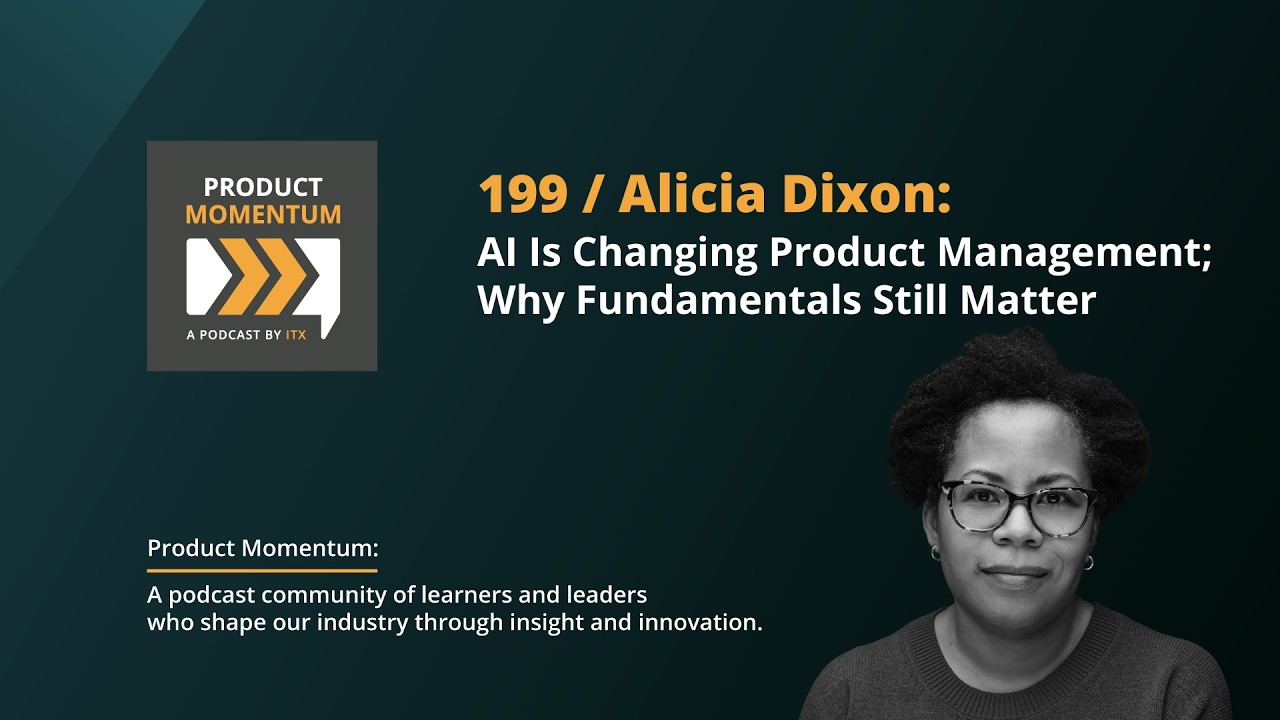
AI’s place in product management may be well established, Alicia Dixon says, but it has not replaced the core principles that continue to serve product leaders and their teams. Alicia is Director of Product Management at Marriott and has held similar roles at Walmart and Dell. In this episode, she brings her experience to our in-person conversation at Mind the Product Conference in Chicago.
Alicia explains that even as AI adoption accelerates, product managers must continue prioritizing customer needs, business outcomes, and critical thinking. By clarifying product strategy and constructively challenging assumptions, she adds, PdMs can continue to demonstrate the value of their work.
Here’s what else we learned:
Product Management Fundamentals Start With Customers
AI is creating new opportunities for product development, but effective product management still starts with understanding customer needs and addressing the challenges that hinder their growth.
“PMs need to still do the same fundamentals,” Alicia says, “but they also need to make sure they’re communicating to everybody who will listen: ‘Here’s what I’ve learned. Here’s who I’ve talked to. Here’s what it means. Here’s the outcome that we’ve gotten so far. Here’s where we still want to go.’”
Product Strategy Requires Clarity and Communication
When organizational priorities are unclear – or you’re presented with a “Do AI” imperative from above – product managers should take the initiative to clarify strategy, align their work with business objectives, and understand the role AI can play in the solution. Alicia first recommends developing a hypothesis about leadership’s intended direction, and then seeking clarification through a constructive conversation.
“Share your ‘here’s what I think you said’ hypothesis, and let them course correct. Don’t go in and just say, ‘I don’t understand this, explain it to me.’ … And if they can’t give you an answer, then you’ve got a bigger problem. But you can’t just say, ‘No, you’re wrong. I’m doing this instead.’ That’s a good way to get fired.”
AI-Powered Product Development Still Needs Critical Thinking
There is no doubt that AI can help product teams accelerate experimentation, evaluate alternatives, and explore possible solutions. But faster development does not guarantee better outcomes; if you solve for the wrong problem, it doesn’t matter how fast you build the solution. The ace up the product manager’s sleeve can be found in the application of critical thinking, the exercise sound judgment, and keeping customer needs at the center of experimentation.
“When I’m evaluating my teams’ performance, I’m still looking for the critical thinking and the nuanced judgment and the thought of ‘here’s the problem we’re trying to solve and here’s some options the AI is giving me to try to solve them.’”
This episode with Alicia marks her second visit to Product Momentum; want more from Alicia Dixon? Check out our episode 41, No Such Thing as the Perfect Product Manager.
- [08:54] Do the work quietly, but then be sure to communicate what you’ve learned, the value you’ve created, why it’s important, and where we still want to go.
- [11:29] When you hit your objectives, celebrate those wins! Make sure everybody feels valuable because the ‘keeping-the-lights-on-work’ is what brings in the money.
- [12:24] In this current environment, people are offloading the responsibility of developing a sound strategy, to AI. That’s how teams end up with AI slop.
- [15:15] When I’m looking for product leaders, I’m still looking for the critical thinking that says, ‘here’s the problem we’re trying to solve; these are the options AI is providing to try to solve them.’
- [17:56] I see a bit of AI resistance on the horizon: customers who want product builders to return to the artistry of something that’s been ‘handcrafted.’
- [19:57] Most leaders welcome someone who has done the researchand presents a new way of looking at a problem; that initiative will position you well.
Podcast: Play in new window | Download
Sean Murray [00:00:09] When you say AI is a layer on top, what does that mean? Can you explain that to us a little bit more?
Alicia Dixon [00:00:13] So, a lot of people are expecting you to be AI first and build with AI and AI enablement of your product. So, when I say AI is a layer on top, it’s another tool, another skill that as a product manager you have to have in your arsenal. But it’s not something that’s going to be 10 years from now. The next sling, there’ll be another sling.
Sean Murray [00:00:39] You mentioned that you’ve got three tactics for product managers to use today to kind of reinforce fundamentals. Tell us about those.
Alicia Dixon [00:00:49] Yeah. So the premise of my talk is that you can still do good product management without having to ask for permission and you don’t have to be loud about it. You can do it quietly and still stick to the fundamentals. Make sure that you are putting the human in the center and making sure that you’re answering for the human. You can make sure that you are tied to a business solution that you… So that’s number two, it’s setting a metric and working towards that metric. And then the last one is to have the end in mind, making sure that you have a goal and a problem that you’re solving. So those aren’t new, those are the foundations of product management.
Dan Sharp [00:01:34] We spend so much time talking about, you know, product in the AI space, but I think that right there is a large part of our community, you go with special work enterprise where not everyone is working on like the bleeding edge solutions, right? How do you keep them motivated when all the attention and all the, it seems like all the budgets are going towards the bleeding-edge stuff.
Alicia Dixon [00:01:51] I think it goes back to OKRs and are you hitting your objectives and you know making sure people are bought in to working on the metrics that are going to move them towards their objectives so you make sure that everybody still feels valuable because those keeping the lights on work that they’re what brings in the money what you know the cash cows for the company so you have to make sure you as a leader also are voicing to those people this is still important, this still matters.
Sean Murray [00:02:19] Do you think some of the challenges that we’re seeing today in terms of motivation, right, or lack of clarity, how much of that is just AI or how much of that it’s like a combination of AI and kind of like our post-pandemic working structure?
Alicia Dixon [00:02:31] I do think that with all of the movement and the dynamics of our current environment, a lot of people are off-roading the responsibility of creating a good strategy to AI. And that’s what’s leading to a lot of the problems, is people aren’t taking the accountability and the ownership of, say, ‘I’m responsible for leading this organization, and here’s what the direction we’re going in, and how we’re gonna get there, here’s the sound strategy.’ [Instead] they’re saying, ‘okay, just go build something and that’s how we end up with AI slop.’
Sean Murray [00:03:14] Dan, we just had an awesome talk with Alicia Dixon. This one was one for the product managers. Tell us all about it.
Dan Sharp [00:03:20] Yeah, you know, it was really great speaking with a product leader about some of the day-to-day that goes into being a product manager, especially when you’re trying to figure out clarity over strategy and outcomes and challenging assumptions and kind of working together to push the right direction.
Sean Murray [00:03:37] Yeah, one of our most practical episodes yet. Let’s do it.
Dan Sharp [00:03:50] Here we are at Mind the Product Conference in Chicago. We are sitting down today with Alicia Dixon. You are the Director of Product Management at Marriott. Before that, you were at Walmart, Dell, a whole bunch of household brands. I found out also that we share a similar alum. We both went to CUNY Brewer College. So thanks for coming and hanging out with us today.
Alicia Dixon [00:04:11] Happy to be here today.
Dan Sharp [00:04:13] So, jumping right in, right? World is crazy. AI has made the pace of change seem like it’s almost exponential. But you’re talk, your thesis is that as product managers, this isn’t the first time. Do you like to describe how product management is staying the same in these chaotic times?
Alicia Dixon [00:04:33] Sure. So when we spoke before, I had, she had a different thesis that I’m going to talk about today, because I did some more research. So my original thesis was that product management would have these pendulum swings back and forth between you had to be very business oriented or technically oriented. And when I did more research, I was realized that the foundations and the good parts don’t go away. So product management started. In the 1930s with actually as part of brand management at P&G, a guy named Neil McElroy sent a memo out and was talking about how someone should own this brand, someone should be responsible or whether or not it’s successful, whether how it performs, understanding if it’s going to do what the customer wants it to do. So that was the basis, the main foundation for product man to make. And then in the 1950s is when HP picked it up. So that’s when It moved over to technology. And so now there’s just, okay, you have to be a part manager should be the bridge between engineers and the customer. So you add another layer on top. And then you go to the 1990s with Netspeed and then that’s when the famous product managers or the CEO of a product memo was where people still tout that one today, so you add a layer of, you know, customer centricity and the whole design thinking, you and all those things. And then after that, in the 2000s, now we go agile and then lean and continuous discovery habits, all those things. So we have had these layers build over decades and now AI and my theory is AI is another letter going on top of all that. Long-winded answer, but. Yeah.
Sean Murray [00:06:20] No, I love it. I never really bought into the CEO of the product. It didn’t come with a, it didn’t come with discretionary budget or, uh, or a country club membership or car. So I was, so I was always out on that. Or the Capaldin parachute. Yeah, no parachute. Right. Why today? Like what, when you say AI is a layer on top, what does that mean? Can you explain that to us?
Alicia Dixon [00:06:43] Yep. So a lot of people are expecting you to be AI first and build with AI, AI enablement of your product. So when I say AI is a layer on top, it’s another tool, another skill that as a product manager, you have to have in your arsenal, but it’s not something that’s going to be, 10 years from now, the next sling, there’ll be another sling. So does that? Yeah. Yeah. Yeah, so…
Sean Murray [00:07:11] You mentioned that you’ve got three tactics for product managers to use today to kind of reinforce fundamentals. Tell us about this.
Alicia Dixon [00:07:21] Yeah, so the premise of my talk is that you can still do good product management without having to ask for permission and you don’t have to be loud about it. You can, you can do it quietly and still stick to the fundamentals of product management, but so you can make sure that you are putting the human in the, in the center and making sure that your answering for the human. You can make that you, are, uh, tied to a business solution that You So that’s number two, it’s having, setting a metric and working towards that metric. And then the last one is to have the end in mind. So don’t just do something for the sake of doing it, making sure that you have a goal and a problem that you’re solving. So like those aren’t new, those are the foundations of product management, but I talk, I give some examples in my talk about how you can do those and still respond to this AI in the end of your VP say, ‘where’s the AI?’ Yeah.
Sean Murray [00:08:23] Yeah. Do you think that sounds like, it sounds a little bit like enabling that concept of like localized strategy that Cassidy Fein talked to us about?
Dan Sharp [00: 08:36] Yeah, I was actually just going to go there. So thanks for the set. And yeah, right. You, you, you just mentioned you’re having an idea of where you’re going. I’m curious, you know, advice you have for the product managers out there, especially who maybe, you have, maybe the outcomes aren’t clear, right? Maybe, you’re maybe from the top down and not being communicated. How can they work from the bottom up, you know, in that quiet manner to keep things moving?
Alicia Dixon [00:08:54] Well, so there’s actually a paradox in my talk, and I should have said this in my last answer. So you do the work quietly, but then you’ve got to be loud about what you’re producing, what your value-added is. So I would say for those people, just go to being loud. They need to still do the same fundamentals, but make sure they’re communicating to everybody who will listen of ‘here’s what I’ve learned. Here’s who I’ve talked to. Here’s what it means. Here’s the outcome that we’ve gotten so far. Here’s where we still want to go.’ Making sure that you communicate frequently all of that.
Dan Sharp [00:09:28] Well, I mean, and you’re your product leader at, you know, some large organizations. Yeah. How would you respond to a case where a product manager is maybe suggesting an objective because they were uncertain. Like, how would you coach them?
Alicia Dixon [00:09:42] Of a product manager who’s.
Dan Sharp [00:09:43] Yeah, right, maybe the objective or the outcome isn’t clear to them, so they’re taking on themselves. I think this is a reasonable objective or outcome.
Alicia Dixon [00:09:52] So if I’m understanding your question correctly the leadership has said go do this thing and they don’t quite understand
Dan Sharp [00:09:59] or, or, you know, it’s kind of nebulous. Like maybe, maybe there’s the PowerPoint deck of strategy that gets communicated, but at the product level, you know make, maybe it’s kinda, you know, found a little bit, you do your roadmap, deliver your features.
Alicia Dixon [00:10:13] So like maybe the company, if I use Walmart as an example, the company’s going all in on AI agents and shopping, but I’m over here, my last job, I’m working on UGC. What does UGC have to do with agents? It’s like, how do I fit that objective into what I do as day to day? So for those people, I would tell them to get time with their skip and frankly have a conversation and say, ‘this is what I understood the strategy to be. Give a hypothesis of here’s what I think you said,’ and let them course correct. Don’t go in and just say, ‘I don’t understand this, explain it to me.’ Make sure that you give it some thought and then go seek clarification. And if they can’t give you an answer to that conversation, then you’ve got a bigger problem. But hopefully you should get clarification from that.
Dan Sharp [00:11:04] I think it’s an interesting, we spend so much time talking about product in the AI space, but I think that right there is a large part of our community, especially we’re an enterprise where not everyone is working on like the bleeding-edge solutions, right? Somebody’s working on the products they’re just keeping the lights on. Right. And how do you keep them motivated when all the attention and all the, it seems like all the budgets are going towards the bleeding-edge stuff.
Alicia Dixon [00:11:29] Um, how do you keep them motivated? So I think it’s goes back to OKRs and are you hitting your objectives and, you know, making sure people are bought into working on the metrics that are going to move them towards their objectives. And when you hit your objectives, that’s a win and you celebrate those wins. So you make sure that everybody still feels valuable because those keeping-the-lights-on work that they’re what brings in the money, what would, you know, the cash cows from the company. So you have to make sure that you. As a leader also are voicing to those people, this is still important, this still matters.
Sean Murray [00:12:04] Do you think some of the challenges that we’re seeing today in terms of motivation, right, or lack of clarity, how much of that is just AI or how much of that it’s like a combination of AI and kind of like our post-pandemic working structure?
Alicia Dixon [00:12:16] You’re trying to get me in trouble.
Sean Murray [00:12:20] Yes. Yeah, I do try to get people in trouble a lot. That’s kind of my thing.
Alicia Dixon [00:12:24] I do think that with the, all of the movement and the dynamics of our current environment, a lot of people are offloading the responsibility of creating a good strategy, to AI. And that’s what’s leading to a lot other problems is people aren’t taking the accountability and the ownership of saying, ‘I’m responsible for leading this organization. And here’s what the direction we’re going in and here’s how we’re gonna get there. Here’s a sound strategy.’ [Instead] they’re saying, ‘okay, just go build something,’ and that’s how we end up with AI slop.
Sean Murray [00:12:58] I think it’s also how we’re going to end up with cautionary tales of like, oh, we weren’t counting on $4 million of tokens to end a month. Exactly. We released this feature that somebody that nobody said that they wanted and nobody agreed to pay for and now we’re in this.
Alicia Dixon [00:13:13] And I have to get a disclaimer for that previous answer that that is not the thoughts of either of any of my previous employer, employer’s recurring employer, that’s my personal thought. Absolutely.
Dan Sharp [00:13:23] Nobody getting in trouble on today’s pod.
Sean Murray [00:13:26] So in, in like, you’ve worked for very large organizations, right? And some of us, I think when we think about like the listenership of this pod, that’s actually probably closer to like what the major cohort is for companies with a thousand plus people. Where do you see larger organizations in terms of their adoption of AI, but also knowing that because they need to adopt AI, we also need sound strategy. Do you think that? Larger organizations typically have sound strategy or are they kind of like relying on their size to kind of drive them and don’t name names.
Alicia Dixon [00:14:02] Um, no, not going to name names. Thank you for, for cautioning me though. Um, No, uh, I was actually going to say though, I don’t think it’s a one size fits all, it’s the same for everybody. I think that they’re even within the same company, there are pockets of groups that are executing very well and they have the strategy and they are implementing AI in a logical manner that is making sense for them. And then there are other parts of the company that are just creating the slop and like just run, just go do it. So it really comes down to who the leadership is over that particular tower of the organization.
Dan Sharp [00:14:38] Kind of like what David Pereira said, you know, that AI is an accelerant. You know, if you’re, if you have strong fundamentals and strong practices, it makes those stronger. And if you have weak, it makes those worse.
Sean Murray [00:14:51] Yeah, that’s a good connection. So as a product leader at a larger organization, what are you looking for from the product professionals under you in order to like, in order to help drive your business forward and bring ideas to you that you can like help green light, what’s the best way. What’s the best way for product professionals to do that? Present their ideas today.
Alicia Dixon [00:15:12] Present their ideas?
Sean Murray [00:15:12] Yes me…
Alicia Dixon [00:15:15] So that’s one of the things that AI helps us do really well now is so that you can very quickly test an idea without having to have poured a whole lot of time and energy into it. So what I’m still looking for though is the critical thinking and the judgment and the thought of ‘here’s the problem we’re trying to solve and now here’s some options the ASI is giving me to try to solve them.’ So you can present those options and then experiment and test those options and see which one bubbles up to the top as being the right one. But you have to have that critical thinking and judgment and also to focus on customer at the beginning. So those are fundamentals that have not changed.
Sean Murray [00:15:57] As the leader in your org, how much do you want to know about the experiments before they happen?
Alicia Dixon [00:16:01] I, for me, I, I like to be in the, with the weeds and it’s, I find it enjoyable. So I just want to know, it’s like, what, what did you try? Would you have it work? And that’s, you know, tinkering around. But I think that for a lot of leaders, they just want to see the results. They want to see, ‘okay. Our hypothesis was X and that if we did that, we would get Y and then we go to Z and they want to hear, okay, did you get to Z or not? If not, where did you get.’ So, you really have to understand who your leadership is and how they want to be communicated with and adjust accordingly.
Dan Sharp [00:16:38] So, you know, kind of thinking down that path here, you know, Marty Cagan was kind of the one of the fore-thinkers of like the empowered product teams, but empowered product team doesn’t mean like, Hey, Sean, go off and product, you know, in a vacuum, right? Like there is leadership constraints that need to be put on it. Yeah. How, how do you provide those constraints to the team so that they can be productive and not end up spinning off and kind of doing their own thing?
Alicia Dixon [00:17:04] So that’s the part that still has to be top-down of, we talked about the, the striving and the vision, but also you have to say, ‘okay, shorter term, this is what we’re, what’s the most important and go after this’ and then the team gets the power to do that. So I am one of the Cagan disciples, I would say are far. So I, that’s how he explains it. And that’s what I believe as well.
Sean Murray [00:17:26] What do you think is like on the horizon? So you said that, you know, product management, like things happen, right? But ultimately the fundamentals stay the same and the AI is just the current thing. What do think is, like, is are agentic systems are like more agentic system’s next? You know, we just listened to Alexis Zheng talk about how the job is actually moving to like design the system versus designing the product. Where do you, what do you think is coming next in terms of like, what is the next thing we’ve got to be ready for?
Alicia Dixon [00:17:56] I do think agents are one thing, but I actually feel this is going to be a hot take. I actually think there might be a resistance of customers who reject AI and want people to go back to the artistry and that they’re going to see people who are like looking for, oh, ‘I want something handcrafted, I wanted something that was made by an expert.’ So. That doesn’t necessarily relate to software, but that’s what I see is coming next. I think that there are a lot of people who are so afraid of AI, but that might be where the trends switch.
Sean Murray [00:18:36] Yeah, that kind of follows like what Martin [Eriksson] was saying around like reducing purchasing intent just by mentioning that you’ve got AI. Like my thing does AI, like I’m gonna put that back on the shelf. Yeah. Yeah. Right. Thank you so much for being with us today. I think like one of my biggest takeaways and where we kind of what we, the path that we went down was like not challenging leadership, but really presenting like kind of like counter case to some of their assumptions, right. And doing it in a productive way versus like, I don’t like this, right? That’s the way. So, or this is wrong. That’s not what people want to hear. People don’t want to here. It’s just wrong. People want to kill us. Here’s some of the assumptions that I think we’ve made at this layer. And like, here’s how it appears, how I’m challenging.
Alicia Dixon [00:19:20] Yes, you have to go in with the case of, okay, ‘I understood you to be asking for this, this thing, but when I did more research, I think it’s actually this other thing and here’s why I think, it’s this other thing,’ and, and then open up a dialog. You can’t just say, no, you were wrong me and I’m doing this instead. That’s a good way to get fired.
Dan Sharp [00:19:42] I think, but I think with that though, like, there’s also a department, like it’s okay to speak up, right? It’s okay. To bring case like, don’t just take y’all in order, right. And go do the thing. Like if you put the thought in, like it’s, okay to say, ‘Hey, I, I I’m seeing this against this assumption.’
Alicia Dixon [00:19:57] Most of the leaders that I’ve seen welcome someone who’s going to take the time to do that thinking and present, here’s how I saw it and I can these other things, then that initiative will position you well.
Sean Murray [00:20:10] Well this has been awesome for our listeners because we’ve kind of got a playbook of like, if you don’t like the direction that you’re moving in, or if you’re just being pulled, ‘do AI,’ you’ve got a path forward.
Alicia Dixon [00:20:21] I hope so.
Sean Murray [00:20:21] What’s next for you after mind the product where you speak in anywhere else?
Alicia Dixon [00:20:25] I have a lot of conferences that I’m going to as an attendee. I will not do any more speaking for a while. It’s going to let out
Sean Murray [00:20:33] Yeah, we believe it we believe that thank you so much for being with us today
Alicia Dixon [00:20:38] Okay, thank you for having me.