Listen
Podcast: Play in new window | Download
About


Martin Eriksson is a board member, strategic advisor, and author of The Decision Stack. With over 30 years building businesses, products, and teams, he’s advised over 150 companies on aligning from vision to execution, and previously served as Product Partner at EQT, one of the world’s largest private investors. As founder of ProductTank, co-founder of Mind the Product, and co-author of Product Leadership (O’Reilly, 2017), he helped define the product management discipline.
Recommended Reading
Impact-first Product Teams: Define Success. Do Work That Matters. Be Indispensable, by Matt LeMay.
EMPOWERED: Ordinary People, Extraordinary Products, by Marty Cagan and Chris Jones.
Money Stories: Communicating the Value of Product Work, by Rich Mironov.
Testing Business Ideas: A Field Guide for Rapid Experimentation, by David J. Bland and Alexander Osterwalder.
The Decision Stack: How Strategic Clarity Unlocks Organizational Momentum, by Martin Eriksson.
Product Leadership: How Top Product Managers Launch Awesome Products and Build Successful Teams, by Richard Banfield, Martin Eriksson, and Nate Walkingshaw.
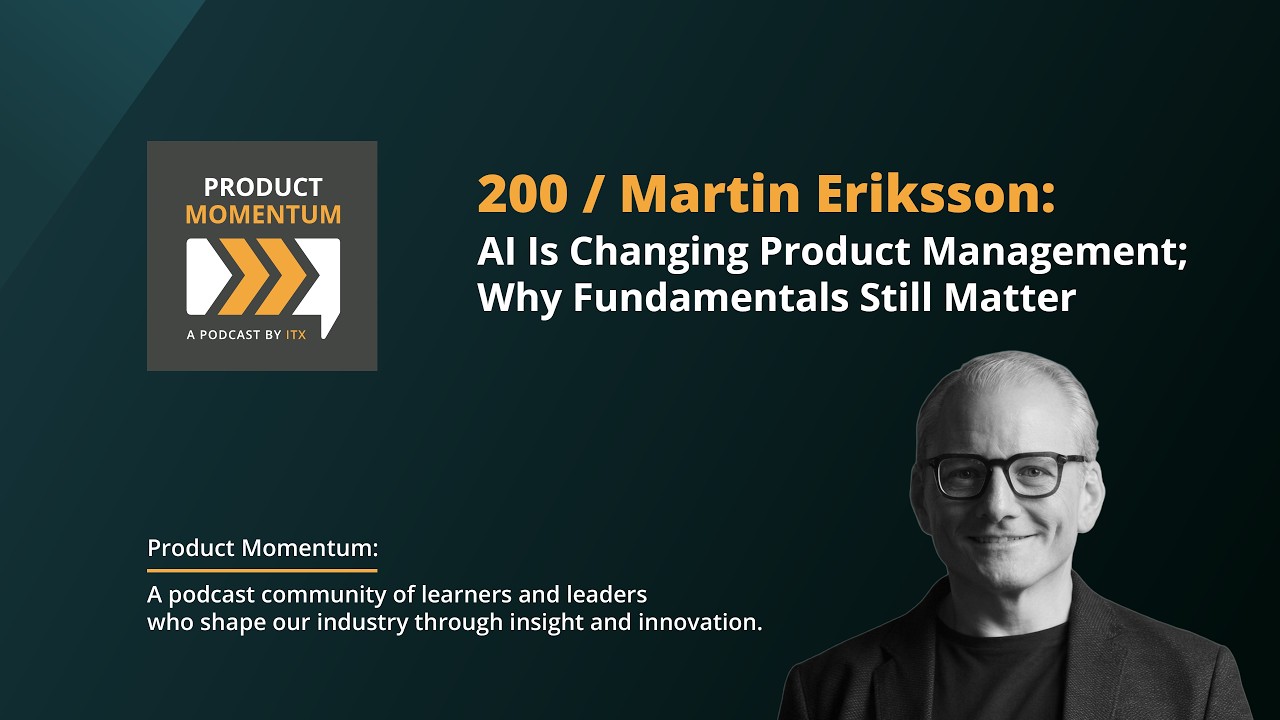
How fitting that Martin Eriksson joined Dan and Sean as guest for Product Momentum’s 200th episode! As co-founder of Mind the Product, author of The Decision Stack, and advisor to more than 150 companies, Martin knows a thing or two about product strategy.
In this milestone podcast, recorded in person at MTP’s Chicago conference, Martin helps us come to appreciate how AI is changing the strategic landscape without changing the fundamentals of good product management. Treat your strategy as if it were a product, Martin says, a thing to be tested, validated, and de-risked. And be ready to (appropriately) challenge the strategy’s underlying assumptions, applying the same discipline to it as you would a product feature or business opportunity.
Here’s what else we learned:
The Decision Stack: Turning Strategy Into Better Outcomes
Effective product strategy requires more than establishing a vision and setting objectives. It requires giving teams the clarity and principles they need to make better decisions independently. Martin’s Decision Stack framework connects vision, strategy, objectives, opportunities, and principles.
Product teams often waste valuable time debating decisions that have already been made. But, as Martin explains, “Principles really are that articulation of your strategy. They’re there to help make better decisions faster without having to escalate every single decision or relitigate a matter every time it comes up.”
Challenge Strategic Assumptions with Evidence, Not Opinion
Product managers regularly test assumptions when developing features and evaluating opportunities. Martin says that same mindset should extend to organizational strategy. Conditions change, expectations evolve, and new technologies can undermine assumptions that once supported a successful strategy.
The key is to present evidence – e.g., customer feedback, market trends, and shifts in technology – rather than just opinions. “It’s every product person’s responsibility to make sure that we have those conversations internally,” Martin offers. “Product people have superpowers around how we do assumption testing, how we do hypothesis testing. We should use that mindset beyond the feature level or opportunity level.”
Leveraging AI To Support Product Management Objectives
“Don’t trust the computer to make management decisions,” Martin advised during his MTP conference keynote. AI is changing how software gets built, he adds, but he cautions against allowing technology to distract teams from customer needs.
As Martin explains: “We have to remember that our customers don’t care about the technology we use; they just want their pain point eliminated. They want the problem solved efficiently.”
Martin Eriksson, in his own words:
- [08:26] 80% of the world’s population have never even touched AI; in Western countries, that number drops to 50%. As tech people, we love this stuff. But we have to remember that our customers don’t care about the technology. They just want the problem solved.
- [10:11] Is AI having a negative effect on purchase intent? Going back to April [Dunford]’s conversation, ‘it’s not about AI. It’s how are you solving the customer’s problem better?’
- [12:40] The right way and the wrong way to challenge product strategy. If all you come in with is your opinion, that’s never the right way to start the conversation. But if you come at it with evidence of market trends moving in a particular way, it depersonalizes the argument.
- [15:40] What does it mean to treat strategy as a product? I think we have to bring the rigor of assumption testing and hypothesis testing up to that conversation. It’s not about consistently changing strategy every quarter, but it is checking in regularly to de-risk these things.
- [17:37] How The Decision Stack framework supports commitment and flexibility to drive a sense of organizational clarity. The tools we’re using are going to change. Our environment has changed; maybe some new options arrived. But we’re still solving the same customer problem.
- [20:51] Kudos for fellow authors and thought leaders. Martin cites the work of past Product Momentum guests, including Marty Cagan, Matt LeMay, and Rich Mironov, as well as David Bland and Alex Osterwalder. Check out their titles in the Recommended Reading section, above.
Podcast: Play in new window | Download
Preroll / Intro
Sean Murray [00:00:08] So first, you know, the Decision Stack was vision, strategy, objectives, opportunities, and principles. Why strategy before objectives?
Martin Eriksson [00:00:19] Yeah, I’ve had that question before. I think, for me, we have to make the right choices about where to play and how to win, to use the classic Roger Martin framework. Those are strategic choices for me. And I think we have to make those before we can then set the objectives and goals. I think people have different answers to those questions. So really, for me, it’s the five questions, right? So where are we going? How are we gonna get there? What matters right now on that journey? What are the actions we’re gonna take to move forward? And then how do we choose between those actions? And I think that opens it up a bit more.
Dan Sharp [00:00:48] So one of the things I really love that resonated in your talk was that you’re talking about assumptions baked in at every level of the Decision Stack. How can we better get those assumptions out in the open, higher up?
Martin Eriksson [00:00:59] Yeah, and I think, I mean, that was kind of my call to arms today, right? I think it’s every product person’s responsibility to make sure that we have those conversations internally. I think product people have these superpowers around, “How do we do assumption testing? How do we do hypothesis testing?” Like, let’s take that up the stack and let’s challenge the rest of our organization. That’s just a different way to challenge our leadership on that question without being confrontational about telling them their strategy isn’t working anymore.
Dan Sharp [00:01:20] You mentioned something I love: “Don’t trust the computer to make management decisions.” I’m curious what advice you have for, you know, product folks out there who are struggling to hold on to the decision-making rights.
Martin Eriksson [00:01:32] Yeah, I think it comes back to what we’re using AI to do internally. So I talked a lot about the strategy and what we’re doing in our product, but we’re also using it to get more efficient, right? Like, how are we getting more efficient in our jobs? What are we trying to do with that time? But I think we actually have to flip the question and say, what is the thing I want to spend more time on, and then how can I carve out the other stuff?
Dan Sharp [00:01:51] More often than not, the strategy’s not changing. I’m curious what advice you have for folks. How, as product leaders, do we kind of maintain a level of calm and discipline when that’s happening, so we don’t just go, “Okay, this. Now this,” right?
Martin Eriksson [00:02:05] And I think that’s the other thing I kind of hammer on about the Decision Stack: consistency and commitment, right? So we’ve made some decisions. We want to be committed to those decisions, but here’s how we know whether we’re on the right track or not and when we need to change those. And I think that forces a level of clarity, not just in the decisions we made, but in when we have to make a change.
Episode
Dan Sharp [00:02:33] Sean, we are here in dressing room five at the Harris Theater in Chicago, Illinois. We just sat down with Martin Eriksson and had a great conversation.
Sean Murray [00:02:41] Martin brings a really modern take on strategy and how the age of AI is impacting strategy. It’s one of the first times we’ve talked about the impact of AI without talking about AI specifically. I’m really excited to bring his viewpoints to our listeners.
Dan Sharp [00:02:57] Let’s do it.
Sean Murray [00:03:07] We are here live at Mind the Product. All of our podcasts are live, so this really isn’t too much of a change for us. But we’re here in the basement of the Harris Theater. We’re with Martin Eriksson. Martin is a board member, a strategic advisor, and author of The Decision Stack. You’ve already been on stage twice, so thank you for continuing your media tour here today. You’re also a co-founder of Mind the Product, and they say you can’t go home again, but here you are.
Martin Eriksson [00:03:33] Well, I love the community. So I stopped being actively involved in 2022, but I just love being in the community and anytime I get invited to speak, of course it’s an extra bonus. I’m happy to be here.
Sean Murray [00:03:44] Thanks for being with us. You were the second speaker today. Your talk was really centered around your concept of the Decision Stack, and then some musings on how AI applies to it, right? So first, the Decision Stack was vision, strategy, objectives, opportunities, and principles, right? We teach a free framework called the vision stack. So now we’ve got competing frameworks here. Okay. Why strategy before objectives?
Martin Eriksson [00:04:14] Yeah, I’ve had that question before. I think, for me, we have to make the right choices about where to play and how to win, to use the classic Roger Martin framework. Those are strategic choices for me, and I think we have to make those before we can then set the objectives and goals. I’m like, okay, well, how are we actually going to achieve that? So for me, it comes down to that order. I do think that’s why I kind of abstract the Decision Stack out sometimes as well. I think people have different answers to those questions. So really, for me, it’s the five questions, right? So where are we going? How are we gonna get there? What matters right now on that journey? What are the actions we’re going to take to move forward? And then how do we choose between those actions? And I think that opens it up a bit more. If you don’t like OKRs, you can use something else. If you want a different way to answer the question “Where are we going?”, that’s fine. I’m less dogmatic about the kind of vision, strategy, and objectives piece of it, because I think it has to flex into how organizations want to work. But I think you have to have answers to those questions, basically.
Sean Murray [00:05:07] Okay, our friend Mary is here from Nat Geo. She was in your workshop yesterday. So this is actually your fourth thing that you’re doing. She really loved your concept of principles. Tell us a little bit about principles.
Martin Eriksson [00:05:18] Yeah. The example I always give is my first product job was 1999 at Monster, right? The job board. And as a job board, it’s a two-sided marketplace. So every product thing we were looking at then, we had this massive debate, right? Do we do it in the job-seeker-friendly way, or do we do it in the recruiter-friendly way? And we just spent ages kind of having that debate until I kind of pulled a founder into the room once and asked him the question. He’s like, “Wait a minute, the job seeker always comes first.” Because if we create a great experience for them, then the recruiter has to follow. And that was kind of in our strategy, but it had never been articulated as that trade-off of like job seekers should always come first. And suddenly those debates go away, right? We’re just not having that debate. We just know every time we’re looking at it, every time it comes into conflict, the job seeker should come first, right. Doesn’t mean the recruiter is not important. They paid the bills at the end of the day, but in any trade-off scenario, we want everyone to go, okay, well, actually what we wanna do is build the best possible experience for job seekers. So principles really are that articulation of your strategy for me. And they’re there to help your teams make better decisions faster without having to escalate every single decision or have to, you know, relitigate that debate every single time it comes up.
Dan Sharp [00:06:20] Almost like a North Star. The North Star strategy, I think that was big two years ago.
Martin Eriksson [00:06:26] But you might have a couple, right? So that’s the simple one in a two-sided marketplace, but you might also have a few others around how you want to do it on like mobile, you know, or desktop or conversion, even over revenue, like things that you really want people to focus on and make those decisions faster.
Dan Sharp [00:06:38] So one of the things I really love that resonated in your talk was that you’re talking about assumptions baked in at every level of the Decision Stack and how often we focus on assumptions at the project implementation level and then higher up, nobody talks about those because maybe the strategy is a thing that you saw once in an all-hands eight months ago. How can we better get those assumptions out in the open higher up in the stack?
Martin Eriksson [00:07:02] Yeah, and I think, I mean, that was kind of my call to arms today, right? I think it’s every product person’s responsibility to make sure that we have those conversations internally, right? So we should be there to challenge our whole stack, right, and look at it and use the tools that we have, right? I think product people have these superpowers around how do we do assumption testing? How do we do hypothesis testing? Okay, let’s not just use that at the feature level or the opportunity level. Like let’s take that up the stack and let’s challenge the rest of our organization. Like, “Hey, wait a minute. What would have to be true for our strategy to happen?” A bunch of assumptions are gonna fall out of that. And then you realize, wait a minute, two or three of those have actually changed massively because of AI. Maybe we need to question that strategy, right? And I think, again, that’s just a different way to challenge our leadership on that question without being confrontational about telling them their strategy isn’t working anymore.
Dan Sharp [00:07:47] Right, that never really goes that well.
Martin Eriksson [00:07:49] So it’s a different conversation when you come in and say, “Hey, our strategy is awesome, but we’ve realized that it’s probably based on these two or three assumptions, and one of them seems to have changed. Do we need to revisit this conversation?” And that’s a much friendlier way to have that conversation, right?
Sean Murray [00:08:03] You challenged the concept of the SaaS-pocalypse, right? And you went through some stats that were really interesting. I like that you said not everybody wants AI. Four in five people in the world have not tried AI. But we’re biased into thinking that everybody does, especially those of us at this conference. We’re in the bubble. Describe the bubble to us and some of those stats.
Martin Eriksson [00:08:26] Yeah, so there’s a lot of stats around this, but if you look at the global level, it is something like four in five people, so 80% of people have never even touched AI yet. Even if you look at Western economies, like the US, I think it’s 50% probably haven’t touched AI. And I think as tech people, we love this stuff. I am a tech guy. I love building. I’m hacking away at the stuff. I’m playing with vibe coding. I’m using Claude Code. I love it. But we have to remember that our customers don’t care about the technology. They just want the problem solved. They want the pain point eliminated. And some of them will pick it up, right? It’s gotten easier. It has definitely democratized software and people will build stuff. But then you have to remember the maintenance of it. You have to remember the support of it, like I’ve built some apps that fall over on Lovable. It wasn’t a great experience, but it’s fine because it’s free. I would never want to ship that to an end user. And I think fundamentally our customers want the problem solved in a way that lets them focus on whatever their business is about. So I use the example of the restaurant manager. They just want stuff that gets out of the way so they can focus on their customers. They don’t want to sit there and hack around with Claude Code to build a better point-of-sale system. They will start asking better questions of their suppliers, I think. Like, wait a minute, why can’t this software be better? Or can’t I customize this better? Or like, can I have a better user interface for it? For sure. So like, we have to step up our game, but I don’t think that person’s gonna go build their own software to solve the problem.
Dan Sharp [00:09:45] I think you’re hitting on something really important that I’ve always considered in software. We’re toolmakers, and it’s so easy for us to get lost in the sauce of how amazing our tool is. But the people on the other end just want to use the tools and get on with their day, right? Keeping that in mind is so important.
Sean Murray [00:10:02] You mentioned that just mentioning an AI feature in some of your marketing copy is starting to reduce purchase intent. Why is that?
Martin Eriksson [00:10:11] I mean, there’s a lot of backlash. I think, I mean, we have probably miscommunicated AI. Obviously there’s all the stories about a 10% chance of killing us all and how it’s going to take everyone’s job. Like, of course people are nervous about it. And then I think, you know, even more localized, there is a lot of resistance to data centers. There are a lot of questions about the environmental impact, and there’s a lot of pushback. So again, AI just for the sake of AI is not something a customer wants, right? They don’t care. I think it was a Washington State University study that showed that putting “artificial intelligence” in the product description has a negative impact on purchase intent. That really stuck with me at Mind the Product. And going back to April’s conversation, like it’s not about AI. It’s how are you solving the customer’s problem better? And if you’re using AI to do that, great. But like, again, they don’t care. They didn’t care whether we were using, you know, what version of SQL we were using, they didn’t even care if it was PHP. Are you still solving my problem better? Cool. Great. Let’s move on, right. So I think we have to remember that again, it’s just falling in love with that problem and how do we solve that better for the customer.
Dan Sharp [00:11:13] You mentioned something I love, right? “Don’t trust the computer to make management decisions,” which I love. Right? Because there’s so much happening now. You have a million tasks to do. You put something into AI and it gives you something good back. Yeah. I’m curious what advice you have for, you know, product folks out there who are struggling to like hold on to the decision-making rights and actually own them when it’s so easy to…
Martin Eriksson [00:11:35] Yeah, I think it comes back to like, what are we using AI to do internally? Right? So I talked a lot about the strategy and what we’re doing in our product, but we’re also using it to get more efficient, right? Like how are we getting more efficient in our jobs? What are we trying to do with that time? Right? Like, where do we want to be spending our time? And I think it’s easy to start looking at it like, oh, well, I’m spending two hours on this a week. I should automate that away. But I think we actually have to flip the question and say, what is the thing I want to spend more time on and then how can I carve out the other stuff? For me, it comes down to user research, customer research. It comes down to decision-making, strategic thinking, like, those are the things you want to hold on to, right? So how do we make more time for that? Not less. How do we not think about, oh, I’m going to automate away writing this strategy doc and hand that over to Claude, right, because that’s probably where you want to have the most impact. And how do you automate away the things that give you time to do that instead, basically?
Sean Murray [00:12:23] Staying with advice for product people, as a board member and a strategic advisor, if you’re going to hear a challenge to a corporate strategy, what are you looking for from a product person? What are you hoping to hear that you think is going to change your mind? “The strategy sucks” probably isn’t it, right?
Martin Eriksson [00:12:40] Yeah, it fundamentally comes down to evidence, right? If we have opinions, then, you know, we have the concept of the HiPPO, the highest-paid person’s opinion. If it’s all about opinions, the HiPPO’s going to win, right? They’re going to trample all over it. So if you come in going, I don’t think this is right, or this is not the right way to do it, or I think the strategy sucks, that’s never the right way to start the conversation. If you come at it with evidence, like, “This assumption seems to be failing,” or “I have new evidence that customers don’t want this,” or “We’re seeing market trends move this way, and here’s the evidence for that,” it depersonalizes the argument, right? You’re not challenging the person, you’re challenging the argument. And so I always find that the best way to do it. And I think the more you can just dig in and come in with a story of like, I think we should make this change because of X, Y, Z. Here’s the evidence for it. Here’s a better approach that we can take. And here’s why I think that’s gonna work. And here’s how we de-risk that. Like that’s an amazing conversation to have, right, with anybody. And again, I think this is where product people, we have superpowers in this, right? Whether you’re a product manager, designer, data scientist, engineer. This is what we do every single day down at the feature level. Like we just have to bring that conversation up and we have to bring that challenge up to the strategy level.
Sean Murray [00:13:46] At our conference last year, we had a speaker come in, David Pereira, and he ran a workshop for us about challenging your assumptions and becoming aware of them. You mentioned assumptions in your talk. April touched on assumptions in her talk. Is this something we’re becoming more aware of because of the new technology we’re all able to use, or is it about getting back to fundamentals?
Martin Eriksson [00:14:11] I think it’s a bit of getting back to fundamentals, but then elevating the conversation as well, right? So I think assumptions are something that we’ve talked a lot about over the last ten-plus years. I mean, this came out of assumption mapping stuff that I think originally came from Janice Fraser and others in San Francisco, and then David Bland and Alex Osterwalder have been building on it, right? With the assumptions mapping exercise. But we’re very good at using it, again, at that feature level, I think. But what we have to do is bring that conversation up. And I think maybe why it’s having its moment right now is because so many of those core assumptions have changed, right? The rug’s been pulled out from under us, and we’re like, “Hang on, why did the strategy break?” It’s because these assumptions have changed, and so I think that’s why it may be getting talked about more. I was talking to David Bland the other week, and his frustration is that it was never meant to be a feature-level thing. It was never meant to be just a product tool. It was meant to be a strategic tool, right? And so that’s just what we’re trying to do is like, how do we raise that conversation, right.
Dan Sharp [00:15:11] You said something else in the talk, right? Humans are inherently awful at predicting the future. When you’re looking at vision and strategy, you need to account for a range of outcomes. I’m curious how, at the strategy level, you can reasonably run a premortem on a strategy at a cadence that keeps pace with the world, without doing it so often that all you’re doing is running premortems and you’re not actually doing anything, right?
Martin Eriksson [00:15:40] And this is where I think like the Decision Stack is helpful, because each of those has different timelines, right? So your vision is probably something fairly static. It doesn’t change very often, you’d hope. I mean, maybe, you know, with AI, you have to question that, but then your strategy obviously, I think is changing more often than it used to. We used to talk about three- or five-year strategies. Those cycles are much shorter. And I think that’s where it can be helpful to companies because they’re like, you don’t have to relitigate everything every single time, right. You just have to go up as far as like the assumptions don’t hold anymore or circumstances have changed. I mean, premortem is a great way to do it, right? You talk about what would have made this succeed or fail in five years. Like even just having that conversation is more assumption testing, more hypothesis testing than most do, right. I kind of made the joke in passing on stage that like, we put all this rigor into how we build product features, right, and we test everything and we go through it like endlessly. And then we go to an offsite in Lisbon and we pass a strategy on vibes and over cocktails. And then, we kind of move on. So I think we just have to bring that rigor up to that conversation because we have the tools already and I think it’s not about consistently changing it every quarter or whatever cycle you’ve defined, but it is checking in. Like, are we still on the right track? And like, do these assumptions still hold? Has anything changed in the market? Okay, cool. We’re still good to go. Let’s keep going, which is going to be the answer most of the time anyway. And then sometimes you can be like, wait a minute, no, this thing has changed or Claude just dropped something or, you know, something has fundamentally changed the strategy and you have to have the conversation again. But yeah, I think it’s about treating strategy as a product, right? Like, how do we test these things? How do we de-risk these things more often than we have in the past?
Dan Sharp [00:17:13] Yeah, and you just said something interesting, right? Like more often than not, the strategy’s not changing. Yeah, I’m curious what advice you have for folks. I think there’s a tendency sometimes when there is a lot of chaos, right, when things are moving quickly to want to react quickly. How do we, as product leaders, maintain a level of calm and discipline when that’s happening to not just go, “Okay, this. Now this,” right?
Martin Eriksson [00:17:37] And I think that’s the other thing I kind of hammer on about the Decision Stack for is consistency and commitment, right? So we’ve made some decisions, we want to be committed to those decisions, but here’s how we know whether we’re on the right track or not, and when we need to change those. And I think that forces a level of clarity, not just in the decisions we made, but in when we have to make a change, right. So, okay, something has changed, now we have to go through the whole process again. How do we commit to that change? But I think it’s important because to your point, like I don’t think the strategy changes as often or needs to change as often as we think it does. And so if we can be consistent that like, no, we are still focused on this customer target. We still think that’s how we’re going to win. The tools we’re going to use to do that, the features, of course those are going to change. Something has happened. Some new options arrived, right? But we’re still solving the same fundamental customer problem, right. Going back to, again, April’s point as well, like we have to be consistent about who are we solving this for, what is the problem, you know, who’s our competition, What are we actually solving for? And I think those change a lot less than we think they do, right? The fundamental user problems, customer problems don’t change very often.
Sean Murray [00:18:41] Yeah, I don’t know. I think you mentioned, you know, cocktail-laden strategy sessions in Lisbon and that really sounds like my speed.
Dan Sharp [00:18:48] Yeah, I mean…
Sean Murray [00:18:48] I’m hoping that eventually we come back to that. I want to take a minute and just ask you about writing The Decision Stack. What was your motivation behind that?
Martin Eriksson [00:18:57] So I think it started as a talk I gave at a conference in Hamburg in 2019. And I gave it as, I don’t want to sound dismissive, but sort of a throwaway talk. I’m like, this seems pretty obvious, right? This is how everyone thinks. And it turns out it wasn’t. And so I’ve kind of been honing it ever since. And then over the last seven years or so, I’ve advised nearly 150 companies and been talking with them about strategy and org design, all this stuff, and just started using these tools. It was like, this is a better way to have a conversation and bring that clarity and connect things for people. And so over time, it’s just become one of these things where I think every couple of months, someone asked me like, when’s the book coming? And I’m like, I guess I should sit down and finally write it. But that’s a great signal, right? It’s a great signal of demand, of pull. People wanted this. It was helpful to people. And I think the hard part is it’s easy to talk about the stack in theory when you’re looking at, you know, the visualization and like a simple slide deck. And then you get into writing the book and you’re like, okay, well, what about this case and what about this side thing and what happens if this changes and like, yeah, the complexity of it kind of exploded a little bit. Yeah, I was really driven by pull, I think, that this clarity is needed. And I think the final thought on that is for me as well as kind of continuation of Product Leadership, the book that I co-authored in 2017, right, where I think that the outcome of that book really was, you know, those early days at the time, talking about empowered teams, right, that the best product teams out there are the ones that are most empowered. And the missing piece to that is, you know, what Marty Cagan calls strategic context. It is the clarity within which to have that empowerment. And I think that’s where the Decision Stack can help close the gap.
Sean Murray [00:20:25] All right, so we need The Decision Stack on our bookshelf. We need Product Leadership on our bookshelf. We try to take this opportunity when we have authors on. What other books do you think would help round out this way of thinking?
Martin Eriksson [00:20:41] So I think it’s interesting that like, there’s a bunch of us now who’ve been talking much more about impact, right, and commercial impact. So I really love Matt LeMay’s Impact-First Product Teams.
Sean Murray [00:20:49] Huge fan. I’m a huge fan of that.
Martin Eriksson [00:20:51] And I know he’s been on before. He’s a good friend of mine as well, lives in London. And I think they’re very complementary, right? Because he’s thinking very much from the team and I’m thinking more of the strategy level and we’re actually doing more work together as well. I think Rich Mironov’s Money Stories has been amazing as well. Like, how do we have that conversation again with leadership? How do we challenge them? How do we have better conversations? I love his line that your C-suite doesn’t hear anything, any sentence that doesn’t have a dollar sign in it, basically. And so it’s a great book and a nice short book as well on that. I think continuing on the assumptions, David Bland and Alex Osterwalder’s Testing Business Ideas is a fantastic field guide. It has like 40 experiments of how you can actually go test this stuff in the real world. So yeah, those would be some of my favorites right now, but I think it’s all about that impact, right?
Dan Sharp [00:21:34] Get those in the show notes for sure.
Sean Murray [00:21:35] Yeah, a new one for us, and we get to close with talking about our friends Matt and Rich.
Dan Sharp [00:21:38] Exactly, exactly.
Sean Murray [00:21:40] Martin, thank you so much. I know this was your fourth thing in the last two days.
Martin Eriksson [00:21:44] Thank you so much for having me. It’s been great.